



TallyPrime vs Daftra Saudi Arabia: Which Accounting Software Wins?
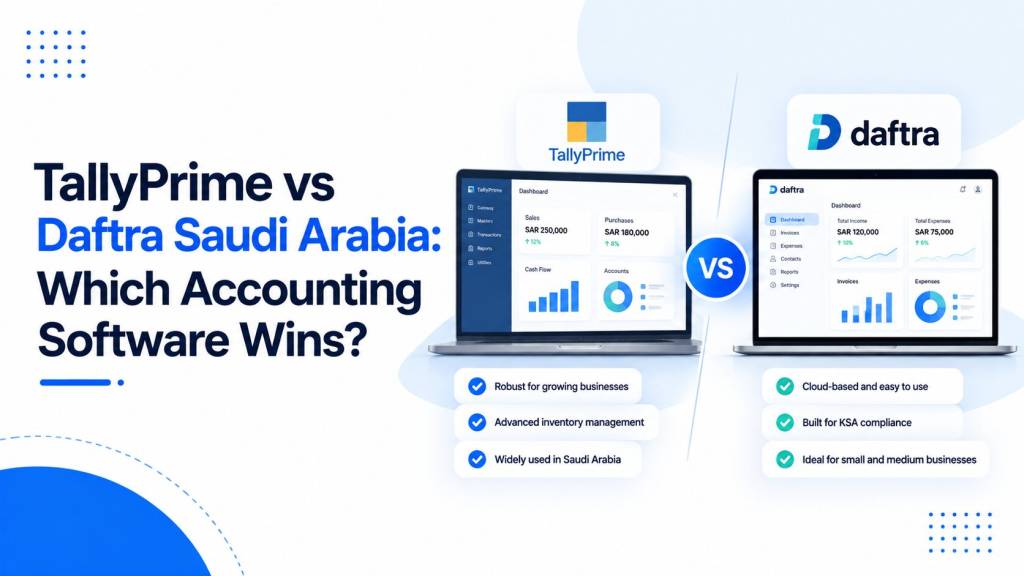
TallyPrime and Daftra get compared constantly by Saudi business owners for a simple reason: both are genuinely capable, both are ZATCA compliant, and both are priced for SMEs rather than enterprises. Neither is a bad choice, which is exactly what makes the comparison harder than picking between a strong product and a weak one. The honest answer is that they are built on different architectures for different working styles, and the right one depends on how your business actually operates day to day, not on which platform has the longer feature list.
This comparison goes through both platforms feature by feature, based on each vendor’s own current product documentation, so you can see where the real differences sit rather than relying on marketing pages from either side.
Quick Answer: TallyPrime or Daftra for a Saudi Business?
TallyPrime is the stronger choice for businesses that need deep, auditor-preferred accounting with genuine multi-warehouse inventory control, particularly trading, wholesale, and distribution businesses used to working with an accountant or bookkeeper in a traditional ledger-based way. Daftra is the stronger choice for businesses that want a single, fully cloud-based subscription covering invoicing, POS, inventory, HR, and CRM together from day one, with no local software installation, particularly service businesses, retailers, and businesses that want to manage everything from a browser without an IT setup step.
Key Takeaways
- Both platforms are ZATCA Phase 2 compliant and can generate compliant e-invoices connected to the Fatoora platform.
- TallyPrime is licensed, accounting-first software with a data model built around immediate ledger posting, which is why auditors and accountants trained on traditional bookkeeping consistently favor it.
- Daftra is a born-cloud, multi-tenant SaaS platform, meaning it was built from the ground up to run entirely in a browser, with no local installation, and bundles invoicing, POS, inventory, and HR under one subscription.
- Daftra’s multi-branch and POS features are genuinely strong, supporting branch-specific permissions and multi-device point-of-sale sessions, which matters for retail-heavy businesses.
- TallyPrime’s advantage sharpens specifically around accounting depth and inventory control for trading and wholesale operations, where ledger accuracy and stock valuation discipline matter more than an all-in-one dashboard.
Architecture and Deployment: The Real Starting Point
The most important difference between these two platforms is not a feature checklist, it is how each one is built.
Daftra is a multi-tenant cloud SaaS platform, meaning your business runs on shared cloud infrastructure accessed entirely through a browser, with Daftra managing hosting, updates, and backups centrally. There is nothing to install, and access from any location requires nothing more than a login. You can review Daftra’s own platform overview directly on its official features page.
TallyPrime is licensed software, historically installed locally, though it can be configured for remote or multi-location access through hosting arrangements set up by an implementation partner. This matters in practice: TallyPrime’s data model and working style are built around the traditional accounting workflow that Saudi accountants and auditors, many trained on ledger-based bookkeeping, already work in daily.
Neither architecture is objectively superior. A business that wants zero local setup and centralized cloud access from day one will lean toward Daftra. A business whose bookkeeping and audit relationships are built around traditional ledger accounting will lean toward TallyPrime.
Accounting Depth and Auditor Preference
TallyPrime removes secondary posting entirely: entries post and show their effect immediately, which is specifically why auditors favor it, since amendments can be made on the spot rather than reconciled after the fact. This is a structural design choice in how TallyPrime handles every transaction, not a configuration option.
Daftra’s accounting module covers the standard range a small business needs, including a chart of accounts, general ledger, automatic journal entries, cost centers, and financial reporting, and it is a fully capable double-entry system. The distinction is less about capability and more about working style: TallyPrime’s ledger-first design matches how many Saudi accounting firms already review and audit client books, while Daftra’s accounting sits inside a broader all-in-one business dashboard alongside sales, POS, and HR.
Inventory and Multi-Branch Comparison
Both platforms handle inventory and multi-branch operations more capably than most comparison content gives either of them credit for.
Daftra supports multi-branch management under one account, with the ability to share or separate customers, products, and suppliers by branch, branch-specific staff permissions, and advanced branch-level financial and inventory reporting. Its inventory module covers stock tracking, barcode scanning, purchases, suppliers, warehouses, stocktaking, and requisitions.
TallyPrime organizes inventory through its godown structure, tracking stock across multiple physical warehouse locations with real-time visibility, alongside batch and expiry tracking, purchase and sales order workflows, and bill-wise ageing for receivables. Our TallyPrime for trading companies page covers this in more depth.
The practical difference shows up in point-of-sale and shop-floor detail. Daftra’s POS module supports multiple simultaneous sessions across devices and branches, barcode scanning, session cash reconciliation, and refund handling built directly into the retail workflow, which makes it a strong fit for a business running active retail counters. TallyPrime’s inventory strength sits more on the wholesale and distribution side, where warehouse-level stock accuracy and ageing-based credit control matter more than a retail point-of-sale experience.
HR, Payroll, and CRM
Daftra bundles employee management, contracts, payroll, loans, attendance, leave management, and appointment or membership-based CRM features directly into its core platform, which is a genuine advantage for a service business that wants HR and customer management in the same login as its accounting. TallyPrime’s payroll module covers standard payroll processing but does not extend into the appointment, membership, or CRM territory Daftra offers as part of its bundled design.
ZATCA E-Invoicing Compliance
Both platforms are built to support ZATCA Phase 2 compliance, including compliant e-invoice generation connected to the Fatoora platform. Daftra markets itself explicitly as a ZATCA-approved solution for Saudi small businesses. TallyPrime’s ZATCA integration is well established across the Saudi market through its network of authorized dealers. Whichever platform you choose, confirm the specific technical integration, UBL 2.1 XML generation, cryptographic stamping, QR code embedding, and Fatoora API connectivity, directly rather than relying on a marketing claim alone, and verify current requirements through ZATCA’s official Fatoora e-invoicing portal. For the regulatory detail behind this requirement, see our ZATCA e-invoicing compliance page.
Pricing Model: Subscription vs License
Daftra is sold entirely on a subscription model, with tiered plans and add-on modules billed monthly or annually. TallyPrime is typically sold as a license, either purchased outright with an optional annual renewal for updates and support, or through rental and hosted arrangements offered by dealers. This is a genuine structural difference worth understanding: a subscription model spreads cost evenly over time with no large upfront outlay, while a license model shifts more cost to the point of purchase but can work out differently over a multi-year horizon depending on how it’s structured. Request a specific comparison based on your own requirements from our TallyPrime dealer page for Saudi Arabia rather than relying on generic published figures for either platform.
Side-by-Side Comparison
| Factor | TallyPrime | Daftra |
| Architecture | Licensed software, hostable remotely | Native multi-tenant cloud SaaS |
| Deployment | Local install or partner-hosted | Browser only, nothing to install |
| Accounting model | No secondary posting, auditor-favored | Standard double-entry, dashboard-integrated |
| Inventory strength | Multi-godown, batch tracking, wholesale-oriented | Multi-branch, barcode, strong POS integration |
| HR and CRM | Standard payroll | Bundled HR, payroll, and appointment/membership CRM |
| Pricing model | License, purchase or hosted rental | Subscription, tiered plans |
| ZATCA compliance | Yes, via dealer-supported integration | Yes, marketed as ZATCA-approved |
| Best fit | Trading, wholesale, distribution, audit-heavy businesses | Retail, service businesses, all-in-one cloud preference |
Which Business Types Fit Each Platform
- Trading and wholesale distributors managing stock across multiple warehouses generally get more from TallyPrime’s godown structure and bill-wise credit control.
- Retail businesses running active point-of-sale counters across branches often find Daftra’s multi-session POS and branch permission system a stronger operational fit.
- Service businesses wanting HR, appointments, and invoicing under one login frequently prefer Daftra’s bundled design.
- Businesses whose bookkeeping is managed by an accountant trained on traditional ledger accounting tend to prefer TallyPrime, since the working style matches what their accountant already expects.
For a broader look at where either platform sits relative to a full ERP, our accounting software comparison for Riyadh and ERP software overview for Saudi Arabia cover that next step.
Common Mistakes When Choosing Between Them
- Assuming Daftra is “just invoicing software” and underestimating its inventory and multi-branch depth.
- Assuming TallyPrime is “old-fashioned desktop software” without checking current remote and hosted access options available through a dealer.
- Choosing based on subscription price alone without factoring in how each platform’s working style matches your accountant’s existing process.
- Not confirming ZATCA technical integration specifics directly, regardless of which platform is chosen.
Illustrative Case Study: A Riyadh Trading Business That Chose TallyPrime Over Daftra
A trading business in Riyadh evaluated both platforms after outgrowing a basic spreadsheet-based system. Daftra’s all-in-one dashboard was appealing for its simplicity, but the business’s external accountant worked exclusively in a traditional ledger-based style and flagged that reconciling Daftra’s dashboard-style reporting against that process would add friction at every audit cycle. TallyPrime’s immediate-posting ledger model matched the accountant’s existing workflow directly, and the business’s multi-warehouse stock needs aligned more closely with TallyPrime’s godown structure than with a general inventory module. The deciding factor was not features on a page, it was fit with how the business’s actual bookkeeping relationship already worked.
Expert Insight
“We get asked to declare a winner between TallyPrime and Daftra more often than almost any other comparison, and the honest answer is that they were built to solve slightly different problems,” says Mohamed Abdul Baseeth, Founder of Maas Consult Middle East Co, who has guided ERP and accounting software implementations for over 2,000 businesses across Saudi Arabia. “A retailer running multiple POS counters and a wholesaler managing warehouse stock for a traditional accountant are not shopping for the same thing, even though both searches start with the same question.”
Frequently Asked Questions
Is TallyPrime better than Daftra for a Saudi business?
It depends on your business type. TallyPrime tends to be the better fit for trading and wholesale businesses with multi-warehouse inventory and a traditional ledger-based accounting relationship. Daftra tends to be the better fit for retail and service businesses that want an all-in-one cloud subscription covering POS, HR, and CRM alongside accounting.
Is Daftra fully cloud-based while TallyPrime is not?
Daftra is a native multi-tenant cloud SaaS platform accessed entirely through a browser. TallyPrime is licensed software that can be hosted remotely or accessed through partner-arranged cloud hosting, but it was not originally built as multi-tenant SaaS the way Daftra was.
Which platform is more ZATCA compliant, TallyPrime or Daftra?
Both are built to support ZATCA Phase 2 e-invoicing requirements. Confirm the specific technical integration, UBL 2.1 XML generation, cryptographic stamping, and Fatoora API connectivity, directly with either vendor or your implementation partner rather than relying on a general compliance claim.
Does Daftra support multi-branch inventory like TallyPrime does?
Yes. Daftra’s multi-branch system supports branch-specific permissions, shared or separate customer and supplier records, and branch-level inventory and financial reporting. TallyPrime organizes this through its godown structure with additional batch and expiry tracking capability.
Why do auditors often prefer TallyPrime?
TallyPrime removes secondary posting, meaning entries post and show their effect immediately, allowing on-the-spot amendment rather than a reconciliation cycle after the fact. This matches the working style many accountants and auditors are already trained on.
Is Daftra cheaper than TallyPrime?
Pricing structures differ rather than one being uniformly cheaper. Daftra uses a tiered subscription model billed monthly or annually. TallyPrime is typically sold as a license, purchased outright or through hosted rental arrangements. Which works out more cost-effective depends on your specific usage and time horizon, so request a direct comparison based on your requirements.
Can I switch from Daftra to TallyPrime or vice versa later?
Yes, though it involves a genuine data migration project, exporting your chart of accounts, customer and supplier records, and transactional history, then mapping and importing them into the new platform with careful reconciliation before cutover.
Does TallyPrime have POS features like Daftra?
TallyPrime’s strength is more on the wholesale and distribution side of inventory management rather than a dedicated multi-session, multi-device point-of-sale experience. Daftra’s POS module is purpose-built for active retail counters running across multiple branches.
Which platform is easier to set up quickly?
Daftra, since it requires no local installation and can be started directly from a browser with a trial account. TallyPrime setup, while still fast, typically involves a dealer or implementation partner to configure company settings, chart of accounts, and ZATCA integration correctly from the start.
Who can help me decide between TallyPrime and Daftra for my Saudi business?
Our team can map your actual accounting workflow, inventory needs, and accountant relationship before recommending either platform. See our TallyPrime implementation guide for Riyadh or our broader accounting software comparison for Riyadh businesses for the next step.
Get an Independent TallyPrime vs Daftra Assessment
If you are weighing these two platforms for your business, our team can walk through your accounting workflow, inventory needs, and existing accountant relationship before recommending either one. Explore our TallyPrime dealer page for Saudi Arabia to get started


