



By Mohamed Abdul Baseeth, Founder, Maas Consult Middle East Co. 16+ years in ERP implementation · 2,000+ businesses served · 800+ ZATCA compliance projects
Quick Answer: ERPNext implementation in Saudi Arabia typically takes 4 to 12 weeks depending on business size and complexity. It is an open-source ERP system that integrates accounting, inventory, HR, payroll, CRM, and manufacturing. It supports full ZATCA Phase 2 e-invoicing compliance, Arabic RTL interface, WPS payroll generation, and GOSI tracking — making it well-suited for Saudi SMEs and mid-market businesses navigating Vision 2030 digital transformation requirements.
Key Takeaways
- ERPNext is a 100% open-source ERP with no per-user license fees — significantly lowering total cost of ownership compared to SAP or Oracle NetSuite
- Full ZATCA Phase 2 e-invoicing compliance (UBL 2.1 XML, cryptographic QR, FATOORAH portal integration) is available within ERPNext for Saudi businesses
- Implementation cost in Saudi Arabia typically ranges from SAR 8,000 to SAR 80,000+ depending on company size, number of modules, and customization requirements
- ERPNext replaces Tally, QuickBooks, and legacy systems commonly used by SMEs in KSA with a unified, compliant platform
- Post-go-live support and annual maintenance contracts (AMC) are critical — often ignored during vendor selection
- Dammam and Eastern Province businesses face a particularly underserved market for ERPNext support
What Is ERPNext and Why Is It Relevant for Saudi Arabia?
Definition Box — ERPNext: ERPNext is a free, open-source Enterprise Resource Planning (ERP) system built on the Frappe Framework. It integrates core business functions — accounting, inventory, sales, purchasing, manufacturing, HR, payroll, CRM, and project management — into a single unified platform. ERPNext is developed by Frappe Technologies and used by thousands of businesses across more than 80 countries.
For Saudi businesses, ERPNext offers something most enterprise ERP platforms struggle to deliver affordably: a fully localized, ZATCA-compliant, Arabic-language-ready system that does not carry SAP’s six-figure price tag.
Saudi Arabia’s Vision 2030 initiative is pushing businesses of all sizes toward digital operations, transparent financial reporting, and government-integrated compliance. ERPNext checks every one of those boxes. According to the General Authority for Small and Medium Enterprises (Monsha’at), SMEs contributed 21.9% to Saudi Arabia’s GDP in 2023, with a government target of 35% by 2030. Most of these SMEs are still running disconnected tools — one software for accounting, another for inventory, spreadsheets for HR. ERPNext replaces all of that.
Having helped implement ERP systems across more than 1,000 businesses in the region, including hundreds of SMEs across Riyadh, Jeddah, and the Eastern Province, the pattern is consistent: businesses that consolidate onto a single integrated platform reduce manual errors, cut reporting time, and make better decisions faster.
Why Saudi Businesses Are Choosing ERPNext Over SAP and Odoo
This comes up constantly — in initial consultations, in discovery calls, and yes, in Google searches too (the PAA data confirms that “Is ERPNext better than SAP?” and “Which is better, Odoo or ERPNext?” are among the most-searched questions related to this topic in Saudi Arabia).
Here is a direct comparison:
ERPNext vs SAP vs Odoo — Saudi Arabia Context
| Feature | ERPNext | SAP Business One | Odoo |
| License Cost | Free (open-source) | SAR 15,000–50,000+/year | SAR 400–1,200/user/month |
| Implementation Cost (SME) | SAR 8,000–40,000 | SAR 80,000–300,000+ | SAR 20,000–100,000+ |
| ZATCA Phase 2 Compliance | Yes (native + custom) | Yes (expensive add-on) | Yes (third-party module) |
| Arabic RTL Support | Yes (native) | Limited | Yes |
| WPS/GOSI Integration | Yes | Via third-party | Via third-party |
| Tally Migration | Yes | No direct path | Possible |
| Modules Included | All (no extra cost) | Per-module licensing | Per-module pricing |
| Hosting Flexibility | Cloud or On-Premise | On-Premise/Cloud | Cloud-first |
| Customization | Full (open source) | Limited | Moderate |
| Best For | Mid to enterprise | Mid to enterprise | SMEs and mid-market |
The honest assessment: SAP Business One is enterprise-grade and has the support infrastructure to match, but its total cost of ownership puts it out of reach for most Saudi SMEs and mid-market companies. Odoo is a solid competitor to ERPNext — the key difference is pricing structure (Odoo charges per user per module; ERPNext does not) and the depth of Saudi localization, where ERPNext has a more active partner ecosystem in the Kingdom.
What ERPNext Covers: Modules Relevant to Saudi Businesses
ERPNext’s modular architecture means you implement only what you need. For Saudi businesses, the most commonly deployed modules include:
Finance & Accounting Full double-entry accounting, multi-currency support, bank reconciliation, automated VAT (15%) calculations, ZATCA-compliant tax reports, and Zakat computation. Saudi businesses appreciate that VAT return preparation — which used to take 20+ hours per quarter manually — becomes a one-click process after ERPNext is live.
ZATCA E-Invoicing (Phase 2) ERPNext generates UBL 2.1 XML invoices, embeds cryptographic QR codes, and integrates directly with the FATOORAH portal for real-time clearance and reporting. With ZATCA Wave 24 deadline falling on June 30, 2026, businesses not yet compliant face penalties of SAR 10,000+ per violation. ERPNext handles this end-to-end.
Inventory & Warehouse Management Multi-warehouse tracking, batch and serial number management, automatic reorder points, and landed cost calculation for imported goods — particularly useful for trading companies in Riyadh and the Eastern Province.
HR, Payroll & WPS Saudi Labour Law-compliant payroll, automatic GOSI deductions, Iqama and visa expiry tracking, Nitaqat Saudization ratio monitoring, and WPS file generation in Ministry of Labour-approved format (supporting Al Rajhi, SNB, Riyad Bank, SAB and Sadad). The 10th-of-month WPS deadline is automated.
Manufacturing Bill of Materials (BOM) management, production planning, work orders, material requisitions, and real-time cost tracking. Manufacturing Enterprises of All Sizes Riyadh’s industrial zones benefit significantly from this module.
CRM & Sales Lead tracking, quotation management, sales pipeline, customer portal, and territory-based sales reporting.
Project Management Timesheet-based billing, project costing, and subcontractor payment management — particularly used by engineering and construction firms.
How ERPNext Implementation Works in Saudi Arabia: Phase-by-Phase
This is where most ERPNext content you will find online falls short. Feature lists are easy. But what does an actual implementation look like — from the first conversation to a live system your team uses every day?
Here is the process we follow at Maas Consult, refined across hundreds of implementations:
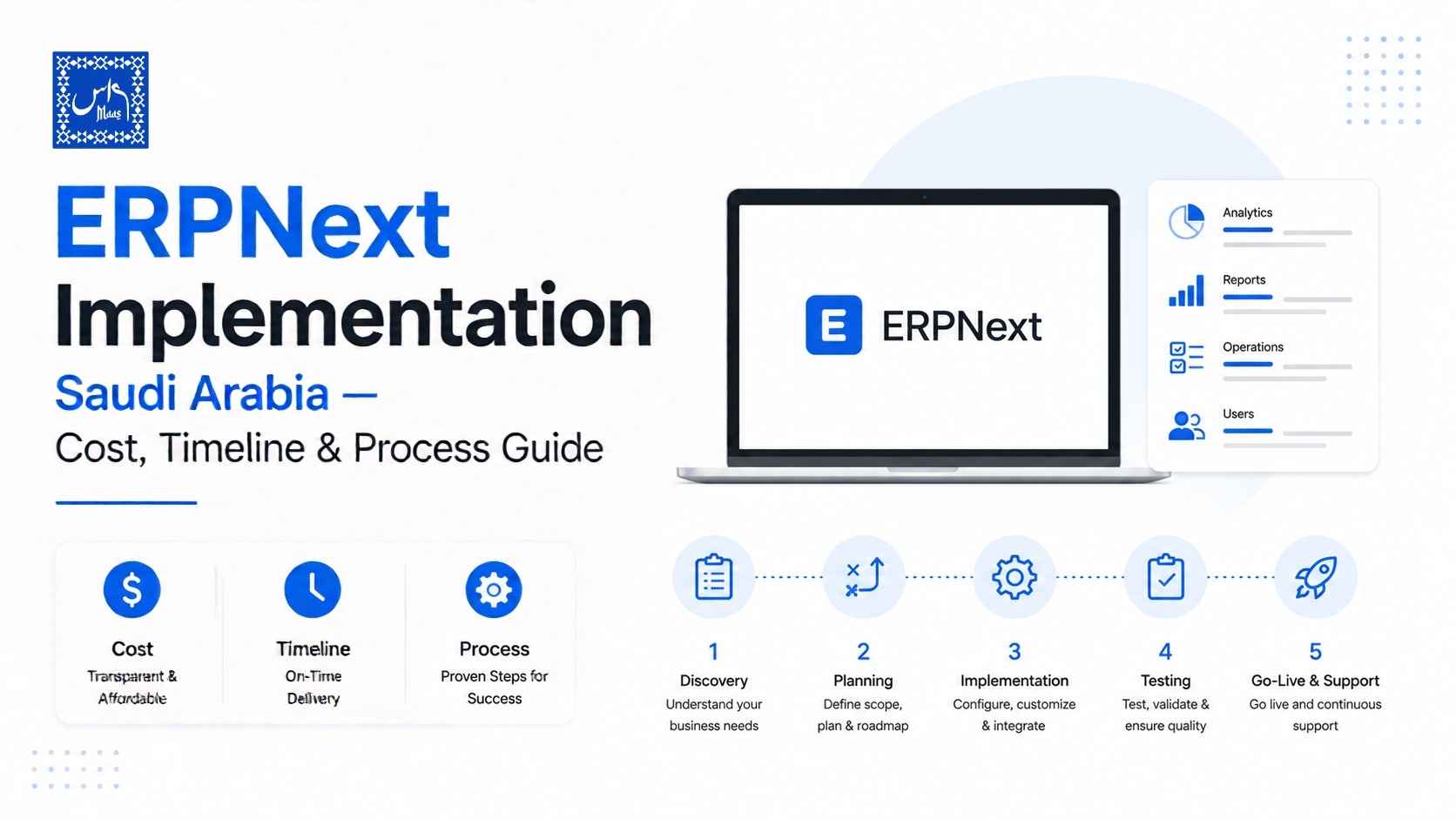
Phase 1: Discovery and Requirements Scoping (Week 1–2)
Before any configuration starts, we spend time understanding how your business actually works — not how you think it works. This includes interviewing department heads, mapping current workflows, documenting compliance requirements (ZATCA status, VAT structure, payroll specifics), and identifying integration points (bank feeds, point-of-sale systems, e-commerce platforms).
The output is a Business Requirements Document (BRD) and an implementation plan. Skipping this phase is the single most common reason ERPNext implementations fail or run over budget.
Phase 2: System Setup and Configuration (Week 2–4)
ERPNext is installed (cloud on Frappe Cloud, or on-premise on your servers in Riyadh or Dammam). The system is configured for your chart of accounts, fiscal year, currency, tax structure, and company details. Saudi-specific settings — ZATCA credentials, CR number, VAT registration, GOSI employer code — are configured in this phase.
Phase 3: Data Migration (Week 3–5)
This is where legacy data comes in. For businesses migrating from Tally, we extract the chart of accounts, customer master, supplier master, opening balances, and historical transactions. For businesses migrating from QuickBooks or Excel, the process is similar but often involves more data cleaning. Getting data migration right the first time saves enormous re-work after go-live.
Phase 4: Module Customization and Integration (Week 4–7)
Saudi businesses rarely need ERPNext “out of the box.” Customizations commonly include custom approval workflows (purchase orders above SAR X require CFO sign-off), custom print formats (Arabic-English bilingual invoices), ZATCA portal integration testing, WPS file format configuration for your specific bank, and any integrations with third-party tools (Foodics POS, Noon seller integration, STC Pay, bank statement imports).
Phase 5: User Training (Week 6–8)
At Maas Consult, we provide training in five languages — English, Arabic, Hindi, Urdu, and Tamil — because Saudi workforces are genuinely multilingual. A manufacturing SME in Riyadh might have a Pakistani finance manager, Indian warehouse staff, and a Saudi operations director. Training only in English is a common implementation failure point that most ERPNext partners in the Kingdom do not address.
Phase 6: Go-Live and Stabilization (Week 8–12)
Parallel running (operating both old system and ERPNext simultaneously for 2–4 weeks) is recommended but not always practical. At minimum, a hypercare period of 30 days post-go-live — where the implementation team is on call daily — is essential. Issues always arise in the first weeks. The difference between a smooth go-live and a chaotic one is how quickly those issues are resolved.
How Much Does ERPNext Implementation Cost in Saudi Arabia?
Pricing transparency is rare in this industry. Here is a realistic guide based on implementation experience across KSA:
| Business Size | Users | Modules | Estimated Cost (SAR) | Timeline |
| Micro / Startup | 1–5 users | Finance + Inventory + HR | SAR 8,000–15,000 | 3–4 weeks |
| Small Business | 5–20 users | Finance + Inventory + HR + CRM + Payroll | SAR 15,000–35,000 | 5–7 weeks |
| Mid-Market SME | 20–50 users | Full modules + ZATCA + customization | SAR 35,000–75,000 | 8–12 weeks |
| Multi-Branch / Manufacturing | 50–100+ users | Full modules + integrations + manufacturing | SAR 75,000–150,000+ | 10–16 weeks |
These figures reflect implementation service costs only. ERPNext software itself is free (open-source). Hosting on Frappe Cloud costs approximately USD 25–200/month depending on capacity. On-premise hosting uses your own servers.
What affects cost:
- Number of users and sites
- Number of modules being deployed
- Volume of historical data being migrated
- Custom workflows, reports, and print formats
- Third-party integrations (POS, banks, e-commerce)
- Language of training required
- Post-go-live support package
Migrating from Tally to ERPNext in Saudi Arabia
This deserves its own section because it is extremely common. A large portion of Saudi SMEs — particularly those run by GCC expat business communities — have been using TallyPrime for years. Tally is a good accounting tool. It is not an ERP system.
As businesses grow and ZATCA compliance becomes non-negotiable, Tally’s limitations become visible: no native ZATCA Phase 2 integration, no inventory management, no HR module, no multi-branch visibility, no approval workflows. The data exists in Tally but is trapped there.
The Tally-to-ERPNext migration path involves exporting the chart of accounts and master data, converting Tally’s voucher format to ERPNext’s transaction structure, cleaning and validating opening balances, and mapping Tally’s cost centre structure to ERPNext’s profit centre hierarchy. This requires experience — a generic ERPNext partner who has never worked with Tally data will struggle. We have done this migration enough times to have built a reliable process for it.
ZATCA Phase 2 and ERPNext: What You Need to Know
Definition Box — ZATCA Phase 2 (Fatoorah): ZATCA Phase 2 is Saudi Arabia’s mandatory e-invoicing requirement for businesses above a revenue threshold. It requires real-time or near-real-time clearance of invoices through the ZATCA portal (Fatoorah), with invoices in UBL 2.1 XML format, embedded cryptographic QR codes, and digital signatures. Non-compliance carries penalties of SAR 10,000+ per violation.
ERPNext handles ZATCA Phase 2 through:
- Automatic generation of XML invoices in UBL 2.1 format
- Cryptographic signing using ZATCA-issued certificates
- Real-time clearance via FATOORAH API for B2B invoices above SAR 1,000
- QR code generation for B2C invoices
- 5-year digital archive within the system
ZATCA Wave 24 (deadline: June 30, 2026) covers businesses with annual revenues between SAR 5 million and SAR 10 million. If your business falls in this range and is not yet compliant, the compliance window is now extremely short. ERPNext can be implemented with ZATCA compliance as the primary focus in as little as 3–4 weeks for a business with a clean existing data set.
Common ERPNext Implementation Mistakes in Saudi Arabia
In over 2,000 implementations, the same mistakes appear repeatedly. Here are the ones most specific to the Saudi Arabia context:
1. Ignoring Arabic training requirements Most implementation partners train in English only. In Saudi businesses with mixed-nationality teams, this means shop-floor staff, warehouse staff, and back-office support teams never become confident users. Adoption suffers. The ROI never materialises.
2. Treating ZATCA as a post-implementation add-on ZATCA compliance needs to be configured from day one — chart of accounts structure, invoice numbering, tax category mapping. Retrofitting it after go-live is significantly more expensive and disruptive.
3. Underestimating data migration complexity “We’ll just start fresh” sounds clean. It usually means months of parallel reporting as historical transactions sit in a spreadsheet outside ERPNext. Proper data migration is worth the upfront investment.
4. Selecting a vendor with no local presence Some businesses are sold ERPNext implementations by vendors with no Saudi presence, no understanding of WPS/GOSI requirements, no Arabic training capability, and no ability to support during Saudi business hours (8 AM to 8 PM, including weekends). When something breaks post-go-live, time zones matter.
5. No change management plan The technology is the easy part. Getting your team to actually change how they work is harder. Without a structured change management and training plan, adoption rates are low and businesses end up paying for ERPNext while still using spreadsheets alongside it.
6. Skipping the AMC (Annual Maintenance Contract) ERPNext is actively developed. Updates, compliance changes (ZATCA regulations evolve), bug fixes, and feature improvements all require ongoing maintenance. Signing off after go-live with no support contract creates risk.
ERPNext for Different Industries in Saudi Arabia
ERPNext’s architecture supports deep customization by industry. Here is how it is most commonly deployed across Saudi sectors:
Manufacturing Companies (Riyadh Industrial Zones) BOM management, production planning, work orders, scrap and rework tracking, quality control checkpoints, material requisitions, batch tracking, and real-time production cost analysis.
Trading and Distribution Companies Multi-warehouse inventory, landed cost for imported goods, letter of credit management, shipment tracking, supplier advance payments, and price list management for multiple customer tiers.
Engineering and Construction Firms Project-based accounting, timesheet billing, subcontractor payment management, retention tracking, inter-company transactions for multi-entity groups.
Retail Businesses POS integration (Foodics, custom solutions), online-offline inventory sync, customer loyalty, promotions management, and multi-branch reporting.
Professional Services Project management, billable hours, retainer billing, CRM pipeline, and client portal access.
ERPNext in Dammam and Eastern Province: The Underserved Market
Most ERPNext content and most implementation partners focus on Riyadh and Jeddah. The Eastern Province — home to Dammam, Khobar, Dhahran, and the ARAMCO supply chain ecosystem — has significant ERP demand and very little specialist coverage.
Petrochemical suppliers, industrial services companies, construction contractors, and trading firms serving the energy sector operate in a unique environment: they often have large non-Saudi workforces (requiring Iqama and visa tracking), complex payroll structures, and procurement systems integrated with major clients’ SAP or Oracle environments.
ERPNext can be configured to handle all of this. At Maas Consult, our team provides the same 8 AM–8 PM, 365-day support coverage to Eastern Province clients as to Riyadh clients — in Arabic, English, Hindi, Urdu, and Tamil. This matters in a region where many supply chain and engineering SMEs are run by non-Arabic-speaking operators.
What to Look for in an ERPNext Implementation Partner in Saudi Arabia
Not all ERPNext implementation partners are equal. When evaluating a partner for your Saudi business, ask these questions:
✅ Do they have experience with ZATCA Phase 2 integration specifically?
✅ Can they train your team in your team’s primary language?
✅ What is their go-live success rate and typical timeline?
✅ Do they offer post-go-live support with defined SLA?
✅ Can they show you live implementations in your industry?
✅ Do they have experience migrating from your current system (Tally, QuickBooks, or legacy)?
✅ Are they reachable during Saudi business hours?
✅ Do they understand WPS, GOSI, Nitaqat, and Iqama requirements?
A 5-minute discovery call will usually reveal whether a partner has done this before or is learning on your time and money.
ERPNext ROI: What Saudi Businesses Typically Achieve
Return on investment from ERPNext varies, but consistent outcomes across implementations include:
- Finance teams report 60–70% reduction in monthly close time — consolidated accounts, automated VAT returns, and bank reconciliation replace days of manual work
- Inventory shrinkage typically drops 20–35% in the first year — real-time visibility eliminates over-ordering and stock loss
- ZATCA compliance penalties avoided — businesses that were manually managing e-invoicing via third-party tools frequently had errors; ERPNext integration eliminates them
- HR/payroll processing time reduced by 50–80% — WPS files generated automatically, leave management automated, visa expiry alerts prevent compliance breaches
- Procurement cycle time reduced by 30–40% — automated purchase order approvals, supplier comparison, and payment scheduling
These are outcomes we have observed across client implementations. They are not guaranteed and depend heavily on implementation quality, adoption rates, and ongoing system use.
Expert Insight
“The businesses that get the most from ERPNext in Saudi Arabia are not the ones with the most sophisticated technology requirements — they are the ones that invested properly in change management and training. A well-trained team on a simple ERPNext configuration will outperform a poorly adopted complex configuration every single time.”
— Mohamed Abdul Baseeth, Founder, Maas Consult Middle East Co.
Getting Started with ERPNext Implementation in Saudi Arabia
If you are evaluating ERPNext for your business, here is a practical starting framework:
- List your current tools — what software, spreadsheets, and manual processes are you replacing?
- Identify your compliance requirements — are you ZATCA Phase 2-registered? What is your VAT structure? What payroll complexity do you have?
- Define your go-live timeline — is there a regulatory deadline driving urgency (e.g., ZATCA Wave compliance)?
- Map your user base — how many users, in which departments, speaking which languages?
- Request a scoped proposal — not a generic quote, but a proposal based on your actual requirements
The difference between a SAR 12,000 implementation and a SAR 50,000 implementation is usually scope, not quality. Understanding your requirements upfront prevents scope creep.
Final Thoughts
ERPNext is not the right choice for every business in Saudi Arabia. Very large enterprises with complex multi-entity structures may need SAP or Oracle. Businesses with extremely simple needs may find a lightweight SaaS tool sufficient.
For the majority of Saudi SMEs and mid-market businesses — trading companies, manufacturers, engineering firms, services businesses — ERPNext offers a compelling combination: enterprise-grade functionality, full Saudi compliance support, genuine Arabic-language capability, and a total cost of ownership that makes sense.
The implementation quality, however, is everything. ERPNext with a skilled, Saudi-experienced partner is a transformative tool. ERPNext poorly implemented is an expensive distraction.
Maas Consult Middle East Co. has been implementing ERP systems across Saudi Arabia and the GCC for over 16 years. If you are at the stage of evaluating whether ERPNext is right for your business, or if you have already decided and need a partner who can execute it properly, we are available for a no-obligation discovery conversation.
Ready to Implement ERPNext in Saudi Arabia?
Maas Consult Middle East Co. — Riyadh, Saudi Arabia CR: 7054000489 | Available 8 AM–8 PM, 365 days
📧 support@maasconsult.co | info@maasconsult.co 📞 +966 53 213 6446 | +966 11 451 6582
👉 Explore ERPNext Implementation Services → 👉 View All Our Services → 👉 Request a Free Discovery Call →
FAQs
Q1: What is ERPNext used for? ERPNext is a comprehensive open-source ERP system used to manage business operations including accounting, inventory, purchasing, sales, HR, payroll, manufacturing, CRM, and project management — all within a single platform. For Saudi businesses, it also handles ZATCA e-invoicing compliance, VAT reporting, WPS payroll files, and GOSI tracking.
Q2: How long does ERPNext implementation take in Saudi Arabia? ERPNext implementation in Saudi Arabia typically takes 4 to 12 weeks. A micro-business with 1–5 users and basic modules can go live in 3–4 weeks. A mid-market SME with 20–50 users, full modules, and ZATCA integration typically requires 8–12 weeks. Manufacturing businesses with complex BOMs and integrations may need 12–16 weeks.
Q3: How much does ERPNext implementation cost in Saudi Arabia? ERPNext implementation cost in Saudi Arabia ranges from approximately SAR 8,000 for small startups to SAR 150,000+ for multi-branch or manufacturing businesses. The ERPNext software itself is free (open-source). Costs reflect implementation services, customization, data migration, training, and support. Cloud hosting via Frappe Cloud costs USD 25–200/month depending on capacity.
Q4: Is ERPNext better than SAP for Saudi Arabia businesses? For most Saudi SMEs and mid-market businesses, ERPNext offers a more cost-effective and flexible alternative to SAP. ERPNext has zero license fees, full ZATCA Phase 2 compliance, native Arabic RTL support, WPS/GOSI integration, and a much lower implementation cost (SAR 8,000–80,000 vs. SAR 80,000–300,000+ for SAP Business One). SAP remains the preferred choice for very large enterprises with complex multi-entity requirements.
Q5: Which is better, Odoo or ERPNext? Both ERPNext and Odoo are strong open-source ERP options. The main differences: ERPNext has no per-user license fees (Odoo charges per user per module); ERPNext has deeper native localization for Saudi Arabia including WPS and GOSI; Odoo has a larger global app marketplace. For Saudi SMEs focused on total cost of ownership, ERPNext typically offers better value.
Q6: Does ERPNext support ZATCA Phase 2 e-invoicing in Saudi Arabia? Yes. ERPNext supports ZATCA Phase 2 e-invoicing (Fatoorah) with automatic generation of UBL 2.1 XML invoices, cryptographic QR codes, digital signing, and real-time clearance via the FATOORAH API. It also maintains the 5-year digital archive required by ZATCA regulations. Businesses facing ZATCA Wave 24 deadline (June 30, 2026) can achieve compliance through ERPNext implementation.
Q7: Can ERPNext replace Tally in Saudi Arabia? Yes. ERPNext can fully replace TallyPrime for Saudi businesses. It includes all of Tally’s accounting functionality plus inventory management, HR, payroll (with WPS), CRM, manufacturing, and ZATCA compliance — capabilities Tally does not natively provide. Maas Consult offers a structured Tally-to-ERPNext migration process that preserves historical data including chart of accounts, customer/supplier masters, and opening balances.
Q8: Can I use ERPNext for free? ERPNext software is free and open-source under the GNU GPL license. You can self-host it without license fees. However, most businesses require professional implementation, customization, training, and ongoing support — which are paid services. Cloud hosting via Frappe Cloud has a monthly cost. The total cost of an ERPNext deployment is implementation + hosting + support, not software licensing.
Q9: Does ERPNext support Arabic language and RTL interface? Yes. ERPNext has a full Arabic language interface with RTL (right-to-left) support. Arabic is one of ERPNext’s primary supported languages. Saudi businesses can generate Arabic-English bilingual invoices, reports, and documents within the system.
Q10: Does ERPNext support WPS and GOSI compliance in Saudi Arabia? Yes. ERPNext’s HR and Payroll module generates Ministry of Labour-approved WPS salary files in formats compatible with all major Saudi banks (Al Rajhi, SNB, Riyad Bank) and payment services (STC Pay, Sadad). GOSI deductions are calculated and tracked automatically within the payroll module. Automated reminders can be configured for the 10th-of-month WPS submission deadline.
Q11: What industries use ERPNext in Saudi Arabia? ERPNext is widely used across manufacturing, trading and distribution, construction and engineering, retail, healthcare, education, professional services, and hospitality industries in Saudi Arabia. It is particularly strong for manufacturing SMEs in Riyadh’s industrial zones, trading companies in Jeddah and Dammam, and engineering services firms in the Eastern Province.
Q12: What is the difference between ERPNext and SAP in Saudi Arabia? ERPNext is free open-source software with no license fees; SAP Business One carries licensing costs of SAR 15,000–50,000+/year. ERPNext implementation for SMEs costs SAR 8,000–80,000; SAP Business One implementation typically costs SAR 80,000–300,000+. Both support ZATCA compliance, but SAP’s Saudi localization often requires expensive add-ons. ERPNext is better suited for Saudi SMEs and mid-market businesses; SAP is better suited for large enterprises with complex requirements.
Q13: Is there on-premise ERPNext hosting available in Saudi Arabia? Yes. ERPNext can be deployed on-premise on your own servers located in Saudi Arabia, which satisfies data residency requirements for businesses that need to keep data within the Kingdom. On-premise deployment is common among government suppliers, healthcare businesses, and companies with strict data governance policies. Cloud deployment via Frappe Cloud is also available for businesses that prefer managed hosting.
Q14: What post-go-live support is available for ERPNext in Saudi Arabia? Post-go-live support for ERPNext in Saudi Arabia typically includes a hypercare period (30–60 days of intensive support after go-live), followed by an Annual Maintenance Contract (AMC) covering bug fixes, system updates, ZATCA compliance updates, user additions, and minor customizations. Maas Consult provides 8 AM–8 PM, 365-day support in five languages: Arabic, English, Hindi, Urdu, and Tamil.

2 Comments