ZATCA for Small Businesses in Saudi Arabia: A Simplified Guide
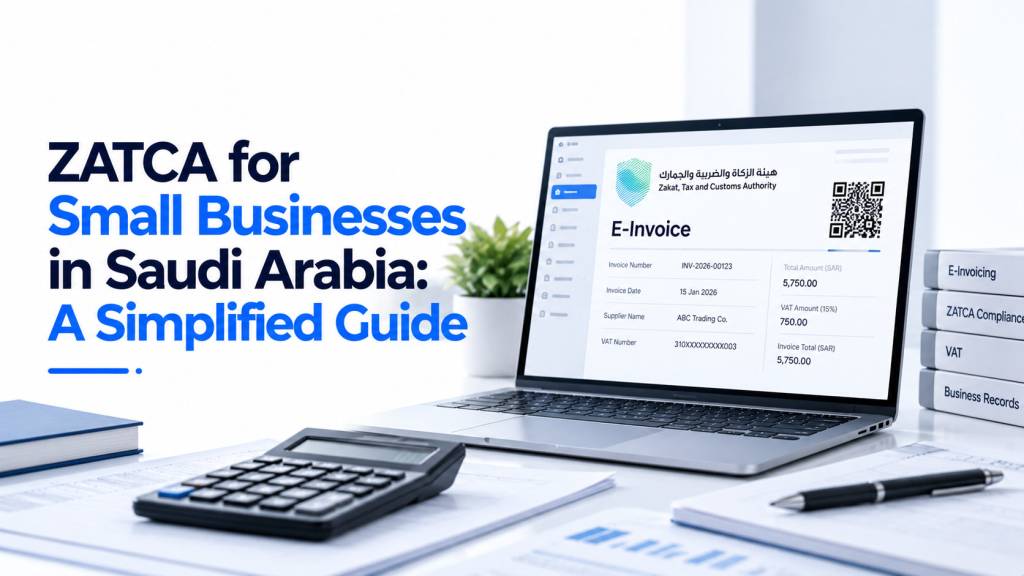
If you run a small business in Saudi Arabia, ZATCA probably feels like a long list of rules written for someone else’s company. VAT, zakat, e-invoicing, waves, QR codes, Fatoora. Most guides cover one of these in depth and leave you to work out how they fit together.
This guide does the opposite. It shows which ZATCA rules apply to your business at your size, what you have to do and when, and the dates that matter over the next six months. It is written for owners, not tax specialists.
I am Mohamed Abdul Baseeth, founder of Maas Consult Middle East Co. Our team has handled 800+ ZATCA compliance engagements, and many of them were small businesses doing this for the first time. If you want the technical detail of e-invoicing integration, our complete guide to ZATCA Phase 2 covers it. This page is the simple version of everything else.
Quick Answer
ZATCA (the Zakat, Tax and Customs Authority) collects zakat, VAT and other taxes in Saudi Arabia. For a small business, four things matter. First, zakat: Saudi and GCC-owned businesses with a commercial registration must register for zakat and file a return each year, with no small-business exemption. Second, VAT: registration is mandatory once taxable sales exceed SAR 375,000 in 12 months, and voluntary from SAR 187,500, at a 15% rate with quarterly returns for businesses under SAR 40 million. Third, e-invoicing: every VAT-registered business must issue electronic invoices, and Wave 25 requires businesses with VAT-subject revenue above SAR 187,500 in any of 2022 to 2025 to integrate with ZATCA’s Fatoora platform by 1 February 2027. Fourth, deadlines: miss them and fines start quickly, although a fines exemption initiative runs until 31 December 2026.
Key Takeaways
- Your revenue band decides most of your obligations. Find yours in the table below first.
- Zakat applies to small Saudi and GCC-owned businesses regardless of size.
- Wave 25’s threshold matches the voluntary VAT threshold, so almost every VAT-registered small business is now in scope for Phase 2.
- The next quarterly VAT return is due on 31 October 2026, and the fines exemption initiative ends on 31 December 2026.
- No software is “ZATCA approved”. You are responsible for your own compliance, whatever system you use.
What Is ZATCA?
ZATCA is the Zakat, Tax and Customs Authority, the Saudi government body responsible for zakat, VAT, income tax, excise tax and customs. For most small businesses, the day-to-day contact with ZATCA is through its online portal and app: registering, filing returns, paying, and, for VAT-registered businesses, e-invoicing through the Fatoora platform.
Step 1: Find Your Revenue Band
Most ZATCA obligations depend on how much your business sells. Use your taxable sales (sales subject to VAT) over the last 12 months, and what you expect over the next 12.
| Annual taxable sales | VAT registration | E-invoicing | VAT returns | Zakat (Saudi and GCC-owned) |
|---|---|---|---|---|
| Under SAR 187,500 | Not required (voluntary only if taxable expenses exceed SAR 187,500) | Not required if not VAT-registered | None | Required |
| SAR 187,500 to 375,000 | Voluntary | Required once registered; Phase 2 under Wave 25 if revenue exceeded SAR 187,500 in any of 2022 to 2025 | Quarterly | Required |
| SAR 375,000 to 40 million | Mandatory | Required; Phase 2 under Wave 25 at the latest | Quarterly | Required |
| Above SAR 40 million | Mandatory | Required; already in an earlier Phase 2 wave in most cases | Monthly | Required |
For reference, Monsha’at, the SME authority, defines micro businesses as 1 to 5 employees and up to SAR 3 million in revenue, and small businesses as 6 to 49 employees and SAR 3 to 40 million. So nearly every micro and small business that is registered for VAT files quarterly.
Foreign-owned businesses pay corporate income tax instead of zakat on the foreign share. Mixed-ownership businesses pay zakat on the Saudi or GCC share and income tax on the foreign share.
Zakat: The Obligation Small Businesses Forget
Many owners assume zakat only matters for big companies. It does not. Under ZATCA’s Implementing Regulations for Zakat Collection (2024):
- Register early. A zakat payer must register with ZATCA before the end of its first fiscal year.
- Rate. Zakat is 2.5% of the zakat base for a Hijri year, adjusted for the number of days if your fiscal year follows the Gregorian calendar. The base is broadly your capital, retained earnings, reserves and profit, less allowed deductions such as fixed assets. It is not 2.5% of revenue.
- File and pay within 120 days of your fiscal year end. For a 31 December year end, that is 30 April of the following year.
- No accounts means estimated zakat. If you do not keep proper accounts, ZATCA can assess zakat on an estimated basis, using indicators such as your sales, imports, purchases and number of employees. The minimum zakat in that case is SAR 500.
The practical lesson: keep proper books from day one. Estimated assessments are rarely in your favour.
VAT Basics for a Small Business
The Rate
Saudi Arabia’s standard VAT rate is 15%.
When You Must Register
Registration is mandatory when your taxable sales exceed SAR 375,000 over the past 12 months, or are expected to exceed it over the next 12. You can register voluntarily once your taxable sales or expenses exceed SAR 187,500. Apply within 30 days of crossing the threshold. Registering late carries a fixed penalty of SAR 10,000, and charging VAT without being registered can lead to a penalty of up to SAR 100,000.
How Often You File
Businesses with annual taxable supplies of SAR 40 million or less file quarterly. The return and payment are due on the last day of the month after the quarter ends. ZATCA’s tax returns calendar lists every date.
Cash Basis Option
ZATCA’s VAT page lists cash basis accounting as available to establishments whose annual supplies, in the current or previous year, do not exceed SAR 5 million. This can help small businesses whose customers pay slowly. Check the conditions with ZATCA or your adviser before switching.
Late Filing and Payment
Filing late carries a fine of 5% to 25% of the tax that should have been declared. Paying late adds 5% of the unpaid tax for each month or part of a month.
E-Invoicing for Small Businesses, in Plain Terms
Phase 1: Already Required
Since 4 December 2021, every VAT-registered business must issue invoices electronically from a compliant system, with a QR code on simplified (B2C) invoices. Handwritten invoices and invoices typed in Word or Excel are not allowed.
Phase 2: Now Reaching Small Businesses
Phase 2 connects your invoicing system to ZATCA’s Fatoora platform. B2B invoices are cleared by ZATCA before they reach the customer, and B2C invoices are reported within 24 hours.
ZATCA has rolled out Phase 2 in waves, starting with the largest businesses. On 24 July 2026 it announced Wave 25, for taxpayers whose VAT-subject revenue exceeded SAR 187,500 in 2022, 2023, 2024 or 2025. They must integrate by no later than 1 February 2027, and ZATCA notifies them directly.
Because SAR 187,500 is also the voluntary VAT threshold, Wave 25 reaches almost every VAT-registered small business with a few years of trading. Two groups may sit outside it for now:
- Businesses registered voluntarily on the basis of expenses, whose revenue never exceeded SAR 187,500 in those years
- New businesses with no revenue in 2022 to 2025
Both must still follow Phase 1, and ZATCA says each future wave will be announced at least six months before its deadline.
What you actually need to do for Phase 2 is set out step by step on our ZATCA e-invoicing page. In short: use a Phase 2 capable system, onboard it with ZATCA through the Fatoora portal, and test your invoices before the deadline.
Your ZATCA Calendar for the Next Six Months
If your fiscal year ends on 31 December and you file VAT quarterly, these are your dates:
| Date | What is due |
|---|---|
| 31 October 2026 | VAT return and payment for Q3 2026 (July to September) |
| 31 December 2026 | Fines exemption initiative ends |
| 31 January 2027 | VAT return and payment for Q4 2026 (October to December) |
| 1 February 2027 | Wave 25 deadline to integrate with Fatoora |
| 30 April 2027 | Zakat return and payment for 2026, and VAT return for Q1 2027 |
ZATCA’s reminder for the Q3 2026 return confirms the 31 October deadline. If you pay non-resident suppliers for services, withholding tax is also due monthly, by the 10th of the following month.
The Fines Exemption Initiative: Use It Before 31 December
ZATCA’s fines exemption initiative runs until 31 December 2026. It covers fines for late registration, late payment, late filing of returns and corrections to VAT returns, provided you are registered, file all outstanding returns and pay the principal tax (installments can be requested). It does not cover tax evasion, fines under Article 45 of the VAT Law, fines already paid, or penalties on returns due after 30 June 2026.
For a small business that missed a registration or filed late in the past, this is the cheapest moment to clean up. Our guide to ZATCA penalties in 2026 explains the fines and the waiver in more detail.
Choosing Software on a Small Budget
ZATCA does not approve or certify software. Its Solution Providers Directory states that the listing is not an approval, and that any taxpayer who meets the requirements is compliant whether or not its provider is listed. So choose on fit:
- Very small service businesses: a simple cloud accounting tool with built-in e-invoicing is often enough.
- Small trading or retail businesses with stock: accounting software with real inventory, such as TallyPrime.
- Growing businesses with branches, manufacturing or projects: a full ERP such as ERPNext.
What a small business pays depends on the number of users and invoicing points (each POS terminal or branch may need onboarding), whether you need inventory, how much setup and data entry is needed, and the support level you want. Our comparison of accounting software options for Riyadh businesses explains the categories.
Records You Must Keep
- Keep invoices, credit and debit notes, accounting records and VAT returns for at least six years. Some records, such as those for capital assets and real estate, must be kept longer.
- Store e-invoices in the required electronic format (XML, or PDF/A-3 with embedded XML), not just as printed copies.
- Keep the evidence behind your zakat return: financial statements, fixed asset records and bank statements.
Startup Checklist: Your First 90 Days with ZATCA
- Register with ZATCA using your commercial registration, before the end of your first fiscal year at the latest.
- Decide your fiscal year end, and diary the zakat deadline 120 days later.
- Choose accounting software that can issue compliant e-invoices, even before you register for VAT, so you do not have to switch later.
- Track your taxable sales monthly against the SAR 187,500 and SAR 375,000 thresholds.
- Register for VAT within 30 days of crossing SAR 375,000, or earlier voluntarily if it suits you.
- Set quarterly VAT reminders for the last day of January, April, July and October.
- Open a separate business bank account so zakat and VAT records are easy to prove.
- Watch for ZATCA notifications about Phase 2 waves on your registered email and in the ZATCA app.
Common Mistakes Small Businesses Make
- Assuming zakat is only for large companies. Every Saudi or GCC-owned business with a CR must register and file.
- Missing the VAT registration point. Sales are measured over a rolling 12 months, not the calendar year.
- Charging VAT before registering. This can lead to a penalty of up to SAR 100,000.
- Typing invoices in Excel. Once VAT-registered, invoices must come from a compliant electronic system.
- Ignoring ZATCA notifications. Wave 25 notices arrive by email and in the portal.
- Believing “ZATCA approved” labels. Responsibility stays with you, whichever software you use.
A Hypothetical Example: A Small Riyadh Café
Picture a café in Riyadh opened in 2023, owned by a Saudi national. Sales passed SAR 375,000 in its second year, but the owner only registered for VAT four months later, after a supplier asked for its VAT number. Invoices came from a basic POS without a proper QR code, and no zakat return had been filed.
Using the fines exemption initiative before 31 December 2026, the owner registers outstanding obligations, files the missing returns and has the late registration and filing fines waived, paying only the principal tax. The café switches to a Phase 2 capable POS and accounting setup, onboards with ZATCA ahead of the 1 February 2027 Wave 25 deadline, and sets quarterly VAT and annual zakat reminders.
This is an illustration built from common patterns, not a named client case.
From the Field
The small businesses that struggle most with ZATCA are rarely the ones that ignored it. They are the ones that did one part well and missed the next: registered for VAT but never filed zakat, or bought e-invoicing software but never onboarded it. Treat ZATCA as one calendar, not four separate projects, and most of the stress disappears.
Frequently Asked Questions
What is ZATCA in Saudi Arabia?
ZATCA is the Zakat, Tax and Customs Authority, the government body responsible for zakat, VAT, income tax, excise tax and customs in Saudi Arabia, including the Fatoora e-invoicing platform.
What is the minimum turnover to register for VAT in Saudi Arabia?
VAT registration is mandatory once taxable sales exceed SAR 375,000 in 12 months, past or expected. Voluntary registration is possible once taxable sales or expenses exceed SAR 187,500.
Does Saudi Arabia have 15% VAT?
Yes. The standard VAT rate in Saudi Arabia is 15%.
Do small businesses pay zakat in Saudi Arabia?
Yes. Saudi and GCC-owned businesses with a commercial registration must register for zakat and file an annual return, with no small-business exemption. Zakat is 2.5% of the zakat base, not of revenue.
Do I need e-invoicing if my business is not VAT-registered?
E-invoicing applies to VAT-registered businesses. If you are not registered because your taxable sales are below the threshold, the e-invoicing rules do not apply to you yet, but keeping proper electronic records makes registration easier later.
Is my small business in ZATCA Wave 25?
If your VAT-subject revenue exceeded SAR 187,500 in any of 2022, 2023, 2024 or 2025, you are within the Wave 25 criteria and must integrate with Fatoora by 1 February 2027. ZATCA notifies targeted taxpayers directly.
How often do small businesses file VAT returns?
Businesses with annual taxable supplies of SAR 40 million or less file quarterly, by the last day of the month after each quarter.
Which accounting software is approved by ZATCA?
None. ZATCA does not approve software. Its Solution Providers Directory is not an approval, and any taxpayer who meets the requirements is compliant, whichever provider they use.
What happens if I register for VAT late?
A fixed penalty of SAR 10,000 applies. Until 31 December 2026, ZATCA’s fines exemption initiative can waive late registration fines if you meet its conditions.
How long must a small business keep records?
At least six years for invoices, accounting records and VAT returns, with longer periods for some records such as capital assets and real estate.
Final Thoughts
ZATCA compliance for a small business comes down to four habits: keep proper books, know your revenue band, file on time every quarter and every year, and issue invoices from a compliant system. Get those right and the rules stop feeling like a threat. With the Q3 VAT return due on 31 October, the fines exemption initiative ending on 31 December and Wave 25 on 1 February 2027, the next few months are the time to get organised.
If you would like help getting your e-invoicing ready for Wave 25, our team runs ZATCA e-invoicing readiness reviews for small businesses across the Kingdom.