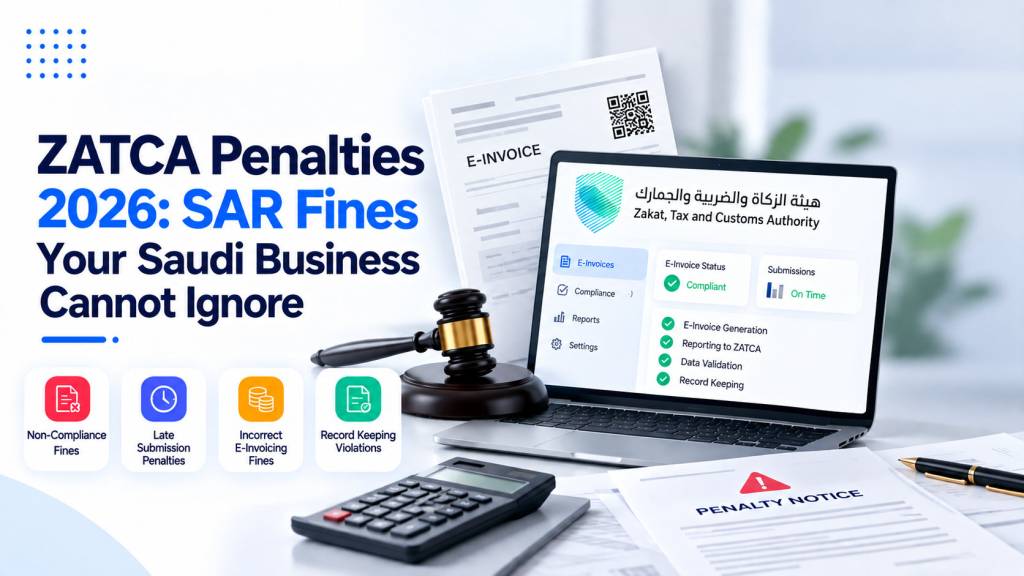
ZATCA Penalties 2026: SAR Fines Your Saudi Business Cannot Ignore
Ask five people what the ZATCA e-invoicing penalty is and four will say “SAR 5,000 to 50,000”. It is the most repeated number in Saudi compliance, and it describes the ceiling, not what most businesses face. The real system is a ladder: a warning first, then fines that climb with every repeat, and a counter that resets after twelve clean months. Misread that and you either panic over fines you will never receive, or ignore the ones that quietly add up to six figures.
I am Mohamed Abdul Baseeth. At Maas Consult Middle East Co we have worked on 800+ ZATCA compliance engagements, and the most common penalty story we hear is not a business that ignored e-invoicing. It is a business that fixed it once, in one system, and forgot the rest. This guide covers what each violation costs in SAR, how the ladder works, what the current waiver does and does not cover, and what to do with the time left.
Quick Answer
For e-invoicing breaches, ZATCA’s published framework is warning-first. The first detection brings a warning and a correction window (30 or 60 days under the 2024 classification, up to three months under the 2022 guide). If the same violation is detected again within twelve months, fines begin and climb with each occurrence. Depending on the violation, the second occurrence costs SAR 1,000, 5,000 or 10,000, and the ceiling per occurrence is SAR 40,000 or SAR 50,000. Other VAT breaches carry separate fines, such as SAR 10,000 for failing to register and up to SAR 100,000 for issuing tax invoices while unregistered.
Key Takeaways
- “SAR 5,000 to 50,000” is a ceiling taken from early announcements. For most e-invoicing violations the first detection is a warning.
- Eleven e-invoicing violations sit on three ladders, with 30-day or 60-day correction windows.
- The count is per violation type and resets after twelve months without a repeat.
- ZATCA’s waiver (1 July to 31 December 2026) names late registration, late payment, late filing and VAT return corrections. Its announcement does not mention e-invoicing violations, so do not plan around it covering them.
- Wave 25 brings more businesses in, with an integration deadline of 1 February 2027.
Why Everyone Quotes SAR 5,000 to 50,000
On 16 November 2021, ahead of the 4 December 2021 start of Phase 1 (generation and storage), ZATCA announced the first e-invoicing fines: SAR 5,000 for not issuing an electronic invoice and SAR 10,000 for deleting or amending an invoice after issue. Missing QR codes, a missing buyer VAT number and unreported technical faults started with a warning. The announcement also said all fines apply according to the type of violation and the number of repetitions.
Those headline numbers were copied everywhere, and the “5,000 to 50,000” range grew from them. On 30 January 2022, ZATCA reclassified the VAT field violations in an official guide: a warning, up to three months to correct, then fines of SAR 1,000, 5,000, 10,000 and 40,000 on repeats, with the count resetting after twelve months. ZATCA’s Simplified Guideline for Classifying General VAT Violations (2nd edition, 2024) then split e-invoicing violations into the three ladders below. ZATCA’s reclassification guide is published on the ZATCA website.
Four Rules That Drive Every ZATCA Fine
- Warning first. The first detection of a classified e-invoicing violation is a warning with a correction window.
- A repeat triggers a fine. If the same violation is detected again, the first fine applies.
- The ladder climbs. Each further occurrence moves up a step until the ceiling, which then repeats.
- Twelve clean months resets the count. Occurrences are counted from ZATCA’s records, so you need to know what ZATCA has recorded against you.
Every E-Invoicing Violation and Its Fine
The table below follows the 2024 classification as published by Qoyod, a ZATCA-linked Saudi accounting provider. Amounts shown are the second occurrence (the first fine, after the warning) and the ceiling per occurrence.
| Violation | First detection | Second occurrence | Ceiling per occurrence | Correction window |
|---|---|---|---|---|
| Not integrating all e-invoicing systems from the mandated date | Warning | SAR 10,000 | SAR 50,000 | 30 days |
| Not sharing invoices and notes with ZATCA in the required format and periods | Warning | SAR 5,000 | SAR 40,000 | 30 days |
| Not issuing e-invoices within the statutory periods | Warning | SAR 5,000 | SAR 40,000 | 30 days |
| Using a prohibited function in the technical solution | Warning | SAR 5,000 | SAR 40,000 | 30 days |
| Deleting or amending an e-invoice after issue | Warning | SAR 5,000 | SAR 40,000 | 30 days |
| Not storing e-invoices in the required format and for the required period | Warning | SAR 1,000 | SAR 40,000 | 60 days |
| Not notifying ZATCA of technical faults | Warning | SAR 1,000 | SAR 40,000 | 60 days |
| Missing QR code on an invoice | Warning | SAR 1,000 | SAR 40,000 | 60 days |
| Missing required data fields | Warning | SAR 1,000 | SAR 40,000 | 60 days |
| Not sharing invoices with customers in the required format | Warning | SAR 1,000 | SAR 40,000 | 60 days |
| Breaching any other e-invoicing provision | Warning | SAR 1,000 | SAR 40,000 | 60 days |
Please read this next to the older scale. ZATCA’s 2022 guide applies one scale to every e-invoicing violation: SAR 1,000, 5,000, 10,000, then 40,000, with up to three months to correct. Because the two documents differ, confirm the amount and window for your own violation with ZATCA on 19993 before you plan around either.
The Climb, Step by Step
For the three ladders, the intermediate steps reported by compliance trackers are:
| Occurrence | Heavy ladder (30 days) | Middle ladder (30 days) | Light ladder (60 days) |
|---|---|---|---|
| 2nd | SAR 10,000 | SAR 5,000 | SAR 1,000 |
| 3rd | SAR 15,000 | SAR 10,000 | SAR 5,000 |
| 4th | SAR 20,000 | SAR 15,000 | SAR 10,000 |
| 5th | SAR 30,000 | SAR 20,000 | SAR 20,000 |
| 6th | SAR 40,000 | SAR 30,000 | SAR 30,000 |
| 7th and after | SAR 50,000 each | SAR 40,000 each | SAR 40,000 each |
Qoyod describes the scale as six tiers plus a seventh. Treat the middle steps as indicative, since we could not confirm them in ZATCA’s own text.
What the Ladder Costs in Practice
Example 1: a recurring missing QR code (light ladder). The first detection is a warning. If the defect keeps recurring, the second to sixth occurrences add up to SAR 1,000 + 5,000 + 10,000 + 20,000 + 30,000 = SAR 66,000.
Example 2: failing to integrate (heavy ladder). The second to sixth occurrences are SAR 10,000 + 15,000 + 20,000 + 30,000 + 40,000 = SAR 115,000, and every occurrence after that is SAR 50,000.
These show how the arithmetic works, not a forecast for any one business. A cheap fix left undone becomes the expensive one.
Other VAT Penalties That Often Get Missed
E-invoicing is only part of enforcement. These come from the wider VAT framework, as summarised by Saudi compliance providers citing ZATCA:
| Violation | Penalty |
|---|---|
| Failure to register for VAT | SAR 10,000 |
| Issuing tax invoices while unregistered | Up to SAR 100,000 |
| Not keeping required records | Up to SAR 50,000 |
| Obstructing ZATCA employees | Up to SAR 50,000 |
| Other VAT law violations | Up to SAR 50,000 |
| Late VAT return filing | 5% to 25% of the unpaid tax |
| Late VAT payment | 5% of the unpaid tax per month or part of a month |
| Understating tax on a return | 50% of the difference |
| Tax evasion | Up to three times the value of the goods or services, plus the tax due |
The general rule is that fines may be doubled if the same violation is repeated within three years of the date it became final.
For the technical background on what Phase 2 requires of your systems, our guide to what ZATCA Phase 2 involves walks through it step by step.
The Penalty Waiver: 1 July to 31 December 2026
On 29 June 2026, ZATCA extended its fines exemption initiative for six months, from 1 July to 31 December 2026. According to ZATCA’s announcement, it covers:
- Late registration under all tax laws
- Late payment
- Late filing of returns
- Fines for VAT return corrections
To qualify you must be registered, submit all outstanding returns and pay the full principal tax. Installment plans are available if requested before the initiative ends.
It does not cover tax evasion, fines under Article 45 of the VAT Law, penalties already paid, or penalties on returns due after 30 June 2026.
E-invoicing fines are not mentioned. An earlier round of the initiative explicitly included e-invoicing field-inspection violations, and some advisers read the current round the same way. ZATCA’s current announcement says nothing about them, so plan as if they are not covered unless ZATCA confirms otherwise in writing.
As of 7 October 2026 there are about 85 days, roughly twelve weeks, left. If you have outstanding registration, filing or payment fines, apply while the window is open.
Wave 25: Who Is Next
ZATCA announced Wave 25 on 24 July 2026. It applies to VAT-registered taxpayers whose VAT-subject revenue exceeded SAR 187,500 in any of 2022, 2023, 2024 or 2025, with an integration deadline of 1 February 2027. That is under four months away. ZATCA gives at least six months’ notice per wave, and Wave 24 (SAR 375,000 threshold) closed on 30 June 2026. KPMG’s summary of Wave 25 sets out the threshold test.
Missing a wave deadline puts you on the heaviest ladder: a warning, then SAR 10,000 on the next occurrence. If your revenue crossed SAR 187,500 in any of those four years, assume you are in scope and work back from February.
The Costs That Never Appear on the Fine Notice
- Rework. Cancelling and reissuing invoices costs staff time and customer goodwill.
- Rejected invoices. Invoices that fail validation can hold up customer payments.
- Audit exposure. A recorded violation makes a wider ZATCA review more likely.
- Emergency implementation. Fixing integration in the last weeks before a deadline costs more than doing it on a calm schedule.
An 8-Point Checklist to Avoid ZATCA Fines
- Confirm whether you are in a wave, and which one.
- Ask ZATCA (19993) whether any violations are recorded against your account.
- Check that every invoice template carries all mandatory fields and a valid QR code.
- Test your Fatoora integration in the sandbox before go-live.
- Make sure invoices cannot be deleted or edited after issue; use credit and debit notes.
- Store invoices in the required format for the required period, and keep them retrievable.
- Report technical faults to ZATCA when they happen.
- Name one person responsible for ZATCA notices and announcements.
Common Mistakes We See
- Treating a warning as harmless and not fixing the cause within the window.
- Fixing one system but not the others. Point of sale, ERP and e-commerce can each issue invoices.
- Letting ZATCA notices go to an old contact who no longer checks them.
- Assuming the waiver will erase e-invoicing fines.
A Hypothetical Example
Picture a Riyadh distributor whose billing works in the head office but not in two warehouses that use an older invoice template. The first missing QR code finding is a warning. Nobody owns the fix, so the problem returns and the fines start. The software was not the cause; ownership was. A named owner and a one-day template check would have prevented it. This is an illustration, not a real client case.
From the Field
On projects like this, the pattern is consistent: the expensive violations usually come from one forgotten branch, one old template or one integration that quietly stopped syncing. A monthly check of your invoices as ZATCA would see them is the cheapest defence we know of.
Frequently Asked Questions
What is the ZATCA penalty for not issuing an e-invoice in Saudi Arabia?
Under the 2021 announcement it was SAR 5,000. Under the later classification, the first detection is a warning with a correction window, and a repeat brings a fine starting at SAR 5,000 and rising to a ceiling of SAR 40,000 per occurrence, according to the 2024 table.
How much is the maximum ZATCA fine?
On the e-invoicing ladders the ceiling is SAR 50,000 per occurrence, for failing to integrate. Other VAT breaches carry fines up to SAR 50,000, and issuing tax invoices while unregistered can reach SAR 100,000.
Does ZATCA always give a warning first?
For the classified e-invoicing violations, yes. Fixed fines such as SAR 10,000 for failing to register do not follow that ladder.
How long do I have to fix a violation?
It is 30 days for the heavier ladders and 60 days for the lightest under the 2024 classification. ZATCA’s 2022 guide gives up to three months.
When does the occurrence count reset?
After twelve months without a repeat of the same violation.
Does the penalty waiver cover e-invoicing fines?
ZATCA’s announcement for 1 July to 31 December 2026 lists late registration, late payment, late filing and VAT return corrections. It does not mention e-invoicing violations, so get written confirmation before relying on it.
When does the waiver end?
31 December 2026.
What is the Wave 25 deadline?
1 February 2027, for taxpayers with VAT-subject revenue above SAR 187,500 in any of 2022 to 2025.
How do I find out whether I have fines recorded?
Call ZATCA on 19993 or check your account on the ZATCA portal.
Is a software fix enough to stay compliant?
Software helps, but ownership matters more. A compliant system that nobody monitors drifts out of compliance.
Final Thoughts
The headline range makes ZATCA penalties sound like a lottery. They are not: they are a ladder with a warning on the bottom rung, and the businesses that stay off it treat the warning as the real deadline. With about twelve weeks left on the waiver and Wave 25 due on 1 February 2027, this is the quarter to check your invoices, your integration and your ZATCA record.
If you want a second pair of eyes on your setup, our team can run a ZATCA e-invoicing readiness check. If your invoicing runs through ERPNext, our ERPNext ZATCA integration guide covers the technical side, and for Riyadh teams our ZATCA software page and ERPNext support in Riyadh cover local help.
Penalty amounts and waiver terms change. This article was last verified on 7 October 2026. Confirm figures with ZATCA before acting.