



ZATCA Software in Riyadh: Which Solution Fits Your Business?
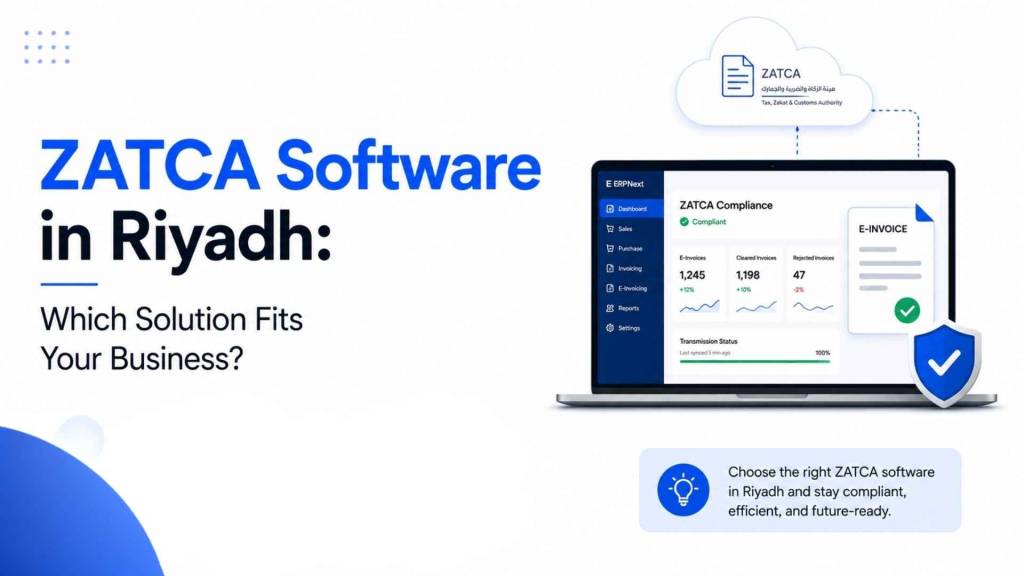
“Which ZATCA software should we use” is usually the wrong first question. The right first question is what kind of business you run, how many invoices you generate, and what system you are already using for accounting, because the answer to “which software” falls out of that far more reliably than any generic product list can tell you. A five-branch trading company and a ten-person consulting firm in Riyadh have almost nothing in common in their ZATCA software needs, even though both fall under the same regulation.
This guide walks through the actual categories of ZATCA-compliant software available to Riyadh businesses, what each one is and isn’t good at, and a straightforward way to decide which category fits before you start comparing individual products. If you want the underlying regulatory detail first, our ZATCA e-invoicing compliance page and ZATCA Phase 2 complete guide cover that ground in full.
Quick Answer: How Do I Choose ZATCA Software in Riyadh?
There is no single best ZATCA software for every business. The right choice depends on your invoice volume, whether you already run an accounting or ERP system, and whether you need e-invoicing as a standalone add-on or as part of a broader system covering inventory, sales, and reporting. A low-volume services business often needs only a lightweight, ZATCA-compliant accounting tool. A trading or manufacturing business generating hundreds of invoices daily usually needs e-invoicing built into a full ERP or accounting-first platform like ERPNext or TallyPrime, because bolting a standalone compliance app onto disconnected systems creates reconciliation problems at scale.
Key Takeaways
- ZATCA-compliant software falls into three broad categories: standalone e-invoicing middleware, accounting-first platforms with e-invoicing built in, and full ERP systems with native e-invoicing.
- The right category depends primarily on invoice volume and whether you already have inventory and stock data that needs to connect to invoicing.
- ZATCA’s Wave 25, announced in July 2026, lowered the mandatory integration threshold to SAR 187,500 in annual VAT-able revenue, with an integration deadline of 1 February 2027, meaning most operating Riyadh businesses now fall under mandatory Phase 2 integration.
- “ZATCA compliant” as a marketing phrase means very little without confirming the specific technical method: UBL 2.1 XML generation, cryptographic stamping, and API connectivity to the Fatoora platform.
- Businesses that already use TallyPrime or ERPNext for accounting rarely need a separate standalone ZATCA app; the integration typically belongs inside the system they already run.
What ZATCA-Compliant Software Actually Needs to Do
Before comparing categories, it helps to know what “ZATCA compliant” is actually supposed to mean technically. A genuinely compliant system needs to:
- Generate invoices in UBL 2.1 XML format, not just a PDF with ZATCA branding.
- Apply a cryptographic stamp to each invoice using a certificate issued through ZATCA’s onboarding process.
- Embed a QR code readable by ZATCA’s verification tools on every simplified tax invoice.
- Connect via API to ZATCA’s Fatoora platform for either real-time clearance (B2B invoices) or 24-hour reporting (B2C invoices), depending on the invoice type.
Any Riyadh business evaluating software should ask a vendor to demonstrate these four points specifically, rather than accepting “we are ZATCA compliant” as a sufficient answer. You can verify your own business’s wave status and the technical specification directly through ZATCA’s official Fatoora e-invoicing portal.
The Three Categories of ZATCA Software in Riyadh
Standalone E-Invoicing Middleware
These are lightweight tools built specifically to generate ZATCA-compliant invoices and connect to the Fatoora platform, often layered on top of whatever accounting system a business already uses. They can be a reasonable short-term fix for a very small business with low invoice volume and no plans to grow into inventory or multi-branch operations, but they introduce a structural weakness: invoice data lives separately from your accounting and stock records, which means someone has to keep the two in sync manually. For any business processing more than a handful of invoices a day, this reconciliation burden tends to outweigh the convenience.
Accounting-First Platforms with Built-In E-Invoicing (TallyPrime)
TallyPrime is ready-made, off-the-shelf, accounting-first software, well suited to businesses that want strong, straightforward accounting with ZATCA e-invoicing built directly into the same system that handles day-to-day bookkeeping and, where relevant, multi-godown stock. Because entries post and show their effect immediately rather than requiring secondary posting, auditors tend to favor it, and invoice generation stays connected to the same ledger and stock data rather than living in a separate tool. This is a strong fit for trading, wholesale, and services businesses that want compliance and accounting unified without the scope of a full ERP. Our TallyPrime implementation guide for Riyadh and TallyPrime for trading companies page cover this in more depth.
Full ERP Systems with Native E-Invoicing (ERPNext)
For businesses that need e-invoicing connected not just to accounting but to inventory, manufacturing, procurement, and HR in one system, a full ERP such as ERPNext is generally the better fit. ERPNext’s open source licensing model also means this depth does not come with escalating proprietary per-user costs as a Riyadh business scales headcount. This is the right category for manufacturers, multi-branch operations, and businesses that need e-invoicing to be one part of a broader operational picture rather than an isolated compliance function. See our ERPNext ZATCA integration guide for the technical detail, and our ERPNext implementation guide for Riyadh for local delivery.
Comparing the Three Categories
| Factor | Standalone Middleware | TallyPrime (Accounting-First) | ERPNext (Full ERP) |
| Best for | Very low invoice volume, simple businesses | Trading, wholesale, and services businesses | Manufacturing, multi-branch, complex operations |
| Data connection | Separate from accounting, needs manual sync | Native to accounting and stock | Native to finance, inventory, and operations |
| Setup speed | Fast | Fast to moderate | Moderate |
| Scales with growth | Limited | Good for trading and accounting growth | Strong across departments |
| Licensing model | Varies by vendor | Licensed software | Open source, no per-user proprietary fee escalation |
How to Choose: A Decision Framework for Riyadh Businesses
- Count your daily invoice volume. Under roughly a dozen invoices a day with no inventory to track, standalone middleware may be sufficient. Above that, or with any stock involved, look at TallyPrime or ERPNext.
- Check what you already use. If you already run TallyPrime or ERPNext for accounting, the e-invoicing integration almost always belongs inside that system, not bolted on separately.
- Decide whether you need inventory connected to invoicing. If stock levels affect what you invoice, a standalone app creates a reconciliation gap that grows more expensive over time.
- Confirm your ZATCA wave status. Different wave thresholds carry different deadlines, so confirm where your business sits before choosing a solution and timeline.
- Ask for a live demonstration of the four technical requirements listed above, not a marketing claim of compliance.
For businesses still unsure which platform category fits, our ERP software overview for Saudi Arabia and ERPNext consultant services page are good starting points for a more detailed assessment.
ZATCA Phase 2 in Riyadh: Where Things Stand
Riyadh, as the seat of ZATCA and home to the largest concentration of VAT-registered businesses in the Kingdom, has felt the practical impact of the wave rollout faster than most regions. Wave 24 covered businesses with VAT-able revenue above SAR 375,000, with an integration deadline of 30 June 2026. Wave 25, announced in July 2026, lowered that threshold to SAR 187,500, with an integration deadline of 1 February 2027, pulling a large share of Riyadh’s small trading, retail, and services businesses into mandatory scope for the first time. Penalties for non-compliance range from SAR 5,000 to SAR 50,000, with additional per-invoice penalties of up to SAR 10,000 for QR code violations. For the full breakdown by wave, see our ZATCA Phase 2 complete guide.
Common Mistakes Riyadh Businesses Make When Choosing ZATCA Software
- Accepting “ZATCA compliant” as a marketing claim without confirming the specific technical integration method.
- Choosing a standalone compliance app while already running TallyPrime or ERPNext, creating two disconnected sources of invoice and stock data.
- Ignoring invoice volume when choosing software, then finding a lightweight tool cannot keep up as the business grows.
- Assuming a solution that was compliant at setup remains compliant indefinitely, without monitoring new wave notifications or technical specification updates.
- Delaying the decision until close to a wave deadline, leaving no time for proper sandbox testing before go-live.
Illustrative Case Study: A Riyadh Services Firm That Outgrew Its Standalone Tool
A professional services firm in central Riyadh initially adopted a standalone ZATCA invoicing app when Wave 24 came into effect, while continuing to track accounting separately in a basic bookkeeping tool. As invoice volume grew, staff were spending several hours a week manually reconciling the two systems, and a batch of invoices went out with a mismatched client reference before anyone noticed. Moving to TallyPrime consolidated accounting and e-invoicing into a single system, and the reconciliation work disappeared because there was only one source of data to check.
Expert Insight
“Businesses in Riyadh often start with whatever standalone ZATCA tool gets them compliant fastest under deadline pressure, which is a reasonable short-term decision, but it becomes a real cost a year later when invoice volume has grown and nobody planned for how that tool connects to actual accounting,” says Mohamed Abdul Baseeth, Founder of Maas Consult Middle East Co, who has supported more than 800 businesses through ZATCA e-invoicing compliance across Saudi Arabia. “The question worth asking early is not just which software is ZATCA compliant today, but which one still makes sense once your invoice volume doubles.”
Frequently Asked Questions
What is the best ZATCA software for a small business in Riyadh?
It depends on invoice volume and whether inventory is involved. A very low-volume services business may manage with lightweight standalone middleware, while a business with any meaningful volume or stock to track is usually better served by TallyPrime or ERPNext with e-invoicing built in natively.
Is a standalone ZATCA app enough for compliance?
A standalone app can meet the technical compliance requirements, but it keeps invoice data separate from your accounting and stock records, which creates a manual reconciliation burden that grows as invoice volume increases.
Does ZATCA software need to connect to my accounting system?
It doesn’t have to, but it should. Disconnected e-invoicing and accounting systems are one of the most common sources of reporting errors and reconciliation delays we see in Riyadh businesses.
What is the difference between TallyPrime and ERPNext for ZATCA compliance?
Both support ZATCA-compliant e-invoicing. TallyPrime is accounting-first and well suited to trading and services businesses that want straightforward accounting with compliance built in. ERPNext is a full ERP better suited to businesses that need e-invoicing connected to inventory, manufacturing, and other operational modules.
How do I know if my Riyadh business needs to comply with ZATCA Phase 2 now?
Check your annual VAT-able revenue against the current wave threshold. As of mid-2026, businesses above SAR 187,500 in annual VAT-able revenue fall under Wave 25’s mandatory integration deadline of 1 February 2027. You can confirm your specific wave status through ZATCA’s official Fatoora portal.
What technical features should ZATCA software actually have?
UBL 2.1 XML invoice generation, cryptographic stamping using a ZATCA-issued certificate, an embedded QR code on simplified tax invoices, and API connectivity to the Fatoora platform for real-time clearance or 24-hour reporting.
Can I switch from a standalone ZATCA app to a full accounting or ERP system later?
Yes, and many Riyadh businesses do exactly this as invoice volume grows. The switch typically involves migrating historical invoice and customer data into the new system and re-testing e-invoicing integration against the new platform.
What happens if my ZATCA software is not properly integrated?
Non-compliance carries penalties ranging from SAR 5,000 to SAR 50,000, with additional per-invoice penalties of up to SAR 10,000 for QR code violations, so confirming genuine technical integration rather than a marketing claim of compliance matters directly.
How much does ZATCA-compliant software cost in Riyadh?
Cost depends on the category chosen, standalone middleware, accounting-first software, or full ERP, along with invoice volume and integration complexity. Request a custom quote based on your specific business rather than relying on generic published figures.
Who can help set up ZATCA-compliant software for my Riyadh business?
Our team can assess your invoice volume and existing systems and recommend the right category, then handle setup and sandbox testing. Reach out through our ERPNext consultant services or TallyPrime dealer page to get started.
Get the Right ZATCA Software for Your Riyadh Business
If you are unsure which category of ZATCA software fits your business, or want a second opinion on a solution you have already implemented, our team can walk through your invoice volume and existing systems before recommending anything. Explore our ERPNext partner services in Saudi Arabia

1 Comment