ERP vs Accounting Software in Saudi Arabia: What’s the Difference?
“Do we need an ERP, or is accounting software enough?” It is one of the first questions Saudi business owners ask us, and it is usually asked for the wrong reason. Either a vendor has said ERP is the only way to be ZATCA compliant, or someone has said ERP is only for big companies. Neither is true.
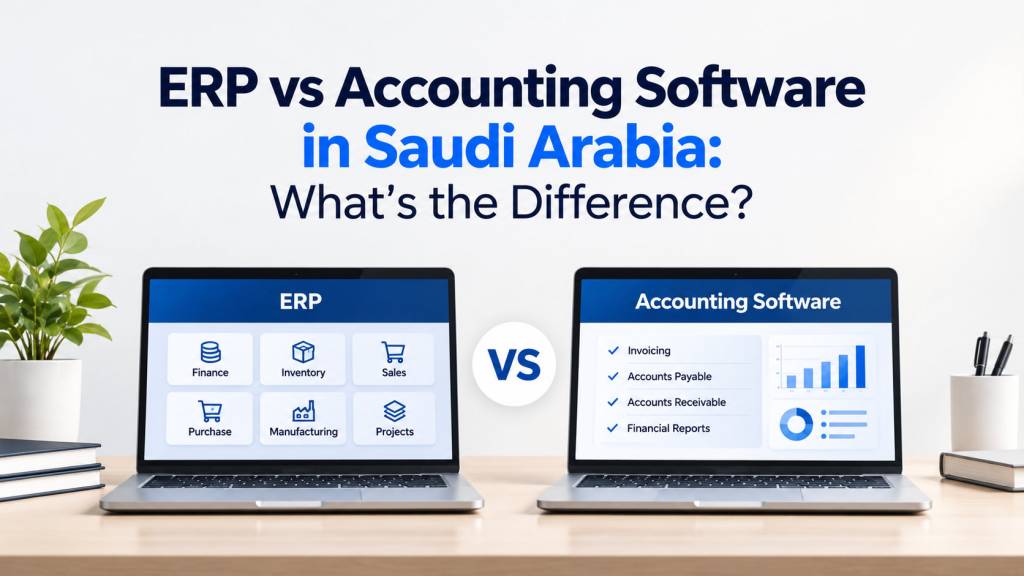
The real difference is simple. Accounting software records what happened to your money. ERP runs the operations that make the money move: buying, stocking, producing, selling, delivering and paying people, with the accounting updated automatically as a result.
I am Mohamed Abdul Baseeth, founder of Maas Consult Middle East Co. We have delivered 1,000+ ERP implementations and work with both sides of this decision every week, implementing TallyPrime as accounting-first software and ERPNext as a full ERP. This guide explains the difference in practical terms, what both must do under Saudi rules, where popular Saudi tools fit, and a short test to decide which one your business needs now.
Quick Answer
Accounting software manages your books: invoices, receipts and payments, VAT, ledgers and financial statements. ERP (enterprise resource planning) software manages the whole business on one database, with accounting as one module alongside inventory, purchasing, sales, manufacturing, projects, HR and payroll. In Saudi Arabia, both must issue ZATCA-compliant e-invoices, show invoices in Arabic and keep records the way the law requires, so compliance alone is not a reason to buy an ERP. Choose accounting software if your operations are simple and the finance team is the main user. Choose an ERP when several departments need to work from the same data, and spreadsheets are filling the gaps between systems.
Key Takeaways
- Accounting software answers “what happened to our money?” ERP answers “what is happening across the business right now?”
- Both are fully capable of ZATCA Phase 2 compliance. ERP is not required for e-invoicing.
- Accounting software with real inventory, such as TallyPrime, covers more ground than many owners expect.
- The signal to move is operational, not financial: staff re-entering data, stock you cannot trust, and reports built outside the system.
- Moving too late costs more than moving too early, but moving too early is also a real mistake.
The Difference in One Table
| Area | Accounting software | ERP |
|---|---|---|
| Main purpose | Record and report financial transactions | Run and connect all business operations |
| Main users | Accountants and the owner | Every department: sales, stores, purchasing, production, HR, finance |
| Invoicing and VAT | Yes | Yes |
| Bank, receivables and payables | Yes | Yes |
| Inventory | Basic to strong, depending on product | Full, multi-warehouse, with valuation and transfers |
| Purchasing | Purchase invoices, sometimes orders | Full cycle: requests, quotations, orders, receipts, approvals |
| Manufacturing | None or basic (BOM in some products) | BOMs, work orders, routings, production planning |
| Projects | Basic cost centres | Project costing, tasks, timesheets, billing |
| HR and payroll | Separate tool or add-on | Built-in or integrated |
| CRM | Usually none | Leads, opportunities, quotations |
| Reporting | Financial statements and VAT reports | Financial and operational reports from one database |
| Setup | Days to weeks | Weeks to months, with process design |
| Main cost drivers | Licence or subscription, setup | Licences or hosting, implementation, data migration, training |
What Both Must Do Under Saudi Rules
Whichever you choose, the software has to help you meet the same legal requirements. That is worth knowing, because “you need an ERP for ZATCA” is one of the most common sales lines in the market, and it is false.
- ZATCA e-invoicing. Every VAT-registered business must issue electronic invoices. Under Phase 2, B2B invoices are cleared by ZATCA before they reach the customer and B2C invoices are reported within 24 hours. ZATCA’s Wave 25 extends integration to taxpayers whose VAT-subject revenue exceeded SAR 187,500 in any of 2022 to 2025, with a deadline of 1 February 2027. Accounting software and ERPs can both do this.
- Arabic invoices and records. ZATCA’s VAT guideline on records and invoicing (version 3, May 2026) requires invoices in Arabic, with other languages allowed as a translation, and VAT records kept electronically within the Kingdom for at least six years, longer for capital assets and real estate.
- Commercial books. The Law of Commercial Books requires merchants to keep their books in Arabic and to keep them, with related correspondence and documents, for at least ten years. Electronic books are allowed for businesses that keep their accounts on computer.
So the decision is about how your business runs, not about compliance. Our ZATCA e-invoicing page covers the Phase 2 requirements in detail.
Accounting Software Comes in Three Flavours
“Accounting software” covers a wider range than most people think.
- Simple cloud accounting tools handle invoicing, expenses, bank feeds and VAT. They suit service businesses and very small traders.
- Accounting-first software with real inventory, such as TallyPrime, adds multi-godown stock, batches, orders and even bills of materials. It is ready-made and off the shelf, and entries post and show their effect immediately with no secondary posting step, which is one reason auditors like it.
- Cloud business suites add modules such as inventory, point of sale and HR to accounting, moving closer to ERP territory.
Our comparison of accounting software options for Riyadh businesses looks at each category in detail.
Where Daftra Fits
Daftra is a popular Saudi cloud platform, and it is a good example of why the line between accounting software and ERP has blurred. Daftra describes itself as an ERP, and alongside accounting it lists apps for inventory, point of sale, HR and payroll, CRM, manufacturing orders and project management, all in the cloud with built-in ZATCA e-invoicing.
For many small businesses, that is enough. The difference from a full ERP such as ERPNext usually shows up in depth rather than breadth: multi-stage manufacturing with routings and planning, multi-company consolidation, detailed project costing, complex approval workflows and the freedom to customise and self-host are where ERPNext goes further. Our Daftra vs ERPNext comparison sets the two side by side, feature by feature.
The 7-Question Test: Do You Need an ERP Yet?
Answer yes or no to each question.
- Do more than two departments need to work from the same live data? For example, sales checking stock, stores receiving purchases and finance invoicing from deliveries.
- Do you hold stock in more than one location? Warehouses, branches, vans or sites.
- Do you make, assemble or repackage products?
- Do you run projects or contracts that need their own costing and billing?
- Does anyone re-enter the same data into a second system or spreadsheet every week?
- Do you have, or plan, more than one legal entity or branch that needs combined reporting?
- Are management reports built by exporting data and combining it in Excel?
0 to 2 yes answers: accounting software is very likely enough. Choose one with good inventory if you hold stock. 3 to 4 yes answers: you are at the crossover. Accounting-first software with strong inventory may still work, but plan for ERP within one or two years. 5 to 7 yes answers: you are already paying the cost of not having an ERP, mostly in staff time and decisions made on old data.
If you already use TallyPrime and answered yes to several of these, our article on the signs you have outgrown TallyPrime goes through each warning sign in detail.
Moving Too Late vs Moving Too Early
Both are real mistakes, with different costs.
Moving too late looks like this: stock counts that never match, salespeople promising goods that are not there, finance spending the first week of every month reconciling spreadsheets, and owners making decisions on figures that are weeks old. The cost is spread across many people’s time, so it rarely appears on any report.
Moving too early looks different: a small team paying for an implementation it does not use, staff overwhelmed by screens and workflows built for a bigger company, and a system configured for processes the business does not yet have. The result is often a return to spreadsheets alongside an expensive ERP.
The right moment is usually when operational pain is visible every week, but before it is causing lost customers or failed audits.
The Middle Path: Accounting Software Plus Add-Ons
Many Saudi businesses connect accounting software to separate tools: a POS system, an inventory app, a payroll service, a CRM. This can work well for a while, especially when each tool is strong in its own area.
The risk is the gaps between them. Every integration is another place for data to break, every tool has its own users and permissions, and reports still have to be combined by hand. When you have three or more connected tools and someone spends hours each week keeping them in sync, an ERP is usually cheaper overall.
When Accounting Software Is Still the Right Choice
ERP is not automatically better, and we tell clients so. Stay with accounting software when:
- You are a service business with no stock and a small team.
- Your operations run from one location and the finance team is the main user.
- Your accountant and auditor already work efficiently in a product like TallyPrime.
- You want something ready-made that works within days, without a project.
- Your growth plans for the next two years do not add branches, manufacturing or projects.
For these businesses, good accounting software, set up properly and integrated with ZATCA, is the better and cheaper answer. Our TallyPrime sales and solutions team works with many of them.
When to Move to an ERP, and How
Once the test points to ERP, plan the move rather than rushing it:
- Map how the business actually runs, from enquiry to payment, including the shortcuts.
- Choose the ERP for fit, not for its feature list. Our ERP software buyer’s guide for Saudi Arabia compares the main platforms.
- Clean your data first, especially items, customers and opening stock.
- Migrate at a natural break, such as a quarter or year end. If you are moving from Tally, our Tally to ERPNext migration guide explains the process.
- Keep ZATCA compliance continuous, with e-invoicing tested in the new system before you switch.
Our ERPNext implementation guide for Saudi Arabia walks through each stage.
What Drives the Cost Difference
We do not publish fixed prices, because both categories vary widely. The main differences in cost come from:
- Licensing model: per-user subscriptions, perpetual licences or open source with no licence fee
- Implementation: a ready-made accounting product needs setup, while an ERP needs process design and configuration
- Data migration: the volume and quality of your existing data
- Training: a few finance users versus every department
- Integrations and customisation: connections to POS, e-commerce or banks, and any custom workflows
- Hosting and support: cloud, on-premise or managed hosting, and the level of ongoing help
Our guide to how much ERP costs in Saudi Arabia breaks these down.
A Hypothetical Example: Two Riyadh Businesses, Two Answers
Picture two Riyadh companies of similar revenue.
The first is an engineering consultancy with 25 staff, no stock and one office. Its work is billed by milestone and its main need is clean books, VAT and e-invoicing. Accounting software with cost centres for each client project does everything it needs. An ERP would add cost and complexity without much benefit.
The second is a building materials distributor with two warehouses, a showroom and eight salespeople. Stock is checked by phone, orders are taken on WhatsApp and the accountant rebuilds sales reports in Excel every month. It answers yes to five of the seven questions. For this business, an ERP is no longer a luxury: it is the cheapest way to stop losing time and sales.
These are illustrations built from common patterns, not named client cases.
From the Field
The most useful question we ask in these conversations is: “Who in your company spends time copying information from one place to another?” If the answer is nobody, accounting software is probably fine. If the answer is several people, every week, the business has already outgrown it, whatever its size.
Frequently Asked Questions
What is the difference between ERP and accounting software?
Accounting software records financial transactions and produces financial reports. ERP software runs the whole business on one database, including inventory, purchasing, sales, manufacturing, projects and HR, with accounting updated automatically from those operations.
Do I need an ERP to comply with ZATCA?
No. Accounting software and ERPs can both meet ZATCA Phase 2 e-invoicing requirements. Choose based on how your business operates, not on e-invoicing alone.
Is TallyPrime accounting software or an ERP?
TallyPrime is accounting-first software with strong inventory, order processing and basic manufacturing features. It is ready-made and suits businesses that want powerful accounting without a full ERP project.
Is Daftra an ERP?
Daftra describes itself as a cloud ERP, with apps for accounting, inventory, point of sale, HR and payroll, CRM, manufacturing orders and projects. It covers many small-business needs. Full ERPs such as ERPNext usually go deeper in multi-stage manufacturing, project costing, multi-company operations and customisation.
When should a Saudi business move from accounting software to ERP?
When several departments need the same live data, stock is held in several locations, the business manufactures or runs projects, or staff spend time every week re-entering data and building reports in spreadsheets.
Is ERP only for large companies?
No. Many small and mid-sized Saudi businesses use ERP, especially open-source options such as ERPNext with no per-user licence fees. The deciding factor is operational complexity, not company size.
Can I start with accounting software and move to ERP later?
Yes. This is the most common path. Keep your data clean and your processes documented, and the move later will be faster and cheaper.
Does ERP replace my accountant?
No. ERP removes manual data entry and reconciliation, which frees your accountant to focus on review, analysis and compliance.
Do both need to produce invoices in Arabic?
Yes. ZATCA requires tax invoices to be issued in Arabic, with other languages allowed as a translation, whichever software you use.
How long does it take to move from accounting software to an ERP?
It depends on the number of modules, users, locations and the quality of your existing data. Planning the move around a quarter or year end makes the switch smoother.
Final Thoughts
Accounting software and ERP are not competitors so much as stages. Most Saudi businesses start with accounting software, and many never need more. The ones that do usually know it from the same signs: data typed twice, stock nobody trusts and reports built outside the system. Use the seven questions above, be honest about the answers, and choose the tool that fits the business you run today and the one you plan to run in two years.
If the answers point to an ERP, our ERP software guide for Saudi Arabia is the natural next step.