



ERPNext Implementation Riyadh: Local Team, On-Site Support & Riyadh Client Results
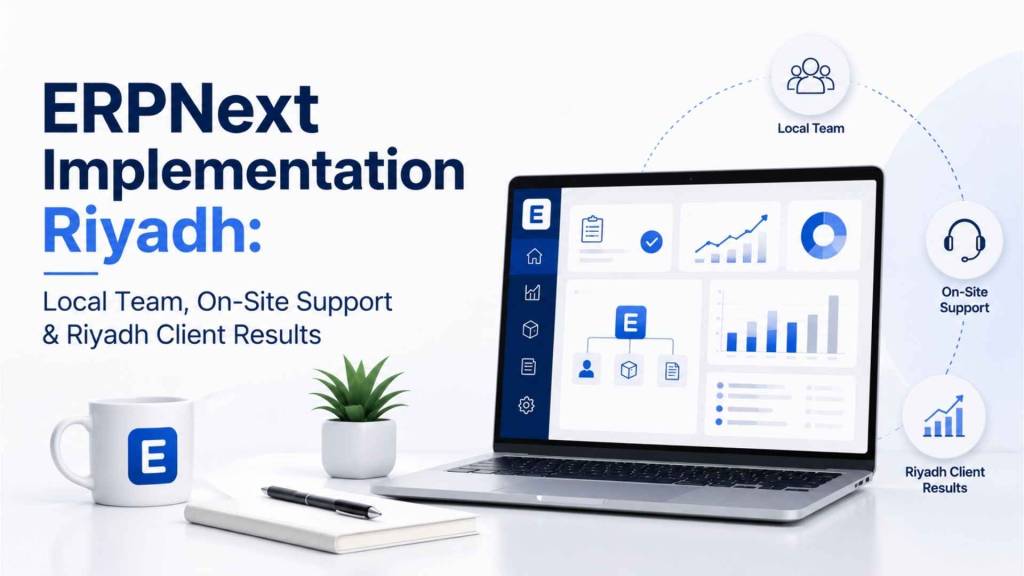
If you have already read up on what ERPNext implementation involves in general, our national ERPNext implementation guide for Saudi Arabia covers that ground in depth: what the process involves, typical timelines, and platform comparisons. This page answers a narrower, more practical question that guide does not: who is actually going to sit across the table from you in Riyadh, show up on-site for your go-live weekend, and be reachable the same afternoon if something breaks.
That question matters more than most businesses expect until they are three weeks into an implementation with a support team in a different city, or a different country, and a cutover issue nobody can look at in person. This page is about our Riyadh presence specifically: how we work with Riyadh businesses, what our local clients say, and how to book time with our Riyadh team.
Quick Answer: Why Does a Riyadh-Based ERPNext Team Matter?
A Riyadh-based ERPNext implementation team can be physically present during process mapping, go-live cutover, and staff training, which materially reduces the risk window during the two moments that matter most: the day you migrate live data, and the first week your team works in the new system without a safety net. Remote-only implementation partners can configure ERPNext competently, but when a warehouse scanner in the Second Industrial City is not talking to the system on a Sunday morning, the value of someone who can walk in the door within the hour is not theoretical.
Key Takeaways
- This page is about local delivery, coverage, and proof, not a repeat of general ERPNext implementation theory, which lives on our national implementation guide.
- We serve businesses across central Riyadh (Olaya, King Fahd Road, Sulaimaniyah), the industrial cities along Al-Kharj Road, and the wider Riyadh metropolitan area.
- Our Riyadh clients consistently point to on-site go-live support and response speed as the deciding factor over choosing a remote provider, not price.
- Local ZATCA Fatoora integration testing is done against your actual Riyadh business registration and wave status, not a generic template.
- You can book a Riyadh process mapping session directly through this page’s contact section below.
Our Riyadh Service Coverage
We work with businesses across the following Riyadh areas on a regular, on-site basis:
- Central business districts: Olaya, King Fahd Road, Sulaimaniyah, Al Malaz, and the surrounding head-office corridor, where most of our trading and professional services clients are based.
- Industrial zones: Riyadh’s First, Second, and Third Industrial Cities along Al-Kharj Road, managed under MODON, where manufacturing and distribution clients typically need on-site warehouse and shop-floor configuration.
- Wider Riyadh metropolitan area, including businesses with a Riyadh head office and branches or warehouses elsewhere in the Kingdom, coordinated centrally from our Riyadh team.
If your business sits within this footprint, process mapping sessions, go-live support, and training are delivered in person by default, not over a video call, unless you prefer otherwise.
What Riyadh Clients Say
Real feedback from Riyadh businesses we have implemented ERPNext for shapes how we run every project that follows it.
“What made the difference for us was that the team was actually in our King Fahd Road office during go-live week, not on a call from somewhere else. When our inventory count did not match on the first morning, someone was already sitting with our warehouse lead sorting it out.” — Abeed Basha Gunjalapati
“We had tried a remote implementation before with another provider and it stalled twice. Having a Riyadh-based team meant the process mapping actually happened properly, in person, before any configuration started.” — Mohammed Al-Khalidi
“ZATCA integration testing was done against our actual wave notification, not a generic checklist. That gave us real confidence before the deadline, not after.” — Fahad Al-Aqeel
“Training our finance team in person in our own office, on our own data, made the go-live week far less stressful than I expected.” — Sami Al-Harbi
Our broader Google reviews profile, currently rated 4.9 out of 5 across 235 reviews, reflects the same pattern across projects well beyond ERPNext alone.
How Our Riyadh Implementation Process Differs From a Remote Engagement
| Project Stage | Remote-Only Provider | Our Riyadh-Based Team |
|---|---|---|
| Process mapping | Video calls, self-reported workflows | In-person sessions on your Riyadh site |
| ZATCA integration testing | Generic sandbox checklist | Tested against your actual wave notification and registration |
| Staff training | Screen-share walkthroughs | On-site, hands-on training with your actual data |
| Go-live cutover | Support ticket queue | On-site or on-standby within the hour |
| Post-launch issues | Scheduled remote session | Same-day Riyadh visit where needed |
For the underlying methodology behind each of these stages, including data migration and configuration detail, our national ERPNext implementation guide walks through the full process. What differs here is delivery, not methodology.
ZATCA Compliance, Handled Locally
Riyadh is home to ZATCA itself and the largest concentration of VAT-registered businesses in the Kingdom, which means local wave notifications, sandbox access issues, and Fatoora platform questions come up constantly in our day-to-day work here. As of mid-2026, Wave 25 lowered the mandatory integration threshold to SAR 187,500 in annual VAT-able revenue, with an integration deadline of 1 February 2027, pulling a large share of Riyadh’s small trading and services businesses into scope for the first time. We test every ERPNext Fatoora integration against the client’s actual ZATCA wave notification rather than a generic template. For the technical detail behind this integration, see our ERPNext ZATCA integration guide and our ZATCA e-invoicing compliance page. You can confirm your own wave status on ZATCA’s official Fatoora e-invoicing portal.
Industry-Specific Local Delivery in Riyadh
- Trading and head-office businesses along King Fahd Road and Olaya: multi-branch inventory visibility, configured on-site with your actual warehouse and finance teams in the room.
- Manufacturers in the Second and Third Industrial Cities: shop-floor and bill-of-materials configuration done on-site, with attention to connectivity resilience in industrial zone locations.
- Professional services firms in central Riyadh: lighter, project-accounting-focused configuration, usually completed faster since inventory and manufacturing complexity is not involved.
- Etimad-registered contractors: financial reporting structured against procurement documentation standards from the first process mapping session, coordinated with clients who need it defensible under government audit.
For businesses evaluating whether ERPNext fits their specific setup at all before committing to a full implementation, our ERPNext consultant services and small business ERP guide are good starting points.
Case Study: A Second Industrial City Manufacturer
A manufacturing client in Riyadh’s Second Industrial City had previously attempted an ERPNext rollout with a remote provider, and the project stalled after data migration produced inventory counts nobody trusted. We restarted the engagement with an on-site process mapping session at their facility, which surfaced that the original configuration had never accounted for how their shop floor actually recorded partial batch completions. Reconfiguring this on-site, alongside the production supervisor rather than through a written requirements document, resolved the discrepancy within the first week, and go-live proceeded with an on-site team present for the full cutover weekend. The client’s own conclusion, echoed in several of the reviews above, was that the in-person process mapping step, not the software itself, had been missing the first time around.
Case Study: A King Fahd Road Trading Company
A trading company with a head office on King Fahd Road and a second warehouse elsewhere in Riyadh had been reconciling stock manually between locations, with ZATCA invoices generated through a separate process each month. On-site process mapping identified that most reconciliation time was actually spent chasing stock discrepancies between the two sites rather than genuine accounting work. After implementation, with centralized inventory and integrated Fatoora invoicing, month-end reconciliation dropped from roughly a week to under two days.
Expert Insight
“We get asked fairly often whether it actually matters that we are based in Riyadh rather than running everything remotely, and the honest answer is that it matters most in exactly two moments: process mapping and go-live,” says Mohamed Abdul Baseeth, Founder of Maas Consult Middle East Co, who has led ERP implementations for over 2,000 businesses and supported more than 800 through ZATCA e-invoicing compliance across Saudi Arabia. “Everything in between can be done well remotely. Those two moments are where being in the room changes the outcome.”
Frequently Asked Questions
Do you have a physical presence in Riyadh, or is this a remote service?
We deliver process mapping, training, and go-live support on-site in Riyadh as standard for businesses within the city and surrounding metropolitan area, rather than defaulting to remote delivery.
Which parts of Riyadh do you cover for on-site visits?
Central business districts including Olaya, King Fahd Road, Sulaimaniyah, and Al Malaz, along with the First, Second, and Third Industrial Cities along Al-Kharj Road, and the wider Riyadh metropolitan area.
How is this different from your national ERPNext implementation guide?
Our national guide covers the general methodology, timelines, and platform comparison that apply anywhere in Saudi Arabia. This page covers what our Riyadh-based delivery specifically looks like, including local coverage, client results, and how to book time with the Riyadh team.
Can you support a business with a Riyadh head office and branches in other Saudi cities?
Yes. Process mapping and coordination are led from Riyadh, with ERPNext’s native multi-branch and multi-warehouse structure used to give centralized visibility across Riyadh, Jeddah, Dammam, or wherever your branches are located.
What happens if an issue comes up after go-live?
For Riyadh-based clients, we prioritize same-day, on-site response for post-launch issues during the stabilization period, rather than routing you into a general remote support queue.
Do you test ZATCA integration against our actual wave notification?
Yes. We test Fatoora integration against your specific ZATCA wave status and business registration rather than a generic sandbox checklist, since wave thresholds and deadlines differ by business.
How quickly can a Riyadh process mapping session be scheduled?
This depends on current project load, but Riyadh sessions are typically scheduled faster than out-of-city engagements simply because our team is already local. Reach out directly to check current availability.
Is on-site delivery more expensive than a remote implementation?
Not necessarily. Cost depends primarily on the number of users, modules, and integration complexity, the same factors that drive any implementation, rather than on-site presence itself. Ask for a specific quote based on your requirements.
Do you work with manufacturers in the Riyadh industrial cities specifically?
Yes, including businesses in the Second and Third Industrial Cities along Al-Kharj Road, where shop-floor and bill-of-materials configuration is typically done on-site given the operational detail involved.
How do I get started with a Riyadh ERPNext implementation?
Reach out through the contact section below to schedule a process mapping session at your Riyadh location. We will walk your actual workflows before recommending any configuration or quoting a project scope.
Talk to Our Riyadh ERPNext Team Directly
If you are evaluating ERPNext for a Riyadh business, or a previous implementation with a remote provider has stalled, get in touch to schedule an on-site process mapping session. Explore our work as an ERPNext partner in Saudi Arabia, or reach out directly through maasconsult.co/contact-us/ or WhatsApp at +966 53 213 6446 to book time with the Riyadh team.

4 Comments