



Quick Answer
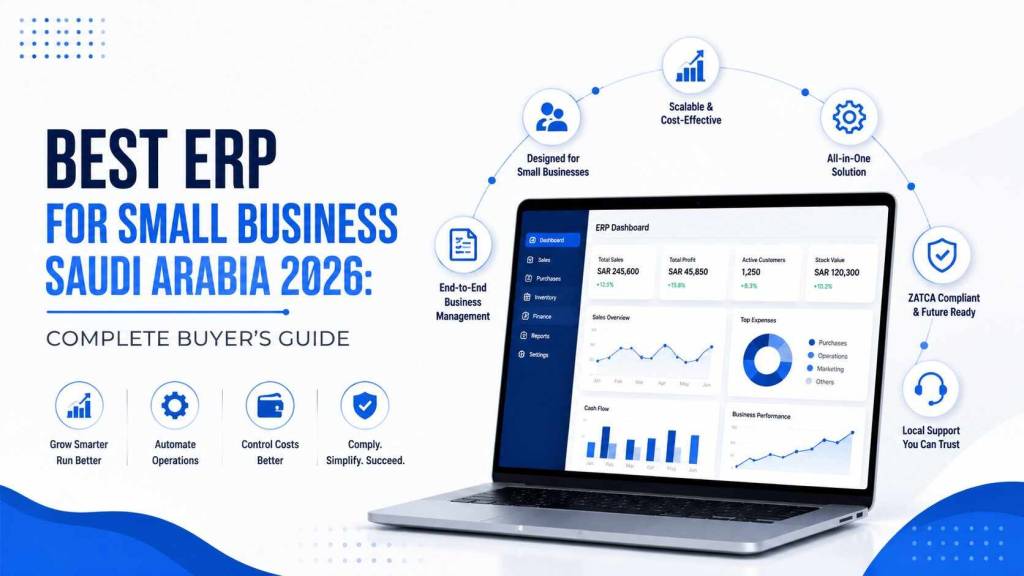
If you are choosing an Enterprise Resource Planning system in Saudi Arabia for the year 2026 ERPNext is hard to ignore. ERPNext gives businesses most of the features that small businesses actually need without the high costs that usually come with larger Enterprise Resource Planning systems. The built-in support for ZATCA e-invoicing through integrations is another big advantage of ERPNext especially if compliance is a priority for your business.
Odoo is still an option if you expect to rely on a wide range of third-party apps or plan to customize your workflows quite a bit. For companies that are running factories, managing branches or dealing with more complicated day-to-day operations, SAP Business One or Microsoft Dynamics 365 Business Central can be worth the extra investment in an Enterprise Resource Planning system.
In the end do not just pick the name in Enterprise Resource Planning systems. Think about how your team works today, where your business is heading over the few years and how quickly you need to meet the ZATCA Phase 2 requirements, for your business.
Key Takeaways
- ZATCA’s Wave 24 deadline (June 30, 2026) lowered the mandatory Phase 2 e-invoicing threshold to SAR 375,000 in annual taxable revenue, which means nearly every VAT-registered small business in Saudi Arabia is now inside the compliance net.
- Open source ERP platforms like ERPNext and Odoo typically cost far less to run over three years than SAP Business One or Dynamics 365, mainly because there are no per-user licensing fees.
- A basic accounting tool is not the same as an ERP. If you are managing inventory, multiple branches, or VAT-registered invoicing, you need integrated financial, inventory, and compliance modules working from one database.
- Implementation timelines for SMEs typically run six to twelve weeks, not the six to twelve months often quoted for large enterprise rollouts.
- The most common reason ERP projects fail for small businesses is not the software, it is inadequate data migration planning and insufficient staff training before go-live.
Introduction
I have sat across the table from more Saudi business owners than I can count who tell me the same thing: “We just need something that works with ZATCA and doesn’t cost a fortune.” That single sentence captures almost every SME ERP conversation happening in Riyadh, Jeddah, and Dammam right now.
Since ZATCA’s Wave 24 pushed the Phase 2 e-invoicing threshold down to SAR 375,000 in annual taxable revenue, with the compliance deadline landing on June 30, 2026, a huge segment of Saudi small businesses that previously felt “too small” for ERP suddenly found themselves squarely inside the regulatory net. If your business crossed that revenue line in 2022, 2023, or 2024, your invoicing system needs to talk directly to the Fatoora platform, generate cryptographically stamped XML invoices, and store them correctly. A spreadsheet or a disconnected accounting tool cannot do that.
This guide walks through what actually matters when choosing ERP software for a small business in Saudi Arabia in 2026: real cost considerations, genuine vendor comparisons, ZATCA compliance mechanics, and a practical implementation roadmap, based on lessons from implementing ERP systems for more than 2,000 businesses and supporting over 800 companies through ZATCA e-invoicing compliance.
What Is ERP Software?
Enterprise Resource Planning (ERP) software is a single integrated system that manages a company’s core operations, including accounting, inventory, purchasing, sales, HR, and compliance, from one shared database. Instead of running separate tools for invoicing, stock tracking, and payroll that never talk to each other, an ERP keeps every department working from the same real-time information.
For a Saudi small business, this typically means one platform handling VAT-compliant invoicing, ZATCA e-invoicing integration, inventory across branches, supplier payments, and financial reporting, all connected.
Why Small Businesses in Saudi Arabia Need ERP in 2026
A few years ago, ERP was mostly a conversation for larger companies. Three things changed that.
First, ZATCA compliance stopped being optional for SMEs. Wave 24 dropped the Phase 2 threshold to SAR 375,000, the lowest it has ever been, meaning thousands of small traders, retailers, and service companies are now legally required to integrate with Fatoora. Non-compliance carries real financial risk, with fines ranging from SAR 5,000 to SAR 50,000 for failing to meet integration requirements, and additional penalties per invoice for missing QR codes or incorrect formatting.
Second, Vision 2030 has accelerated digital expectations across every sector. Government tenders, bank financing applications, and even supplier onboarding increasingly expect a business to show digitized, auditable financial records.
Third, growing businesses simply outgrow spreadsheets and basic accounting software faster than owners expect. I have watched trading companies go from one warehouse to three within eighteen months, and the moment that happens, disconnected systems start producing stock discrepancies, duplicate entries, and invoicing delays that directly cost money.
ZATCA E-Invoicing and Your ERP Choice
Quick Answer: Phase 2 of ZATCA e-invoicing (the Integration Phase) requires VAT-registered businesses to connect their invoicing system directly to ZATCA’s Fatoora platform, generating invoices in UBL 2.1 XML or PDF/A-3 format, each carrying a cryptographic stamp, a UUID, and a QR code, cleared or reported to ZATCA depending on invoice type.
Here is what that means practically when evaluating ERP options:
- Clearance invoices (standard B2B and B2G tax invoices) must be submitted to ZATCA and approved before being sent to the buyer.
- Reporting invoices (simplified B2C invoices) are issued to the customer first, then reported to ZATCA within 24 hours.
- All e-invoices and related credit or debit notes must be stored and retrievable for at least five years.
- Your ERP or invoicing software needs API connectivity to Fatoora, not just the ability to print a QR code on a PDF.
Any ERP marketed toward the Saudi market in 2026 should be evaluated first on whether it has a proven, certified path to Fatoora integration, and only second on features like reporting dashboards or mobile apps. I have seen businesses buy attractive software, only to discover during onboarding that ZATCA integration required an expensive third-party add-on nobody mentioned at the sales stage.
How to Choose the Right ERP for Your Small Business: Step-by-Step
Step 1: Map your actual processes, not your wish list. Write down how invoices, purchase orders, inventory movements, and payroll actually flow through your business today. Most SMEs overestimate how “complex” their operations are and underestimate how much time manual reconciliation costs them.
Step 2: Confirm ZATCA Phase 2 readiness first. Ask any vendor directly: is this certified and integrated with Fatoora today, not “in progress,” not “planned for next release.”
Step 3: Separate must-have modules from nice-to-have modules. Accounting, inventory, and sales are almost always must-haves. Advanced manufacturing or multi-currency treasury tools are only needed if your business genuinely requires them.
Step 4: Compare total cost of ownership over three years, not just the sticker price. Factor in licensing, hosting, customization, training, and ongoing support, not just the initial setup quote.
Step 5: Ask about data migration methodology. This is the single biggest predictor of whether an ERP project finishes on time. Ask how the vendor handles historical invoice data, opening stock balances, and customer records.
Step 6: Pilot with real data before full rollout. A short pilot using your actual invoices, actual stock counts, and actual staff catches problems no sales demo ever will.
Step 7: Plan training as a project phase, not an afterthought. The businesses that get the fastest ROI treat staff training as seriously as the software configuration itself.
Comparing the Best ERP Options for Saudi SMEs in 2026
| ERP System | Best For | ZATCA Integration | Relative Cost Model | Key Strength | Key Limitation |
| ERPNext | Retail, trading, services, growing SMEs | Available via certified integrations | Open source, no per-user licence fees, cost tied to hosting and implementation | Highly flexible, strong inventory and accounting fit, lower total cost of ownership | Requires an experienced implementation partner to configure correctly |
| Odoo | Businesses wanting a large third-party app ecosystem | Available via local ZATCA-certified apps | Open core, paid apps can add up depending on modules selected | Broad app marketplace, modern interface | Costs can climb quickly once multiple paid modules are added |
| SAP Business One | Larger SMEs with complex multi-branch or manufacturing needs | Mature, well established in KSA market | Licensed, higher upfront and per-user cost | Strong brand recognition, deep manufacturing and distribution features | Often more system than a genuinely small business needs |
| Microsoft Dynamics 365 Business Central | SMEs already invested in the Microsoft ecosystem | Available through certified add-ons | Subscription per user | Familiar interface for Office 365 users, solid financial reporting | Can be costly at scale, heavier setup for simple use cases |
| Zoho | Micro businesses and freelancers wanting simple invoicing plus light ERP | Available via regional partners | Subscription per app or bundle | Fast to set up, low learning curve | Limited depth for inventory-heavy or multi-branch operations |
| TallyPrime | Very small businesses focused mainly on accounting | Available via ZATCA-compliant add-ons | Licensed, lower entry cost | Familiar to many South Asian and Saudi trading businesses, easy accounting workflows | Not a true ERP, limited scalability once inventory and operations grow |
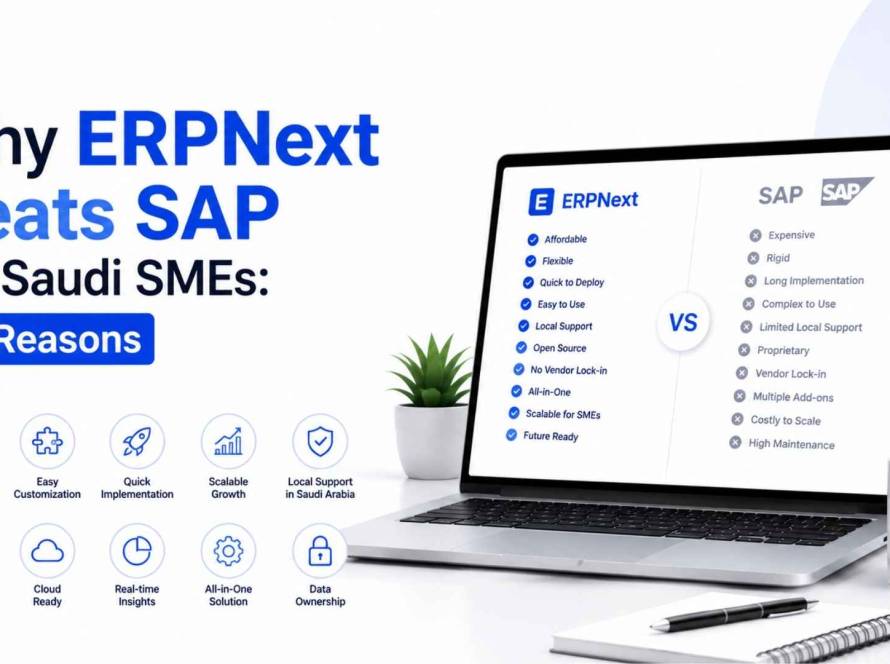
Expert Insight: In practice, I generally point growing trading and retail SMEs toward ERPNext first, because the combination of open source flexibility and lower recurring cost fits the budget reality of most Saudi small businesses. Where a business already runs on TallyPrime and is happy with basic accounting, staying on TallyPrime with a proper ZATCA-compliant add-on can be the right short-term call, but the moment that business adds a second location or needs real inventory control across branches, migrating to ERPNext tends to pay for itself within a year.
Cost Considerations for SME ERP in Saudi Arabia
There is no honest single number for “how much does ERP cost,” and any article giving you a fixed package price without knowing your business is guessing. What genuinely drives ERP cost for a Saudi SME includes:
- Number of users and departments needing access
- Number of branches or warehouses requiring separate inventory tracking
- Whether you need custom reports, Arabic-English bilingual invoicing, or industry-specific workflows
- Data migration complexity, particularly how many years of historical records need to move
- Hosting choice, cloud versus on-premise
- Ongoing support level required after go-live
Open source platforms like ERPNext generally carry lower total cost of ownership because there are no per-user software licence fees, the cost sits mainly in implementation, hosting, and support. Licensed platforms like SAP Business One and Dynamics 365 typically carry higher recurring per-user costs that scale as the team grows. The right way to budget is a cost-factor conversation with a genuine implementation partner, not a fixed price list, since every business’s data volume, branch count, and customization needs are different.
ROI: What a Small Business Actually Gains
In real implementations, the return on ERP investment for a Saudi SME usually shows up in three places within the first year:
- Time recovered from manual reconciliation. Businesses running separate accounting and inventory tools routinely lose hours each week matching stock counts to sales records by hand.
- Avoided ZATCA penalties. A single missed integration deadline or malformed invoice can trigger fines that dwarf a year of ERP hosting costs.
- Better cash flow visibility. Real-time reporting across branches lets owners catch slow-paying customers and overstocked inventory faster than a monthly spreadsheet review ever could.
Case Study Example: Trading Company Migration from Spreadsheets to ERPNext
A Riyadh-based trading company with three branches came to us running invoicing on spreadsheets and a basic accounting tool that had no path to Fatoora integration. Their Wave 24 notification letter arrived with roughly four months until their compliance deadline. We mapped their existing chart of accounts and inventory data, migrated two years of invoice history into ERPNext, connected certified ZATCA e-invoicing integration, and trained their finance and warehouse staff over a six-week implementation. The business went live with full Phase 2 compliance before their deadline, and within the first quarter, branch managers reported catching stock discrepancies within days instead of finding them at month-end.
Common Mistakes Saudi SMEs Make When Choosing ERP
- Choosing based on brand recognition alone, without checking whether the platform actually fits the business size and complexity.
- Ignoring ZATCA integration until late in the buying process, then discovering it requires a costly add-on.
- Underestimating data migration time, which pushes go-live dates and frustrates staff.
- Skipping a pilot phase and rolling out to the entire company at once, which multiplies the impact of any configuration mistake.
- Treating training as a one-day event rather than an ongoing process through the first few months of use.
- Waiting until the ZATCA notification deadline is weeks away before starting the ERP selection process at all.
Best Practices for a Successful ERP Rollout
- Start the ZATCA compliance conversation the same day you start the ERP conversation, they are not separate projects.
- Assign one internal project owner who is accountable for the rollout, not a shared responsibility across several people.
- Migrate a full quarter of historical data before go-live so opening balances are accurate from day one.
- Run the new system in parallel with your old process for at least one billing cycle before fully switching over.
- Document your standard operating procedures inside the ERP itself, not in a separate manual nobody opens.
Industry-Specific Recommendations
Retail businesses: Prioritize ERP with strong point-of-sale integration and real-time inventory sync across locations, since stockouts and overstock directly hit margins.
Trading and distribution companies: Prioritize multi-warehouse inventory control and supplier payment tracking, since cash tied up in stock is usually the biggest working capital issue.
Contracting and construction firms: Prioritize project-based accounting and cost tracking against budgets, since margin visibility per project matters more than company-wide totals.
Professional services firms: Prioritize time tracking, invoicing automation, and simpler inventory needs, since the core requirement is billing accuracy and ZATCA compliance rather than stock control.
Final Thoughts
The ERP conversation for Saudi small businesses in 2026 is really two conversations happening at once: a compliance deadline that is no longer avoidable for most VAT-registered SMEs, and a genuine operational upgrade that most growing businesses need regardless of ZATCA. The good news is that both problems are solved by the same decision. Choose an ERP platform that is properly ZATCA-integrated, sized correctly for your business, and implemented by a partner who plans for data migration and staff training as carefully as the software configuration itself, and the compliance deadline becomes a reason to finally fix the operational gaps that have been costing you money quietly for years.
Get Expert Guidance
If your business crossed the SAR 375,000 threshold and you are unsure which wave you fall into, or you simply want a straight answer on whether ERPNext, Odoo, or another platform genuinely fits your operations, our team at MAAS Consult can walk through your specific numbers and processes. Get in touch with MAAS Consult to request a ZATCA compliance assessment or a discovery call, no fixed package pitch, just an honest read on what your business actually needs.
FAQs
What is the best ERP for small businesses in Saudi Arabia? For most Saudi SMEs, ERPNext offers the strongest balance of cost, flexibility, and ZATCA compliance readiness. Businesses with more complex manufacturing needs or larger budgets may find SAP Business One or Microsoft Dynamics 365 Business Central a better fit.
Is ERPNext ZATCA compliant? ERPNext can be configured for full ZATCA Phase 2 compliance through certified e-invoicing integrations that connect it directly to the Fatoora platform, generating XML invoices with the required cryptographic stamps, UUIDs, and QR codes.
How much does an ERP system cost in Saudi Arabia? Cost depends on user count, number of branches, data migration complexity, and hosting choice. Open source platforms like ERPNext generally carry lower total cost of ownership since there are no per-user licence fees, while licensed platforms like SAP Business One or Dynamics 365 typically involve higher recurring per-user costs.
What is the difference between ERP and accounting software? Accounting software manages financial records in isolation. ERP integrates accounting with inventory, sales, purchasing, and often HR into one connected system, giving a real-time view across the whole business rather than just the books.
Do small businesses in Saudi Arabia need ERP software? Any VAT-registered business now falling under ZATCA’s Wave 24 threshold of SAR 375,000 in annual taxable revenue needs an invoicing system capable of Fatoora integration. Beyond compliance, businesses managing inventory across more than one location generally benefit significantly from full ERP over standalone accounting tools.
Which ERP is cheaper, Odoo or SAP Business One? Odoo generally has a lower entry cost than SAP Business One, since it is open core rather than fully licensed per user. However, Odoo costs can increase as more paid modules are added, so total cost should be compared over a three-year period rather than initial price alone.
How long does ERP implementation take for a small business? Most SME ERP implementations run six to twelve weeks, depending on data migration volume and the number of modules being configured, considerably shorter than typical enterprise-scale rollouts.
What happens if my business misses its ZATCA wave deadline? Non-compliance can result in fines ranging from SAR 5,000 to SAR 50,000, with additional penalties of up to SAR 10,000 per invoice for missing QR code requirements, along with possible escalation for repeated violations.

1 Comment