Why ERPNext Beats SAP for Saudi SMEs: 10 Reasons (2026)
When a Saudi SME asks us to compare ERPNext against SAP, they are almost always asking about SAP Business One, SAP’s product built specifically for small and mid-sized companies, not the enterprise-scale S/4HANA suite that global conglomerates run. That distinction matters, because comparing ERPNext against the wrong SAP product produces a comparison that is technically true but practically useless. This article compares ERPNext against SAP Business One directly, on the criteria that actually decide which system a growing Saudi business should run.
To be upfront about where we stand: Mohamed Abdul Baseeth and the team at Maas Consult have implemented ERPNext for businesses across Saudi Arabia for years, and we are open source ERP advocates by conviction, not just by business model. That said, the reasons below are structural facts about how each platform is licensed, priced, and delivered, not opinions, and we have included a section on when SAP genuinely remains the better choice, because it sometimes is.
Quick Answer: Why Do Most Saudi SMEs Choose ERPNext Over SAP?
Saudi SMEs generally choose ERPNext over SAP Business One because ERPNext’s open source licensing removes the escalating named-user fees that make SAP Business One more expensive as headcount grows, implementation typically takes weeks rather than months, and the platform can be customized directly rather than through a formal, often costly change request process with an SAP-authorized reseller. SAP Business One remains a legitimate choice for Saudi subsidiaries of multinational groups already standardized on SAP globally, or businesses needing specific SAP-only industry modules.
Key Takeaways
- SAP Business One uses named-user licensing with distinct Professional and Limited user tiers, so cost rises directly with headcount in a way that ERPNext’s open source model does not.
- SAP Business One is sold through Value Added Resellers, which adds a partner margin layer on top of SAP’s own list pricing, a structural cost factor worth understanding before signing.
- Typical SAP Business One go-live timelines run two to four months for a standard SME deployment; ERPNext implementations for comparable Saudi SMEs commonly complete in six to ten weeks.
- ERPNext’s open source model means full access to the underlying source code, which matters directly for customization speed and long-term vendor independence.
- SAP still makes sense for Saudi subsidiaries of SAP-standardized multinational groups, or businesses needing deep SAP-specific industry verticals; this article is not a claim that ERPNext fits every business.
What SAP Business One Actually Is
SAP Business One is SAP’s ERP product built for small and mid-sized businesses, covering financials, sales, purchasing, inventory, and production in one system. It is licensed on a named-user model, Professional users get full module access, while Limited users (CRM, Logistics, or Financials-focused) get restricted access at a lower cost, and businesses choose between a perpetual license with annual maintenance fees or a cloud subscription. It is sold exclusively through SAP’s network of Value Added Resellers, which means pricing includes both SAP’s list price and the reseller’s own margin. You can review SAP’s own product positioning directly on the official SAP Business One page.
What ERPNext Is
ERPNext is a full open source ERP platform covering finance, inventory, manufacturing, procurement, HR, and CRM, with the complete source code openly available and no per-user proprietary licensing fee. For the platform’s own technical documentation, see ERPNext’s official documentation.
10 Reasons ERPNext Outperforms SAP Business One for Saudi SMEs
1. Open Source Licensing Removes the Per-User Cost Ceiling
SAP Business One’s named-user model means every additional employee who needs system access adds directly to your licensing bill, with Professional users costing meaningfully more than Limited users. ERPNext’s open source model does not carry this same escalating per-user licensing structure, which matters specifically for Saudi SMEs planning to grow headcount over the next few years rather than staying flat.
2. No Reseller Margin Layer on Top of List Price
Because SAP Business One is sold exclusively through Value Added Resellers, the price a business actually pays includes SAP’s own list price plus the reseller’s margin, effectively two negotiation layers rather than one. ERPNext’s open source distribution model does not carry this structural markup.
3. Faster Implementation Timelines
Standard SAP Business One deployments for SMEs commonly run two to four months from kickoff to go-live. Well-scoped ERPNext implementations for comparable Saudi SMEs typically complete in six to ten weeks, which matters directly for businesses that need to be operational, and ZATCA compliant, on a tighter timeline. Our ERPNext implementation guide for Saudi Arabia covers this process in detail.
4. Full Source Code Access and No Vendor Lock-In
ERPNext gives you the actual source code, not just configuration access within a vendor-controlled environment. This matters for long-term independence: if you ever need to change implementation partners, your data and customizations remain fully yours, rather than tied to a specific SAP reseller relationship.
5. Direct Customization Without a Formal Change Request Cycle
SAP Business One customization typically goes through your authorized reseller under a formal change request process, which adds both time and cost to even moderate configuration changes. ERPNext’s open architecture allows direct customization, which our ERPNext customization services handle without that layered approval process.
6. Built for SME Complexity, Not Retrofitted From Enterprise Architecture
SAP Business One was built specifically for SMEs, which is a genuine strength over full S/4HANA, but it still carries architectural assumptions inherited from SAP’s broader enterprise product family. ERPNext’s module structure is generally more approachable for a business scaling from a handful of users to a few hundred, without the enterprise-oriented complexity baked into SAP’s platform family.
7. Right-Sized ZATCA E-Invoicing Integration
Both platforms can meet ZATCA Phase 2 requirements, but ERPNext’s open architecture makes it straightforward to keep e-invoicing integration current as ZATCA’s wave thresholds and technical specifications continue to change, without waiting on a reseller’s update cycle. Our ERPNext ZATCA integration guide and ZATCA e-invoicing compliance page cover this in depth.
8. A Growing Regional and Global Community
ERPNext benefits from an active global open source community contributing improvements, localization, and troubleshooting knowledge continuously, rather than relying solely on a single vendor’s release cycle and regional partner network.
9. Lower Total Cost of Ownership Over a Multi-Year Horizon
SAP Business One’s three-year total cost of ownership for a mid-sized team commonly runs into the hundreds of thousands of riyals once licensing, implementation, and ongoing support are combined, with license costs alone typically representing only 30 to 40 percent of that total. ERPNext’s open source licensing removes the largest recurring cost driver in that equation, which is why the multi-year gap between the two platforms tends to widen rather than narrow as a business grows.
10. Local Riyadh-Based Implementation and Support
Beyond the platform itself, Saudi SMEs choosing ERPNext gain access to a local implementation and support ecosystem that can be on-site in Riyadh for process mapping, go-live, and ongoing support, rather than routed through a multinational reseller’s regional support queue. See our ERPNext implementation guide for Riyadh for how this works in practice.
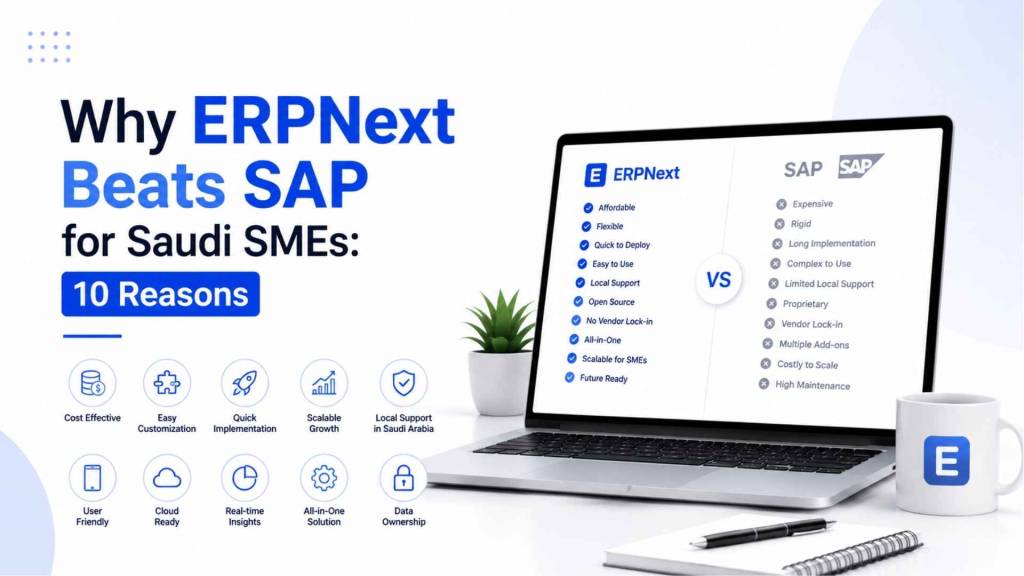
ERPNext vs SAP Business One: Side-by-Side Comparison
| Factor | ERPNext | SAP Business One |
| Licensing model | Open source, no per-user proprietary fee | Named-user licensing (Professional and Limited tiers) |
| Sold through | Direct or local implementation partners | Exclusively through authorized resellers (VARs) |
| Typical SME go-live | 6 to 10 weeks | 2 to 4 months |
| Customization | Direct access to source code | Formal change request through reseller |
| Source code access | Full | Not applicable, proprietary |
| Cost scaling with headcount | Minimal licensing impact | Direct, per named user |
| Best fit | Growing Saudi SMEs, mid-market businesses | Multinational subsidiaries standardized on SAP |
When SAP Business One Still Makes Sense
Fairness matters here, since not every business fits the ERPNext side of this comparison. SAP Business One remains the better choice when a Saudi business is a subsidiary of a multinational group that has already standardized on SAP globally, since consolidated reporting across group entities is simpler when every subsidiary runs the same platform family. It can also be the right choice for businesses in industries where SAP has built deep, SAP-specific vertical modules that would otherwise require significant custom development on any other platform. If your business fits either of these situations, SAP Business One deserves genuine consideration rather than being dismissed on cost grounds alone.
Common Mistakes When Evaluating ERPNext vs SAP
- Comparing ERPNext against full S/4HANA rather than SAP Business One, which produces a comparison that does not reflect what an SME would actually be quoted.
- Evaluating only the first-year licensing quote rather than the multi-year total cost of ownership, where the gap between the two platforms tends to widen.
- Underestimating how much a formal reseller change-request process slows down even minor customizations after go-live.
- Choosing a platform based on brand recognition alone rather than mapping actual business processes first, a mistake that applies equally whichever platform is chosen.
A Decision Checklist for Saudi SMEs Comparing the Two
- Are you part of a multinational group already standardized on SAP, or an independent Saudi business?
- Do you need deep, industry-specific modules only SAP has built, or would standard ERPNext modules and configuration cover your needs?
- How quickly do you need to be operational and ZATCA compliant?
- How much headcount growth do you expect over the next three to five years?
- Do you want direct access to customize your system, or are you comfortable routing changes through a reseller’s formal process?
For a broader look at ERP options beyond this specific comparison, our ERP software overview for Saudi Arabia and best ERP for small business in Saudi Arabia guides can help.
Illustrative Case Study: A Riyadh SME Reassessing an SAP Quote
A growing distribution business in Riyadh had received a SAP Business One quote as part of an ERP evaluation and came to us for a second opinion before committing. Mapping their actual processes showed a business with straightforward multi-branch inventory and accounting needs, without any of the deep vertical requirements that would have justified SAP’s additional cost and reseller-managed customization process. Moving forward with ERPNext instead, the business reached go-live in under ten weeks, at a fraction of the multi-year cost the SAP quote implied once licensing, implementation, and ongoing reseller-managed changes were accounted for.
Expert Insight
“We are not neutral on open source ERP, we believe in it, but the reason we recommend ERPNext over SAP Business One to most Saudi SMEs isn’t loyalty to the platform, it’s that the licensing math genuinely works differently as a business scales,” says Mohamed Abdul Baseeth, Founder of Maas Consult Middle East Co, who has guided ERP implementations for over 2,000 businesses across Saudi Arabia. “The businesses where SAP is still the right call are usually the ones already living inside a global SAP environment. Outside of that specific situation, the case for ERPNext gets stronger, not weaker, the longer you run the numbers out.”
Frequently Asked Questions
Is ERPNext really cheaper than SAP Business One?
Generally, yes, over a multi-year horizon. SAP Business One’s named-user licensing and reseller markup mean cost rises directly with headcount, while ERPNext’s open source model removes that primary cost driver. Request a specific comparison based on your actual user count and requirements rather than relying on generic figures.
Is ERPNext as powerful as SAP for a growing Saudi business?
For the large majority of Saudi SME needs, finance, inventory, sales, procurement, manufacturing, and HR, ERPNext covers the same functional ground as SAP Business One. SAP’s advantage narrows to specific deep industry verticals or multinational group consolidation scenarios.
Does ERPNext support ZATCA e-invoicing as well as SAP?
Yes. Both platforms can meet ZATCA Phase 2 technical requirements when properly configured and integrated with the Fatoora platform.
How long does it take to implement ERPNext compared to SAP Business One?
ERPNext implementations for Saudi SMEs commonly take six to ten weeks, compared to a typical two to four month timeline for standard SAP Business One deployments.
Why is SAP Business One more expensive than ERPNext long-term?
SAP Business One’s named-user licensing model means cost scales directly with headcount, and the exclusive reseller distribution model adds a partner margin on top of SAP’s own list price. ERPNext’s open source model does not carry either of these structural cost drivers.
Is SAP ever the better choice for a Saudi business?
Yes. SAP Business One is the stronger fit for Saudi subsidiaries of multinational groups already standardized on SAP globally, or businesses needing deep, SAP-specific industry vertical modules.
Can ERPNext be customized as easily as SAP Business One?
More easily, in most cases. ERPNext’s open source architecture allows direct customization, while SAP Business One customization typically goes through a formal change request process with an authorized reseller.
What is the difference between SAP Business One and SAP S/4HANA?
SAP Business One is built for small and mid-sized businesses. S/4HANA is SAP’s enterprise-scale suite for large, often multinational organizations. Most Saudi SME comparisons with “SAP” are really comparisons with Business One, not S/4HANA.
Does choosing ERPNext mean I lose access to a support team?
No. Local implementation partners in Saudi Arabia provide the same kind of dedicated support relationship as an SAP reseller would, with the added benefit of direct source code access rather than a vendor-controlled change process.
How do I know if ERPNext or SAP is right for my business?
Start by mapping your actual processes and requirements rather than comparing brand names. If you are an independent Saudi SME without a global SAP mandate or a need for SAP-specific vertical modules, ERPNext is very likely the better fit on cost, timeline, and flexibility grounds.
Get an Honest ERPNext vs SAP Assessment for Your Business
If you are weighing ERPNext against a SAP Business One quote, our team can map your actual requirements and give you a straight comparison, not a sales pitch for one platform over the other regardless of fit. Explore our ERPNext consultant services in Saudi Arabia, review our work as an ERPNext partner, or reach out to request a side-by-side assessment for your business.