



Accounting Software Company in Riyadh: Compare Your Options
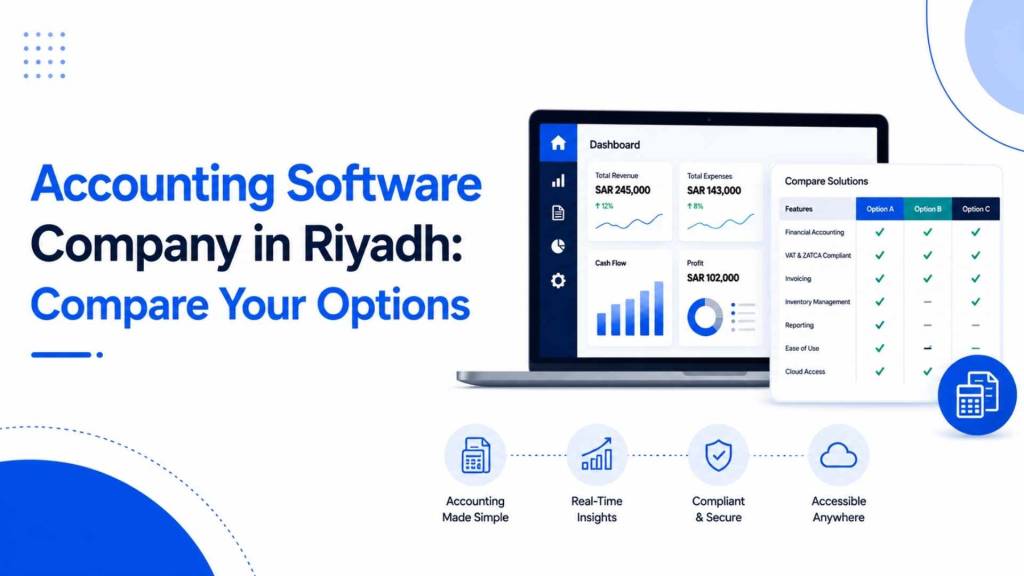
Search for an accounting software company in Riyadh and you will find dozens of platforms, each claiming to be ZATCA compliant, each pitched as the obvious choice. Almost none of that content actually helps you decide, because the honest answer is that the right accounting software depends less on which brand you pick and more on which category of software actually fits your business: a lightweight cloud subscription, an accounting-first platform with real inventory depth, or a full ERP. This page walks through that decision directly, including the comparison we get asked about most often in Riyadh: TallyPrime against Daftra.
Quick Answer: What’s the Best Accounting Software for a Riyadh Business?
There is no single best accounting software for every Riyadh business. Cloud SaaS platforms such as Daftra, Zoho Books, or QuickBooks Online suit very small businesses that want a quick, all-in-one subscription with minimal setup. TallyPrime suits trading, wholesale, and services businesses that need genuinely strong, auditor-friendly accounting combined with multi-warehouse inventory control. A full ERP such as ERPNext or Odoo suits businesses that need accounting connected to manufacturing, multi-branch operations, or HR in one system. The right choice depends on your invoice volume, inventory complexity, and how much your business is likely to grow over the next few years, not on which brand is most heavily marketed.
Key Takeaways
- Every accounting software operating in Saudi Arabia must meet the same ZATCA baseline, but meeting that baseline says nothing about whether the platform actually fits your business operationally.
- Cloud SaaS platforms like Daftra are genuinely strong for very small, single-location businesses, but they are, by design, positioned for SMEs rather than businesses with multi-entity structures or heavy transaction volume.
- TallyPrime’s advantage over generalist cloud accounting tools is depth: real multi-godown inventory, batch tracking, and an accounting model auditors specifically favor because entries post and show their effect immediately without secondary posting.
- A full ERP becomes the right category once a business needs accounting connected to manufacturing, multi-branch stock, or HR, not before.
- “Accounting software company in Riyadh” searches often lead to product comparisons, but the more useful comparison is between categories first, and specific products second.
What Every Accounting Software Must Do in Saudi Arabia
Regardless of category, any accounting software operating in the Kingdom needs to meet ZATCA’s Phase 2 technical requirements: generating invoices in UBL 2.1 XML format, applying a cryptographic stamp using a ZATCA-issued certificate, embedding a QR code on simplified tax invoices, and connecting via API to the Fatoora platform for real-time clearance or 24-hour reporting. ZATCA maintains its own list of approved e-invoicing solution providers, and confirming a platform’s actual compliance status through ZATCA’s official Fatoora e-invoicing portal is worth doing directly rather than relying on a vendor’s own compliance claim. For the full regulatory picture, see our ZATCA Phase 2 complete guide. If you want a deeper breakdown of software categories specifically through a ZATCA compliance lens, our ZATCA software guide for Riyadh covers that in more detail.
Three Categories of Accounting Software in Riyadh
Cloud SaaS Platforms (Daftra, Zoho Books, QuickBooks Online)
This category covers Arabic-first, all-in-one cloud subscriptions built for small businesses that want to be operational quickly with minimal setup. Daftra, for example, is a cloud platform covering invoicing, sales, POS, inventory, CRM, and HR under a single subscription, with ZATCA Phase 2 integration built in and designed specifically for the Arabic-speaking SME market. This category genuinely works well for a small, single-location business that needs straightforward invoicing and basic bookkeeping without much operational complexity. The trade-off is depth: these platforms are, by design, positioned for smaller operations rather than businesses with multi-entity structures, complex inventory needs, or high transaction volume.
Accounting-First Platforms with Real Inventory Depth (TallyPrime)
TallyPrime sits a level deeper than generalist cloud SaaS tools. It is ready-made, off-the-shelf, accounting-first software, but with genuine multi-godown stock management, batch and expiry tracking, purchase and sales order workflows, and bill-wise credit control built in, not layered on as an afterthought. TallyPrime also removes secondary posting entirely: entries post and show their effect immediately, which is specifically why auditors tend to favor it over software that requires a reconciliation cycle after the fact. This makes it a strong fit for trading, wholesale, and distribution businesses in particular. See our TallyPrime for trading companies page and our TallyPrime dealer guide for Saudi Arabia for more on this fit.
Full ERP Systems (ERPNext, Odoo)
A full ERP connects accounting to manufacturing, multi-branch operations, procurement, and HR in one system. This is the right category once a business has outgrown pure accounting and inventory needs and requires production planning, multi-entity consolidation, or department-wide process integration. ERPNext, in particular, offers this depth through an open source licensing model without the escalating per-user proprietary costs of many closed platforms. Our ERP software overview for Saudi Arabia and ERPNext implementation guide cover this category in full.
Comparing the Three Categories
| Factor | Cloud SaaS (Daftra, Zoho, QuickBooks) | TallyPrime | Full ERP (ERPNext, Odoo) |
| Best for | Very small, single-location businesses | Trading, wholesale, distribution, services | Manufacturing, multi-branch, complex operations |
| Inventory depth | Basic | Strong, multi-warehouse | Strong, integrated with production |
| Setup speed | Fastest | Fast | Moderate |
| Accounting model | Standard cloud bookkeeping | No secondary posting, auditor-favored | Full financial and operational integration |
| Scales with complexity | Limited | Good for trading growth | Strong across departments |
| ZATCA compliance | Built in on most current plans | Built in | Built in |
TallyPrime vs Daftra: The Comparison Riyadh Businesses Actually Ask About
These two platforms get compared constantly because they sit closest together in practice, both serve SMEs, both are ZATCA compliant, and both are reasonably priced relative to a full ERP. The real difference is depth versus breadth. Daftra bundles invoicing, POS, CRM, and HR into one lightweight cloud subscription, which is genuinely convenient for a small business that wants everything in one place without much configuration. TallyPrime goes deeper specifically on accounting and inventory: real multi-godown stock tracking, batch and expiry management, bill-wise ageing, and an accounting model built around immediate posting that auditors specifically prefer. A small service business with light invoicing needs and no real inventory to track will often find Daftra’s breadth more useful. A trading or wholesale business managing stock across more than one location will generally find TallyPrime’s accounting and inventory depth outgrows what a generalist cloud SaaS platform is built to handle.
How to Choose: A Decision Framework
- Do you carry inventory across more than one location? If yes, lean toward TallyPrime or a full ERP rather than a generalist cloud SaaS platform.
- Do you need manufacturing, multi-branch consolidation, or HR in the same system as accounting? If yes, a full ERP is the right category.
- Is your business a single location with straightforward invoicing needs and little to no inventory? A cloud SaaS platform like Daftra may be genuinely sufficient.
- How fast are you likely to outgrow your first choice? A business expecting significant growth over the next few years should weigh a platform’s depth ceiling now, rather than migrating twice.
- Have you confirmed the platform’s actual ZATCA integration method, not just its marketing claim of compliance?
For businesses still unsure which category fits, our best ERP for small business in Saudi Arabia guide and cloud ERP overview for Saudi Arabia are useful next steps.
Common Mistakes When Choosing an Accounting Software Company in Riyadh
- Choosing based on subscription price alone without considering how the platform handles inventory if the business carries stock.
- Assuming a cloud SaaS platform will scale indefinitely, then discovering its depth ceiling once the business adds a second location or a manufacturing process.
- Treating “ZATCA compliant” as a sufficient answer without confirming the specific technical integration method.
- Comparing brand names rather than categories, which leads to comparing tools that were never built for the same kind of business in the first place.
Best Practices for Choosing the Right Platform
- Map your actual invoice volume and inventory complexity before comparing any specific product.
- Confirm ZATCA integration technically, not just through a vendor’s marketing page.
- Choose based on where your business will be in three years, not only where it is today.
- Get an independent assessment rather than relying solely on a vendor’s own sales pitch for their platform.
Illustrative Case Study: A Riyadh Business Outgrowing a Cloud SaaS Tool
A small retail business in Riyadh started on a generalist cloud accounting subscription when it opened its first store, which worked well for the first year. Once the business opened a second location and needed to track stock transfers between the two, the platform’s basic inventory features could no longer give an accurate combined stock picture. Moving to TallyPrime with proper multi-godown configuration resolved this directly, since stock across both locations became visible in one place, something the original cloud subscription was never built to handle at that depth.
Expert Insight
“Businesses in Riyadh rarely ask us which brand of accounting software is best, they ask which one will still make sense in two years, and that is really a question about category, not brand,” says Mohamed Abdul Baseeth, Founder of Maas Consult Middle East Co, who has guided ERP and accounting system implementations for over 2,000 businesses across Saudi Arabia. “A generalist cloud subscription and TallyPrime are not competing for the same business, most of the time, they are answering different questions about how much operational depth you actually need.”
Frequently Asked Questions
What is the best accounting software company in Riyadh?
There is no single best option for every business. The right choice depends on your invoice volume, inventory complexity, and growth plans, cloud SaaS platforms for very small businesses, TallyPrime for trading and services businesses needing real inventory depth, and full ERP systems for manufacturing or multi-branch operations.
Is TallyPrime or Daftra better for a small business in Riyadh?
It depends on whether inventory is involved. A small service business with straightforward invoicing needs and little to no stock to track often finds Daftra’s all-in-one cloud subscription sufficient. A trading or wholesale business managing stock across more than one location generally outgrows a generalist cloud platform and benefits from TallyPrime’s deeper inventory and accounting features.
Does all accounting software in Saudi Arabia need to be ZATCA compliant?
Yes. Any business above the current wave threshold must use software capable of UBL 2.1 XML invoice generation, cryptographic stamping, QR code embedding, and API connectivity to ZATCA’s Fatoora platform, regardless of which category or brand of software is chosen.
What is the difference between an accounting-first platform and a full ERP?
An accounting-first platform like TallyPrime focuses on strong bookkeeping and inventory control. A full ERP like ERPNext connects accounting to manufacturing, multi-branch operations, procurement, and HR within a single system, which matters once a business’s operations extend meaningfully beyond accounting and stock.
When should a Riyadh business move from a cloud SaaS tool to TallyPrime or a full ERP?
Generally once the business adds a second location with stock to track, needs deeper credit control and ageing analysis, or starts to outgrow the basic inventory and reporting features that generalist cloud platforms are built to offer.
Can accounting software be upgraded later without switching platforms entirely?
This depends on the platform. Cloud SaaS tools generally require a full migration to a different category once outgrown, while TallyPrime and full ERP systems tend to have more room to expand configuration and modules within the same platform as a business grows.
How do I confirm an accounting software vendor’s ZATCA compliance claim?
Ask for a live demonstration of the four technical requirements, UBL 2.1 XML generation, cryptographic stamping, QR code embedding, and Fatoora API connectivity, and where possible, confirm the vendor’s status directly through ZATCA’s own solution provider information rather than relying solely on the vendor’s marketing claim.
Is TallyPrime suitable for a business with multiple branches in Riyadh and other Saudi cities?
Yes, through its multi-godown structure, which tracks stock separately by physical location while keeping accounting centralized. For businesses needing manufacturing or HR integration alongside this, a full ERP may still be worth evaluating.
Which accounting software is easiest to set up quickly in Riyadh?
Cloud SaaS platforms are generally the fastest to get running, often within days, since they require minimal configuration. TallyPrime and full ERP systems take somewhat longer to set up properly but offer more operational depth in return.
Who can help compare accounting software options for my Riyadh business?
Our team can assess your invoice volume, inventory needs, and growth plans and recommend the right category before any specific product decision. Reach out through our TallyPrime sales and solutions page or ERPNext implementation service page to get started.
Get an Independent Comparison for Your Riyadh Business
If you are comparing accounting software options and want a straight answer on which category actually fits your business, not a sales pitch for whichever platform we sell, get in touch to walk through your invoice volume, inventory needs, and growth plans. Contact-us to request an independent assessment.

2 Comments