
Trading Company ERP in Riyadh: End Inventory Chaos with ERPNext
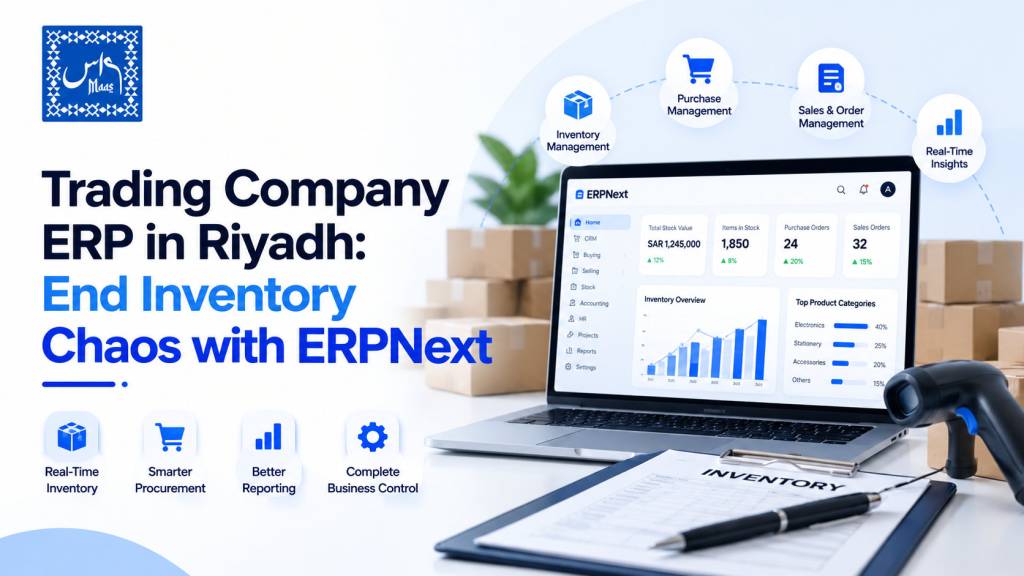
Every Riyadh trading company I have walked into has a version of the same story. The system says 400 cartons are in the Al Sulay warehouse. The storekeeper says 310. The sales team has already promised 350 to a customer in Jeddah, and nobody can explain where the other 90 went, or what those cartons actually cost once freight, duty and clearance were added.
That is inventory chaos, and it is not a software brand problem. It is what happens when a trading business grows across warehouses, price lists, currencies and customers faster than its spreadsheets and accounting tool can follow.
I am Mohamed Abdul Baseeth, founder of Maas Consult Middle East Co. We have delivered 1,000+ ERP implementations and 800+ ZATCA compliance engagements, and trading and distribution businesses are the ones we see most often in Riyadh. This guide is not a list of ERP brands. It is a practical look at the specific problems Riyadh traders face, how ERPNext solves each one, what to configure, and when ERPNext is not the right answer.
Quick Answer
A trading company ERP in Riyadh needs to do six things well: keep real-time stock across every warehouse and branch, calculate true landed cost on imports, manage units of measure and price lists, control customer credit, track batches or serial numbers where needed, and issue ZATCA Phase 2 compliant e-invoices for both B2B and B2C sales. ERPNext covers all six in a single open-source system, with full Arabic support and no per-user licence fees. For a small trader that only needs accounting and stock, TallyPrime can be enough. For a multi-warehouse importer or distributor, ERPNext is usually the better fit.
Key Takeaways
- Wholesale and retail trade, restaurants and hotels made up 12.3% of Saudi GDP in 2025, and Saudi imports hit a record SAR 949.8 billion. Trading is a big, competitive and thin-margin business in the Kingdom.
- The most expensive inventory mistake is not lost stock. It is wrong landed cost, which makes margins look healthier than they are.
- ERPNext handles multi-warehouse stock, landed cost vouchers, UOM conversion, pricing rules, credit limits, batches and serial numbers as standard features.
- ZATCA Wave 25 brings trading companies with VAT-subject revenue above SAR 187,500 into Phase 2, with an integration deadline of 1 February 2027.
- The ERP is only half the job. Clean item masters, a proper opening stock count and trained warehouse staff decide whether the chaos actually ends.
Why Riyadh Trading Companies Hit Inventory Chaos
Riyadh is the Kingdom’s largest consumer market and the point where imported goods arriving through Dammam and Jeddah are stored, broken down and redistributed. A typical Riyadh trader might hold stock in a warehouse in Al Sulay or the Second Industrial City, run a showroom or counter in the city, and keep a branch or agent in Jeddah or Dammam. Some now also sell through their own online store or marketplaces.
The scale of the market explains the pressure. According to the General Authority for Statistics, wholesale and retail trade, restaurants and hotels contributed 12.3% of Saudi GDP at current prices in 2025, with the sector growing 5.4% year on year in the fourth quarter. On the supply side, Saudi Arabia’s merchandise imports reached a record SAR 949.8 billion in 2025, up 9% on 2024, as reported by Argaam from GASTAT data. Machinery and electrical equipment alone made up 29% of that.
More goods flowing through more locations means more chances for numbers to drift apart. The infrastructure is getting better too. The Special Integrated Logistics Zone at King Khalid International Airport, launched in 2022, and the Riyadh Dry Port rail link to Dammam both make faster distribution possible. But faster logistics only helps if your system knows what you have and where it is.
The 9 Problems That Create Inventory Chaos, and How ERPNext Fixes Each
These are the problems we see most often in Riyadh trading companies, in rough order of how much they cost.
1. Stock Numbers That Never Match
The symptom: The system, the warehouse and the sales team each have a different number for the same item.
The cause: Stock moves happen outside the system. Goods are transferred between warehouses on a phone call, returns sit in a corner without being received, and delivery notes are entered days later.
How ERPNext fixes it: Every location is a warehouse in ERPNext, including vans, showrooms and branch stores. Stock only moves through documents: Purchase Receipt, Delivery Note, Stock Entry (Material Transfer) and Sales Return. Each one updates the stock ledger in real time, so the “Stock Balance” and “Stock Ledger” reports show exactly what moved, when and who did it. Periodic Stock Reconciliation entries correct the gap after a physical count and leave an audit trail of every adjustment.
2. Wrong Landed Cost, Wrong Margins
The symptom: The business looks profitable on paper, but cash keeps getting tighter.
The cause: Imported goods are valued at the supplier invoice price. Freight, insurance, customs duty, clearing agent fees and local transport go to expense accounts instead of into the cost of the stock.
How ERPNext fixes it: The Landed Cost Voucher adds these charges to the valuation rate of the items on a Purchase Receipt or a stock-updating Purchase Invoice. The real cost then flows through to every sale and margin report automatically.
Here is why this matters. Take an illustrative import shipment of 1,000 cartons:
| Cost element | Amount (SAR) |
|---|---|
| Supplier invoice (USD 20,000 at the pegged rate of 3.75) | 75,000 |
| Freight and insurance | 6,000 |
| Customs duty (illustrative) | 4,050 |
| Clearing agent and transport to Riyadh warehouse | 2,950 |
| Total landed cost | 88,000 |
Invoice cost per carton is SAR 75. True landed cost is SAR 88, about 17% higher. If you sell at SAR 95 per carton, you think your gross margin is about 21%. It is actually about 7%. Multiply that across a year of imports and the “profitable” product lines can turn out to be the ones draining cash.
One detail many traders get wrong: import VAT paid at customs is normally recoverable as input VAT by a VAT-registered business. It belongs in your VAT return, not in landed cost. Putting it into stock value overstates cost and double-counts the tax.
3. Cartons, Pieces and Dozens
The symptom: You buy in cartons, store in cartons, sell in pieces to some customers and dozens to others, and stock goes negative or wildly positive.
How ERPNext fixes it: Each item has a stock UOM and any number of conversion factors (for example, 1 carton = 24 pieces). Purchases, sales and transfers can each use the UOM that suits them, and ERPNext converts everything back to the stock UOM so the balance stays correct.
4. Price Lists Nobody Trusts
The symptom: Salespeople quote from memory, special prices for key customers live in WhatsApp chats, and discounts are given without approval.
How ERPNext fixes it: Separate price lists for wholesale, retail, distributor and export customers, plus Pricing Rules that apply discounts, special rates or free items by item, item group, brand, customer, customer group or territory. Rules can be limited by minimum and maximum quantity or value and given start and end dates for promotions. The salesperson no longer decides the price. The system does.
5. Customers Who Owe Too Much
The symptom: Receivables keep growing, and some customers keep buying long after they stopped paying.
How ERPNext fixes it: Credit limits per customer or customer group, with orders blocked above the limit unless a manager overrides it. Payment terms on each invoice feed the Accounts Receivable ageing report, so your collections team can see who is overdue by 30, 60 and 90 days at a glance.
6. Expiry Dates and Serial Numbers
The symptom: Expired food, cosmetics or pharma products are found on the shelf, or warranty claims arrive for electronics you cannot trace.
How ERPNext fixes it: Batch tracking with manufacturing and expiry dates, so expired batches are filtered out of stock transactions. Serial number tracking for electronics, machinery and spare parts, from purchase to sale to warranty claim. Batches can be created automatically when goods are received.
7. Reordering by Gut Feel
The symptom: Fast movers run out while slow movers fill the warehouse.
How ERPNext fixes it: Reorder levels and reorder quantities per item per warehouse. When stock falls below the level, ERPNext can raise a Material Request automatically. Stock ageing and stock projected quantity reports show what is moving and what is gathering dust.
8. Orders That Live in WhatsApp
The symptom: Orders arrive by phone, WhatsApp and email, and some never make it into the system until after delivery.
How ERPNext fixes it: Every order becomes a Sales Order before it is picked. Pick Lists guide warehouse staff, Delivery Notes confirm what left, and invoices are created from the delivery. Barcode scanning on items cuts picking errors. B2B customers can also use the customer portal to view orders, invoices and statements themselves.
9. ZATCA Phase 2 Stress
The symptom: Invoices are generated in one system, credit notes in another, and nobody is sure the e-invoices are compliant.
How ERPNext fixes it: With a properly configured ZATCA integration, B2B tax invoices are sent to ZATCA for clearance before they reach the customer, and B2C simplified invoices are reported within 24 hours. Credit notes for returns and debit notes go through the same e-invoicing flow. Our ERPNext ZATCA integration guide explains how the integration is set up and tested.
What a Riyadh Trading ERP Must Do: A Checklist
Use this list when you evaluate any ERP, not only ERPNext.
| Requirement | Why it matters for Riyadh traders | ERPNext |
|---|---|---|
| Multi-warehouse, multi-branch stock | Riyadh warehouse plus Jeddah or Dammam branches | Standard |
| Landed cost allocation | Imports priced in USD, CNY or EUR with freight and duty | Standard (Landed Cost Voucher) |
| Multi-currency purchasing | Foreign suppliers, SAR books | Standard |
| UOM conversion | Carton, piece, dozen, kilogram | Standard |
| Price lists and pricing rules | Wholesale, retail and key-account pricing | Standard |
| Customer credit limits | Controlling receivables | Standard |
| Batch and expiry tracking | FMCG, food, cosmetics, pharma | Standard |
| Serial number tracking | Electronics, spare parts, machinery | Standard |
| Barcode support | Faster, accurate picking | Standard |
| ZATCA Phase 2 e-invoicing | Legal requirement for in-scope taxpayers | Through a ZATCA integration app, configured and tested |
| Arabic interface and invoices | Staff and customers who work in Arabic | Standard (Arabic and right-to-left supported) |
| Van or route sales | Delivery and sales from vehicles | Each van set up as a warehouse; mobile POS or a dedicated add-on for field use |
For a broader look at how ERPNext is used across the trading and distribution sector, see our ERPNext for trading and distribution page.
ZATCA Phase 2 and Wave 25: The Deadline Trading Companies Cannot Miss
ZATCA announced Wave 25 in July 2026. It applies to VAT-registered taxpayers whose VAT-subject revenue exceeded SAR 187,500 in any of 2022, 2023, 2024 or 2025, with an integration deadline of 1 February 2027. That is under four months away. KPMG’s summary of the Wave 25 announcement sets out the threshold test.
That threshold pulls in a large share of small Riyadh traders who had never had to think about integration before. For trading companies, three Phase 2 details deserve particular attention:
- Returns. Every sales return needs a compliant credit note linked to the original invoice. Traders with high return rates feel this first.
- Mixed customers. If you sell to both businesses and walk-in customers, you need both clearance (B2B) and reporting (B2C) flows working.
- Multiple invoicing points. A warehouse system, a showroom POS and an online store can each issue invoices. All of them must be compliant, not only the head office system.
Missing your wave deadline does not usually bring an instant fine, but it starts a warning-and-escalation process that gets expensive quickly. Our guide to ZATCA penalties in 2026 breaks down the amounts.
When ERPNext Is Not the Right Choice
ERPNext is not the answer for every trader, and pretending otherwise would not help you.
- Small traders who only need accounting and stock. If you run one or two locations, a manageable item list and an accountant who already knows Tally, TallyPrime may be all you need. Our guide to TallyPrime for trading companies covers where it fits well.
- Businesses inside a global SAP or Oracle group. If your parent company runs SAP worldwide, consolidating on the group platform usually makes more sense.
- High-volume automated warehouses. If you run conveyor belts, robotic picking or very high pick volumes, you may need a dedicated warehouse management system integrated with your ERP, rather than ERPNext’s stock module alone.
If you are still deciding between software categories, our comparison of accounting software for Riyadh businesses and our guide to the best ERP for small businesses in Saudi Arabia cover those broader choices. This page assumes you are a trading company that has already decided you need real inventory control.
How an ERPNext Rollout Works for a Riyadh Trading Company
The timeline depends on how many items, warehouses and branches you have, and above all on how clean your data is. The steps are the same either way.
Step 1: Map How Goods and Money Actually Move
Before any setup, we map your real process from purchase order to customer payment, including the shortcuts. The shortcuts are where stock disappears.
Step 2: Clean the Item Master
Duplicate items, inconsistent names and missing UOM conversions are the biggest single cause of a failed trading ERP. Every item needs one code, one name (in English and Arabic if you invoice in both), correct UOMs, and batch or serial settings decided upfront.
Step 3: Configure Warehouses, Pricing and Credit
Set up every warehouse, van and branch store, then load price lists, pricing rules, customer groups, territories and credit limits.
Step 4: Set Up and Test ZATCA Integration
Onboard each invoicing point with ZATCA, test clearance and reporting in the sandbox, and test credit notes for returns before go-live.
Step 5: Count Opening Stock Properly
Do a full physical count close to go-live, enter it with Stock Reconciliation, and load opening balances for customers and suppliers. If you are moving from Tally, our Tally to ERPNext migration guide explains how to move the data cleanly.
Step 6: Train the Warehouse, Not Just the Accountants
Storekeepers and drivers create most stock documents. If they are not confident with Purchase Receipts, transfers and Delivery Notes, the numbers will drift again. Our team runs ERPNext implementation in Riyadh with on-site process mapping and go-live support for exactly this reason.
Step 7: Review After 30 Days
Compare system stock to a spot count, review negative stock and adjustment entries, and tighten any process that is still happening outside the system. ERPNext support in Riyadh after go-live keeps the system matching reality as you add products, branches and staff.
What Drives the Cost of a Trading ERP
We do not publish fixed packages, because two trading companies of the same size can need very different setups. These are the factors that drive cost:
- Number of items, warehouses, branches and users
- Whether you need batches, serial numbers or both
- Number of invoicing points that need ZATCA integration
- Data migration from Tally, Excel or another system, and how clean that data is
- Integrations with e-commerce, marketplaces, barcode printers or a WMS
- Hosting choice and ongoing support level
ERPNext itself is open source, so there are no per-user licence fees. For a full breakdown of what drives ERP cost in the Kingdom, see our guide to how much ERP costs in Saudi Arabia.
Common Mistakes Riyadh Traders Make with ERP
- Going live without a physical count. Loading last year’s spreadsheet balance into a new system guarantees the old errors carry over.
- Expensing landed costs. Freight and duty booked as expenses hide the true cost of each product.
- Letting sales staff override prices freely. If every price is editable, pricing rules mean nothing.
- Keeping the old system running “just in case”. Two systems means two sets of numbers, and staff will default to the old one.
- Treating ZATCA as a box to tick. An integration that works for invoices but not for credit notes is still non-compliant.
- Training only the finance team. The warehouse team creates most of the transactions that decide stock accuracy.
A Hypothetical Example: A Riyadh Electronics Importer
Picture a Riyadh importer of electronic accessories with a main warehouse in Al Sulay, a city showroom and a small branch in Jeddah. It buys in US dollars and Chinese yuan, sells to retailers on credit and to walk-in customers at the showroom, and has around 3,000 items.
Before ERPNext, landed costs were expensed, so product margins were overstated. Serial numbers were not tracked, so warranty claims could not be checked against sales. Transfers to Jeddah were arranged by phone, and the branch regularly sold stock it did not have.
After implementation, every location is a warehouse, transfers go through Stock Entries, landed cost vouchers are posted for every shipment, serial numbers are scanned at receipt and sale, and showroom and B2B invoices are both ZATCA compliant. The first real margin report shows that two “best-selling” product lines barely break even once freight and duty are included.
This is an illustration built from common patterns, not a named client case.
From the Field
The trading companies that get the most out of ERPNext are rarely the ones with the most features switched on. They are the ones that decided, before go-live, that no stock moves without a document. That single rule does more for inventory accuracy than any report or dashboard. The software makes the rule easy to enforce. The management team has to decide to enforce it.
Frequently Asked Questions
What is the best ERP for a trading company in Riyadh?
For most multi-warehouse traders, importers and distributors in Riyadh, ERPNext is a strong fit: it covers multi-warehouse stock, landed cost, pricing rules, credit control, batches, serial numbers and ZATCA e-invoicing in one system, without per-user licence fees. Small traders who only need accounting and basic stock may be better served by TallyPrime.
Is ERPNext ZATCA Phase 2 compliant?
ERPNext can meet ZATCA Phase 2 requirements through a ZATCA integration app that handles clearance for B2B invoices and reporting for B2C invoices. Compliance depends on correct configuration, onboarding of each invoicing point and testing in ZATCA’s sandbox.
Can ERPNext calculate landed cost for imported goods?
Yes. The Landed Cost Voucher adds freight, insurance, customs duty and clearing charges to the valuation of the received items, so margins reflect the true cost of the goods.
Can ERPNext manage warehouses in Riyadh, Jeddah and Dammam together?
Yes. Each location is set up as a warehouse under one company or several companies, with real-time stock visibility, inter-warehouse transfers and consolidated reports.
Does ERPNext support Arabic?
Yes. ERPNext has an Arabic interface with right-to-left layout, and invoices can be printed in Arabic or bilingual formats.
Can ERPNext handle van sales?
Yes. Each van is set up as a warehouse, stock is transferred to it, and sales are recorded against it, typically through the POS or a mobile add-on suited to field sales.
Can we move from Tally or Excel to ERPNext?
Yes. Item masters, customers, suppliers, opening stock and opening balances can be migrated. The quality of the result depends mostly on how clean the source data is and on doing a fresh physical stock count.
Does ERPNext support barcodes?
Yes. Items can carry one or more barcodes, and barcode scanning is supported in purchase, sales and stock transactions.
Do we need ZATCA Phase 2 if our revenue is small?
If your VAT-subject revenue exceeded SAR 187,500 in any of 2022 to 2025, you are in scope for Wave 25, with an integration deadline of 1 February 2027.
Is TallyPrime enough for a trading company?
For smaller traders with simple stock needs and an accounting-first approach, TallyPrime can be enough. Once you need multi-branch control, landed cost on every shipment, complex pricing or a growing sales team, a full ERP such as ERPNext usually serves you better.
Final Thoughts
Inventory chaos in a Riyadh trading company is rarely about one big mistake. It is hundreds of small stock moves that never reach the system, landed costs that never reach the item value, and prices that never reach a price list. ERPNext gives every one of those a place to live. With Wave 25 due on 1 February 2027, this is also the right moment to fix stock and ZATCA compliance together rather than in two separate projects.
If you want to see how this would look for your own warehouses, items and customers, our team in Riyadh can walk through your current process and show you where the gaps are, as part of an ERPNext implementation in Riyadh.