



Quick Answer
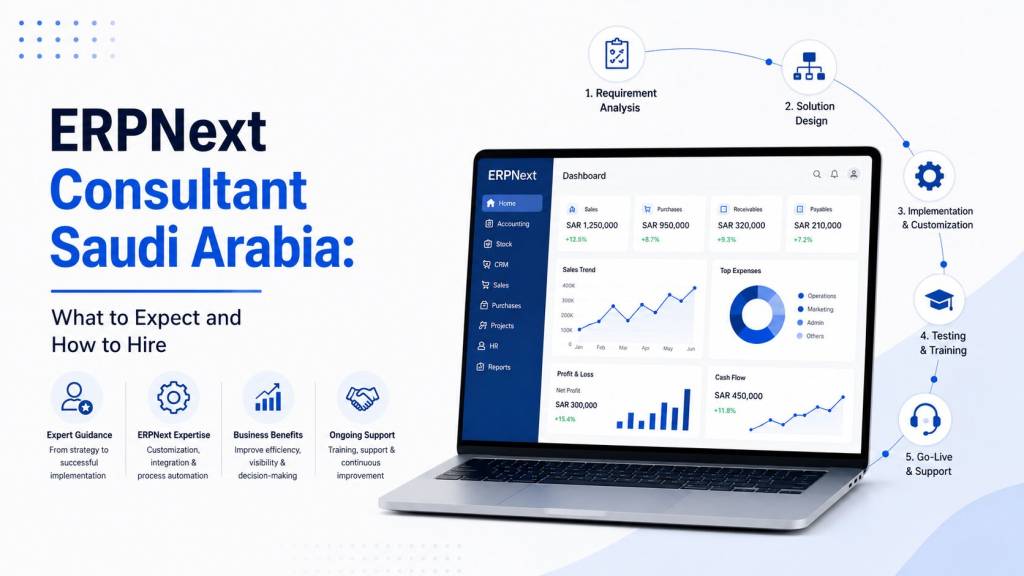
An ERPNext consultant is a specialist who plans, configures, customizes, and supports an ERPNext deployment so it matches how a Saudi business actually operates, including Zakat, VAT, and ZATCA e-invoicing requirements. In Saudi Arabia, the right consultant does more than install software. They understand Fatoora integration, Arabic-English bilingual reporting, GCC trade rules, and the compliance deadlines ZATCA is currently enforcing. Expect a discovery phase, a configuration and data migration phase, a testing and training phase, and a go-live plus support phase, typically running 6 to 20 weeks depending on complexity.
Key Takeaways
- ERPNext consultants in Saudi Arabia fall into three working roles: functional, technical, and implementation lead. Most SMEs need someone who can cover all three, or a small team that combines them.
- ZATCA Phase 2 (Integration Phase) is now in full enforcement. As of 1 July 2026, the penalty waiver ended and Wave 24 businesses (VAT-taxable revenue above SAR 375,000) must already be integrated with Fatoora. This has made ZATCA experience a non-negotiable filter when choosing a consultant, not a nice-to-have.
- Typical ERPNext consulting engagements in Saudi Arabia run from a few weeks for a lean single-branch setup to several months for multi-branch manufacturing or distribution operations.
- Cost depends far more on scope, data quality, and customization needs than on the software itself, since ERPNext’s core is open source.
- The biggest hiring mistake we see is choosing on price alone, then discovering mid-project that the “consultant” has never actually completed a ZATCA-integrated go-live in the Kingdom.
What Is an ERPNext Consultant?
ERPNext consultant is a business and technology advisor who helps an organization deploy, configure, customize, integrate, and maintain ERPNext, the open-source ERP platform built on the Frappe framework, so that it supports real operations, not just a demo environment.
In Saudi Arabia specifically, that definition carries extra weight. A consultant here is not just configuring a chart of accounts and a sales pipeline. They are also expected to understand Saudi VAT rules, Zakat calculation logic for GCC-owned entities, Arabic invoice formatting, and the technical requirements ZATCA has published for e-invoicing integration through the Fatoora platform. If you are new to this area, our complete guide to ZATCA Phase 2 e-invoicing is a useful starting point before you speak to any consultant. Get any of that wrong and a business is not just inconvenienced, it is exposed to financial penalties.
I have sat in enough kickoff meetings to say this plainly: the businesses that succeed with ERPNext are not the ones that pick the “cheapest implementer.” They are the ones that pick a consultant who asks hard questions about their actual processes before touching a single configuration screen.
What an ERPNext Consultant Actually Does, Day to Day
- Business process discovery. Mapping how sales, procurement, inventory, production, and finance actually flow today, warts and all, before designing the ERPNext structure around it.
- System configuration. Setting up company structure, chart of accounts, warehouses, price lists, tax templates (including ZATCA-compliant VAT templates), and approval workflows.
- Data migration. Moving historical customer, vendor, inventory, and financial data out of spreadsheets or a legacy system such as TallyPrime, Excel, or an older ERP, then validating every field.
- ZATCA e-invoicing integration. Connecting ERPNext to the Fatoora platform, generating UUID and cryptographic-stamp compliant XML invoices, and testing clearance and reporting workflows for both B2B and B2C invoice types. See our ZATCA e-invoicing services for how we approach this specific piece of work.
- Customization. Building custom fields, print formats (bilingual Arabic/English), reports, and dashboards that reflect how the business actually needs to see its data.
- Integration. Connecting ERPNext with e-commerce storefronts, payment gateways, banks, POS hardware, and third-party logistics or CRM tools.
- Training and change management. Getting finance, warehouse, and sales staff comfortable enough with the system that they actually use it correctly after go-live.
- Post go-live support. Fixing issues, tuning performance, and expanding the system as the business grows.
Types of ERPNext Consultants (And Which One You Actually Need)
| Consultant Type | Focus | Best Fit For |
|---|---|---|
| Functional Consultant | Business processes, module configuration, workflow design, user training | Businesses that need ERPNext mapped closely to existing operations without heavy custom code |
| Technical Consultant | Custom development, API integrations, scripting, performance, Fatoora integration engineering | Businesses with specialized workflows, legacy system integrations, or ZATCA integration needs |
| Implementation Consultant / Project Lead | End-to-end delivery, timeline ownership, coordinating functional and technical work | Businesses running their first ERP project or a multi-department rollout that needs single-point accountability |
Most Saudi SMEs and mid-market companies do not need three separate hires. What they need is a partner whose team internally covers all three roles, with one accountable project lead who speaks for the whole engagement. That is the model we run at Maas Consult, and it is the model I would recommend regardless of who you hire, because split accountability is where ERP projects quietly fall apart.
Why ERPNext Consultants Matter More in Saudi Arabia Right Now
Three forces are converging in the Saudi market in 2026, and they change what “good ERPNext consulting” looks like here compared to almost anywhere else.
1. ZATCA Phase 2 enforcement is active, not theoretical. ZATCA rolled out Phase 2 (the Integration Phase) in successive waves by taxpayer revenue threshold. Wave 24, covering businesses with VAT-taxable revenue above SAR 375,000 in 2022, 2023, or 2024, had an integration deadline of 30 June 2026. The penalty cancellation initiative that gave businesses breathing room to fix mistakes also ended on that date. That means as of today, ZATCA has moved into full enforcement mode, and non-compliant invoicing can trigger penalties starting from SAR 5,000 for non-issuance or non-archiving, and from SAR 10,000 for deleting or amending invoices after issuance. A consultant who has not actually taken a business through Fatoora onboarding, CSR generation, sandbox testing, and production CSID issuance is learning on your project, not leading it.
2. Vision 2030 is pushing digital-first operations across every sector. Government tendering, banking relationships, and even supplier onboarding increasingly assume a business runs on a proper system of record, not spreadsheets.
3. The GCC talent and vendor market is crowded but shallow on real ERPNext depth. Plenty of firms list “ERPNext” on a services page after doing one or two small projects. Genuine, repeatable, ZATCA-integrated ERPNext delivery experience in the Kingdom is a much smaller pool than the marketing suggests.
What to Expect When You Hire an ERPNext Consultant in Saudi Arabia
Step-by-Step: A Realistic ERPNext Implementation Timeline
- Discovery and scoping (1 to 3 weeks). Process mapping, requirements gathering, module selection, and a written implementation plan. Any consultant who skips this and jumps straight to configuration is setting the project up to be redone.
- System design and configuration (2 to 6 weeks). Company setup, chart of accounts, tax templates, warehouse and inventory structure, roles and permissions.
- Data migration and validation (1 to 4 weeks, often running in parallel). Cleaning and importing customers, items, opening balances, and historical transactions where needed.
- ZATCA / Fatoora integration and testing (1 to 3 weeks). Sandbox testing, XML structure validation, cryptographic stamp application, and production onboarding.
- User acceptance testing and training (1 to 2 weeks). Real staff running real transactions in a test environment before anyone touches production.
- Go-live and hypercare (1 to 4 weeks post launch). Close daily support while the team transitions fully off the old system.
A lean single-branch trading business can realistically complete this in 6 to 8 weeks. A multi-branch manufacturer with legacy TallyPrime data and custom production workflows should plan for 3 to 5 months. Anyone promising a full ZATCA-integrated go-live for a complex manufacturer in two weeks is either underscoping the work or has not done this before. You can see how we structure this on real projects on our ERPNext implementation in Saudi Arabia page.
Cost Considerations
ERPNext’s core platform is open source, which is genuinely one of its biggest advantages over closed, license-fee-heavy alternatives. But “free software” does not mean “free implementation.” What you are paying for is the consultant’s time: discovery, configuration, customization, data migration, integration, and training.
Costs vary widely based on:
- Number of users and branches
- Number of modules deployed (accounting only versus accounting, inventory, manufacturing, HR, and CRM together)
- Volume and cleanliness of historical data to migrate
- Degree of customization and third-party integration
- Whether ZATCA Phase 2 integration is in scope
- Hosting choice (self-hosted, cloud, or managed hosting through the partner)
We do not publish fixed tiers, and any consultant who quotes a flat number before a discovery call is guessing. The honest approach, and the one we use with every prospective client, is to scope the actual requirement first and provide a tailored quote. If a vendor gives you a firm number in the first email with no discovery call, treat that as a warning sign rather than efficiency.
ERPNext Consultant vs In-House Team vs Freelancer vs Large System Integrator
| Option | Strengths | Risks in the Saudi Context |
|---|---|---|
| In-house team | Deep knowledge of your own operations | Rarely has prior ZATCA integration experience; steep learning curve; project often stalls when the one internal champion leaves |
| Independent freelancer | Lower hourly cost | Single point of failure, limited bandwidth for multi-module projects, inconsistent availability for post-go-live support |
| Boutique ERPNext consulting partner | Focused expertise, direct access to senior consultants, faster decision-making, typically strong on both functional and ZATCA technical work | Smaller firms vary widely in depth, so vetting matters more here than anywhere else |
| Large regional system integrator | Broad resource pool, brand recognition | ERPNext is often a small line item among many products they sell; junior staff frequently assigned; higher overhead reflected in pricing |
There is no universally “best” option here. A five-person trading company and a 300-employee manufacturer have genuinely different needs. What matters is matching the partner’s actual depth to your project’s complexity, not the size of their logo wall.
Key Qualities to Look For in an ERPNext Consultant in Saudi Arabia
- Verified ZATCA Phase 2 delivery experience. Ask for a specific example of a Fatoora integration they completed, including which wave the client fell under. Our own ERPNext ZATCA integration guide walks through exactly what that process should look like, so you know what to expect from whoever you hire.
- Bilingual capability. Arabic-English invoice formats, reporting, and support are not optional extras in the Kingdom.
- Industry-relevant implementations. A consultant who has configured production planning for a food manufacturer understands batch and expiry tracking in a way a purely retail-focused team will not.
- Transparent, scoped pricing. Willing to walk through cost drivers rather than hiding behind a single number.
- Local presence or Saudi-hours support. Time zone misalignment during go-live week is a genuine, underrated risk.
- A real post-go-live support plan. Ask specifically what happens in week two after launch, not just who to call.
- References you can actually verify. Not just logos on a website, but named contacts willing to speak about the engagement.
Questions to Ask Before You Hire
- How many ZATCA Phase 2 integrations have you completed, and in which waves?
- Can you describe a project that did not go smoothly and what you changed afterward?
- Who on your team will actually be assigned to my project, and what is their direct experience?
- What does your data migration validation process look like?
- What is included in support after go-live, and for how long?
- Have you worked in my industry before, and can I speak to that client?
- How do you handle scope changes mid-project?
Red Flags That Should Make You Pause
- A firm cannot describe a specific ZATCA integration they have completed, only that they “can do it.”
- Quoted pricing arrives before any discovery conversation.
- No one on the team can explain the difference between clearance-based B2B invoices and reporting-based B2C invoices under Phase 2.
- Heavy reliance on generic marketing language with no named case studies or verifiable references.
- Reluctance to put support terms and response times in writing.
Industry-Specific Guidance
ERPNext is flexible enough to serve almost any sector, but a consultant who has never worked in your industry will spend your budget learning it. Here is what “good” looks like across the sectors we see most often in the Saudi market.
Manufacturing ERP Saudi Arabia: Look for consultants who understand bill of materials, work orders, subcontracting, and shop floor tracking, not just finance and sales.
Construction ERP Saudi Arabia: Project-based costing, subcontractor management, and multi-project resource allocation matter more here than standard retail inventory logic.
Healthcare ERP Saudi Arabia: Procurement of medical supplies, equipment tracking, and strict financial and regulatory reporting are the priority, alongside data handling discipline.
Retail ERP Saudi Arabia: Multi-branch inventory visibility, POS integration, and e-commerce connectivity should be proven, not theoretical.
Distribution ERP Saudi Arabia: Warehouse accuracy, replenishment automation, and supplier coordination across multiple locations are the core test.
Trading ERP Saudi Arabia: Import/export documentation, multi-currency handling, and landed cost tracking are frequently underestimated by generalist implementers.
Oil and Gas ERP Saudi Arabia: Asset-heavy maintenance scheduling, vendor compliance documentation, and project accounting need specific configuration depth.
Logistics ERP Saudi Arabia: Real-time shipment visibility, warehouse coordination, and transportation tracking are where generic implementations tend to fall short.
Food Manufacturing ERP Saudi Arabia: Batch tracking, expiry management, and traceability from raw material to finished goods are non-negotiable, particularly with SFDA-related quality expectations.
Hospitality ERP Saudi Arabia: Seasonal demand swings (notably around Hajj and Umrah periods), procurement volume spikes, and multi-outlet coordination require a consultant who has actually handled that seasonality before.
Education ERP Saudi Arabia: Fee management, procurement, and administrative finance workflows tend to matter more than manufacturing-style modules.
Case Study Example: TallyPrime to ERPNext Migration
One of the clearest patterns we have seen across Saudi SMEs is a business that started on TallyPrime for straightforward bookkeeping, then outgrew it as operations expanded into inventory management, multi-branch sales, and eventually ZATCA Phase 2 integration requirements. Precihole Machines, a manufacturing operation, made exactly this move, migrating historical TallyPrime data into ERPNext while extending into production planning and compliant e-invoicing. The lesson from projects like this is consistent: businesses do not need to abandon what worked at an earlier stage, they need a consultant who can migrate that history cleanly and build the next stage properly around it. Because Maas Consult is also a TallyPrime dealer in Saudi Arabia as well as an ERPNext partner, we are able to advise honestly on when a business should migrate and when it should not, rather than pushing a single product regardless of fit.
Common Mistakes Businesses Make When Hiring an ERPNext Consultant
- Choosing on price alone. The cheapest quote almost never accounts for ZATCA integration testing, data validation, or post-go-live support properly.
- Skipping the discovery phase to save time. This is the single most common cause of expensive mid-project rework.
- Underestimating data cleanup. Garbage data migrated into a new system produces garbage reports, no matter how well the ERP is configured.
- Treating go-live as the finish line. The first four weeks after go-live are where user adoption is won or lost.
- Not confirming ZATCA experience specifically. General ERP experience is not the same as proven Fatoora integration experience.
Best Practices for a Successful ERPNext Implementation
- Start with a written, agreed scope document before any configuration begins.
- Assign an internal project owner on your side, even when working with an external consultant.
- Run a genuine user acceptance testing phase with real staff and real transactions.
- Budget time and attention for training, not just technical setup.
- Confirm ZATCA sandbox testing is completed and verified before production go-live.
- Plan for a defined hypercare period immediately after launch.
Final Thoughts
Hiring an ERPNext consultant in Saudi Arabia in 2026 is a different exercise than it was even two years ago. ZATCA Phase 2 enforcement is now active, Vision 2030 is pushing every sector toward digital operations, and the number of firms claiming ERPNext expertise has grown faster than the number of firms with genuine, verifiable delivery experience. The businesses that get the best outcomes are the ones that vet carefully, ask direct questions about ZATCA integration history, and choose a partner who will still be there for support in month six, not just at go-live.
Mohamed Abdul Baseeth, Founder of Maas Consult Middle East Co, has spent more than 16 years in ERP implementation and business process optimization work, supporting over 2,000 businesses across ERPNext, Odoo, and TallyPrime deployments, and guiding more than 800 businesses through ZATCA e-invoicing compliance. That depth of pattern recognition, knowing what tends to go wrong and catching it early, is exactly what a good consultant should bring to your project.
Work With Maas Consult
If you are evaluating ERPNext for your business in Saudi Arabia, or you need a partner with proven ZATCA Phase 2 integration experience, Maas Consult offers a straightforward starting point: a discovery call to understand your operations, followed by a scoped, honest recommendation, not a generic sales pitch. You can contact our team to request a custom quote, book a ZATCA compliance assessment, or ask for a digital transformation roadmap review, whichever fits where you are right now.
Get a custom ERPNext consultation with Maas Consult →
FAQs
What does an ERPNext consultant do in Saudi Arabia? An ERPNext consultant plans, configures, migrates data into, customizes, and supports an ERPNext deployment, while also ensuring the system meets ZATCA VAT and e-invoicing requirements specific to businesses operating in the Kingdom.
How much does ERPNext consulting cost in Saudi Arabia? Cost depends on the number of users, modules deployed, data migration complexity, customization needs, and whether ZATCA Phase 2 integration is included. Since ERPNext’s core software is open source, most of the cost is the consultant’s implementation and integration work rather than licensing fees. A tailored quote after a discovery call is the only reliable way to know your actual cost.
Is ERPNext ZATCA compliant? ERPNext can be configured to meet ZATCA Phase 2 requirements, including XML invoice generation, cryptographic stamping, and Fatoora platform integration, but this requires a consultant with specific ZATCA integration experience rather than general ERP knowledge.
How do I choose an ERPNext implementation partner in KSA? Verify their specific ZATCA Phase 2 delivery history, confirm bilingual Arabic-English support capability, ask for references in your industry, and insist on a proper discovery phase before accepting a quote.
How long does ERPNext implementation take? A lean single-branch business can go live in around 6 to 8 weeks. A multi-branch manufacturer or distributor with legacy data migration and ZATCA integration should expect 3 to 5 months.
Can ERPNext be used for VAT and Zakat reporting in Saudi Arabia? Yes, ERPNext can be configured with Saudi-specific tax templates and reporting structures to support VAT reporting and Zakat-relevant financial data, when set up by a consultant familiar with Saudi tax requirements.
What is the difference between an ERPNext consultant and an ERPNext partner company? An individual consultant typically works alone or in a small team, while a partner company has a broader bench of functional, technical, and support staff, which matters more for larger or more complex implementations that need coverage beyond one person’s availability.
Is ERPNext free to use in Saudi Arabia? ERPNext’s core software is open source and free to use. Costs come from implementation, customization, hosting, and ongoing support services, not from software licensing.
Can a business migrate from TallyPrime to ERPNext? Yes. This is a common path for Saudi SMEs that started with TallyPrime for accounting and outgrew it as inventory, multi-branch, or manufacturing needs expanded. A consultant experienced in both platforms can migrate historical data cleanly and advise on whether a full migration or a hybrid approach fits best.
Does hiring an ERPNext consultant guarantee ZATCA compliance? No consultant can “guarantee” compliance in a legal sense, since ZATCA rules and enforcement evolve. What a qualified consultant provides is a correctly configured, tested, and validated integration aligned with ZATCA’s published technical requirements at the time of go-live, along with guidance on staying current as requirements change.


2 Comments