



Cloud ERP Saudi Arabia 2026: Benefits, Risks, ZATCA Compliance & Best Picks
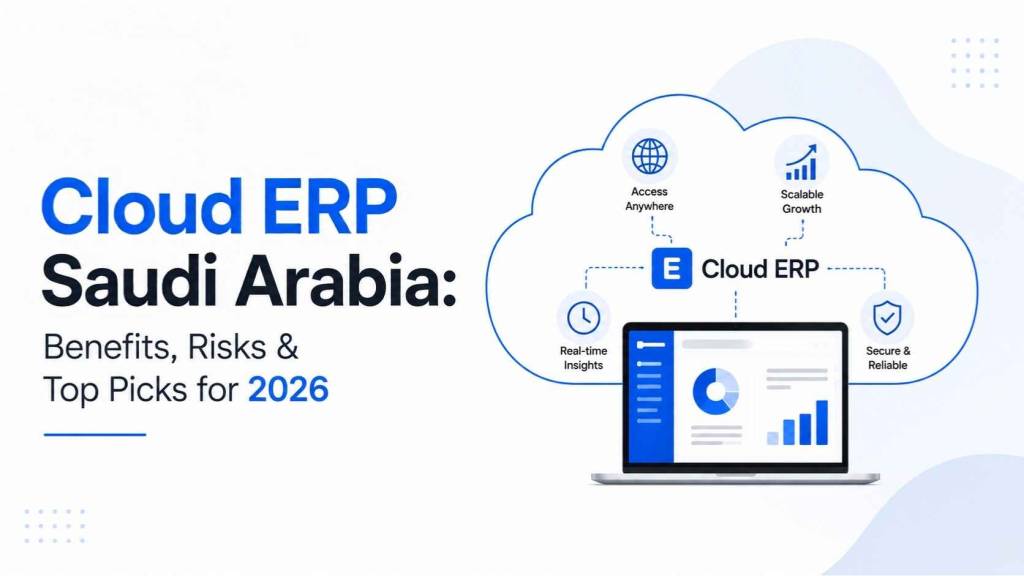
Every week, a Saudi business owner asks us some version of the same question: should we move our accounting and operations to a cloud ERP, or is that a decision we will regret in twelve months. It is a fair question. Cloud ERP is not a trend anymore in the Kingdom, it is the default starting point for most new implementations, but that does not mean every business should adopt it the same way, or for the same reasons.
This guide is written from the vantage point of having sat across the table from hundreds of Saudi business owners making exactly this decision. It covers what cloud ERP actually is, where it genuinely helps, where it creates new problems that vendors rarely mention, how it interacts with ZATCA e-invoicing and the Personal Data Protection Law, and how to pick a platform without getting talked into more software than your business needs.
Quick Answer: Is Cloud ERP Right for Your Saudi Business?
Cloud ERP is enterprise resource planning software hosted on remote servers and accessed through the internet, rather than installed on a computer or server inside your office. For most small and mid-sized Saudi businesses, cloud ERP is the right choice in 2026 because it reduces upfront IT cost, supports multi-branch and multi-city operations common across Riyadh, Jeddah, and the Eastern Province, and integrates more easily with ZATCA e-invoicing requirements. It is a weaker fit for businesses with unreliable internet connectivity, extremely sensitive data that must stay on local hardware for regulatory reasons, or highly specialized processes that off-the-shelf cloud platforms cannot model without heavy customization.
Key Takeaways
- Cloud ERP shifts ERP cost from a large upfront purchase to a recurring subscription, which changes how you should budget and evaluate return on investment.
- Saudi Arabia’s Personal Data Protection Law (PDPL) requires attention to where your data is physically hosted, not just whether the vendor is reputable.
- ZATCA Phase 2 has moved into its most demanding waves yet. As of mid-2026, the threshold for mandatory integration dropped to SAR 187,500 in annual VAT-able revenue under Wave 25, meaning most operating businesses in the Kingdom now need a system that can connect to the Fatoora platform.
- Cloud ERP and on-premise ERP are not simply “new versus old.” Each has legitimate use cases, and the right answer depends on your industry, data sensitivity, and IT maturity.
- Open source cloud ERP platforms such as ERPNext offer a meaningfully lower cost of ownership than proprietary SaaS suites for SMEs, without giving up ZATCA compliance capability.
- The most common and expensive mistake we see is choosing a platform based on a sales demo rather than a documented process mapping exercise.
What Is Cloud ERP? A Working Definition
Cloud ERP is a single, integrated software system covering finance, inventory, sales, procurement, HR, and reporting, delivered as a hosted service rather than installed software. Instead of buying a server, installing software on it, and maintaining that infrastructure yourself, you access the ERP through a web browser, and the vendor or hosting partner manages the servers, backups, security patches, and uptime.
This is different from cloud accounting software, which typically covers bookkeeping and invoicing only, and different from a cloud-hosted on-premise system, where a traditional ERP license is simply run on rented servers rather than in your office. True cloud ERP (sometimes called SaaS ERP) is built for multi-tenant, subscription-based delivery from the ground up.
Why Cloud ERP Matters for Saudi Arabia Specifically in 2026
Three forces are converging on Saudi businesses right now, and each one pushes toward cloud infrastructure.
Vision 2030 and government digitization requirements. Access to Monsha’at financing programs, National Development Fund loans, and Etimad government contracting increasingly depends on demonstrable digital maturity: integrated financial reporting, GOSI payroll data, and clean audit trails. A cloud ERP that centralizes this data is usually the fastest way to meet those criteria, because the reporting is already structured rather than scattered across spreadsheets.
ZATCA e-invoicing. This is the single biggest driver of ERP purchasing decisions in the Kingdom today, and it is worth explaining in some detail because so much of the online content about it is already outdated by the time it is published.
Market maturity. Saudi Arabia’s cloud services spending has moved well past the early-adopter phase, with software as a service now the dominant delivery model and small and mid-sized businesses representing the fastest-growing segment of that spend, helped along by Monsha’at-backed digitization programs. Hyperscale data center investment from the major cloud providers has also made local, in-Kingdom hosting far more available than it was even two years ago, which matters directly for the data residency point below.
ZATCA Phase 2 Waves: Where Things Stand as of August 2026
ZATCA’s e-invoicing mandate rolls out in successive waves defined by annual VAT-able revenue. Each wave lowers the threshold, pulling more businesses into scope.
- Wave 24 applied to businesses with VAT-able revenue above SAR 375,000 in 2022, 2023, or 2024, with an integration deadline of 30 June 2026.
- Wave 25, announced in July 2026, cut the threshold in half again to SAR 187,500, with an integration deadline of 1 February 2027. Enforcement penalties, ranging from SAR 5,000 to SAR 50,000 and up to SAR 10,000 per invoice for QR code non-compliance, are already in effect for earlier waves.
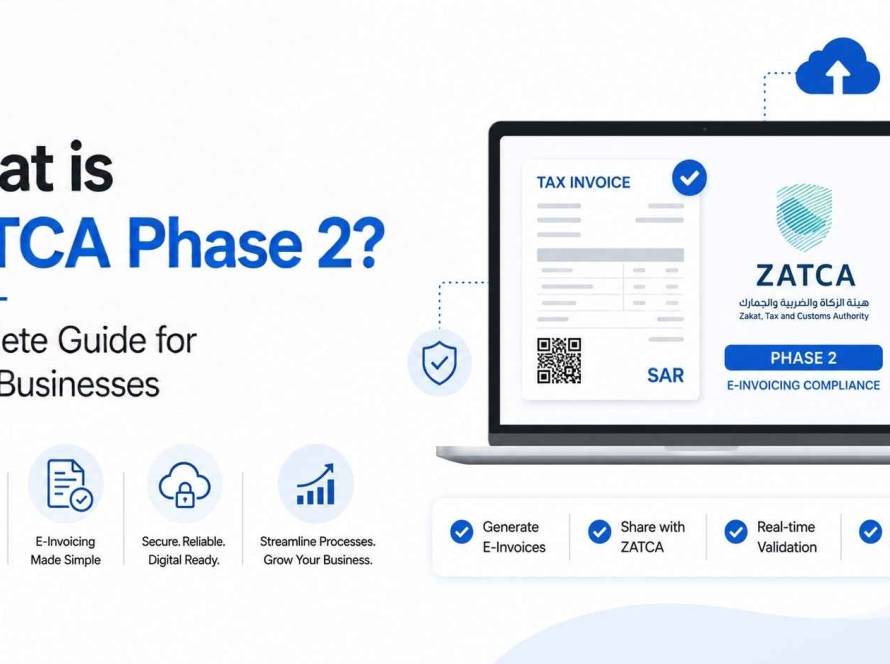
In practical terms, this means the overwhelming majority of operating businesses in Saudi Arabia, well into the small business segment, now fall under mandatory Phase 2 integration, or will within the next reporting cycle. If your current system cannot generate UBL 2.1 XML invoices, apply a cryptographic stamp, and connect to the Fatoora platform via API for real-time clearance or 24-hour reporting, this is no longer a future problem to plan for eventually. For a full breakdown of requirements by wave, see our complete ZATCA Phase 2 guide and our dedicated page on ZATCA e-invoicing compliance. You can also verify your own wave status directly through ZATCA’s official e-invoicing (Fatoora) portal.
Cloud ERP vs On-Premise ERP: A Direct Comparison
| Factor | Cloud ERP | On-Premise ERP |
|---|---|---|
| Upfront cost | Low, subscription based | High, license plus hardware |
| Ongoing cost | Recurring monthly or annual fee | Maintenance contracts, in-house IT |
| Implementation speed | Typically faster | Typically slower |
| Updates and patches | Handled by vendor automatically | Managed manually by your team |
| Multi-branch access | Native, works from any location | Requires VPN or additional setup |
| Data location control | Depends on hosting region chosen | Fully within your own premises |
| Internet dependency | Required for daily operation | Not required for core functions |
| ZATCA API integration | Usually built in or add-on | Often requires middleware |
| Customization depth | Moderate, platform-dependent | Can be extensive |
| Best fit | SMEs, multi-branch, fast-growing firms | Highly regulated, data-sensitive, or offline-heavy operations |
Neither column is universally “better.” A construction contractor with sites that lose connectivity for days at a time has a genuine argument for a hybrid setup. A retail chain with five branches across Riyadh and Dammam has almost no argument against cloud.
The Real Benefits of Cloud ERP for Saudi Businesses
Lower Upfront Investment, Predictable Monthly Cost
Instead of a large capital purchase, cloud ERP is billed as an operating expense. This matters in Saudi Arabia’s SME segment specifically, where access to growth capital is often the binding constraint, not appetite for better systems. Rather than quoting fixed figures here, the right approach is cost-factor analysis: number of users, modules required, data volume, and integration complexity all move the number, and any credible partner should walk you through those factors before quoting anything.
Built for Multi-Branch and Multi-City Operations
If you operate across Riyadh, Jeddah, Dammam, or further into the Eastern Province, a cloud ERP gives every branch the same real-time data without a dedicated IT presence at each site. This is one of the more underused advantages we see, because most SME owners default to thinking about ERP as a head-office tool rather than a way to standardize operations across locations that have historically run on different spreadsheets and habits.
Faster Path to ZATCA Compliance
Modern cloud ERP platforms are generally easier to keep current with regulatory changes than on-premise systems, because the vendor pushes updates centrally rather than requiring a manual patch cycle at every client site. Given how quickly ZATCA’s wave thresholds have moved in 2026 alone, this update cadence is not a minor convenience, it is close to a compliance requirement in its own right. See our detailed ERPNext ZATCA integration guide for how this works in practice on an open source platform.
Scalability Without Re-Platforming
Adding users, warehouses, or entire branches in a cloud ERP is usually a configuration change, not a new infrastructure project. This matters for fast-growing SMEs that do not want to repeat an implementation project every eighteen months.
Disaster Recovery and Business Continuity
Reputable cloud ERP vendors run redundant, geographically distributed backups as a standard feature. Very few SMEs maintain equivalent backup discipline on their own on-premise servers, in our experience it is one of the most commonly skipped IT tasks once the initial excitement of a new system fades.
The Risks and Limitations Nobody Puts in the Sales Deck
Balanced advice means being honest about where cloud ERP creates new problems.
Data residency and the Personal Data Protection Law. Saudi Arabia’s PDPL requires certain categories of personal data to be hosted within the Kingdom, or under specific cross-border transfer conditions. This is the single most important technical question to ask any cloud ERP vendor before signing: where, physically, will your data live, and does that hosting arrangement satisfy PDPL requirements for your industry. A polished user interface means nothing if the hosting region creates a compliance exposure.
Internet dependency. Cloud ERP does not function meaningfully without a stable connection. For businesses in industrial zones or remote project sites with inconsistent connectivity, this is a legitimate operational risk, not a hypothetical one.
Recurring cost over time. A subscription model is easier on cash flow initially, but over a five to seven year horizon it can, depending on the platform and pricing structure, cost more than an on-premise license would have. This is a genuine trade-off, not a reason to avoid cloud ERP outright, but it deserves an honest multi-year comparison rather than a first-year-only view.
Vendor lock-in and data portability. Before signing, ask exactly how your data can be exported if you ever need to switch providers, and in what format. Some proprietary SaaS platforms make this deliberately difficult.
Customization ceilings. Highly specific, industry-particular processes sometimes exceed what a standard cloud ERP’s configuration options can handle without expensive custom development. This is where the distinction between open source and closed proprietary platforms becomes genuinely important, which we cover below.
How to Choose the Right Cloud ERP Platform: A Decision Framework
- Map your actual processes first, before looking at any software. Write down how invoicing, inventory movement, and approvals currently work, including the workarounds. A platform chosen from a demo rather than your own process map is the single most common source of failed implementations we are called in to fix.
- Confirm ZATCA Phase 2 integration capability, not just “ZATCA compliant” marketing language. Ask specifically whether the platform generates UBL 2.1 XML, applies cryptographic stamps, and connects via API for real-time clearance.
- Confirm data hosting location and PDPL alignment in writing, not verbally.
- Evaluate total cost across five years, not the first-year subscription quote alone.
- Check multilingual and multi-currency support, particularly Arabic and English side by side, which is a baseline requirement for most Saudi operations rather than a premium feature.
- Test data export and exit terms before you need them.
- Pilot with real data, not the vendor’s demo dataset, for at least one full accounting cycle before committing to a Kingdom-wide rollout.
Top Cloud ERP Categories for Saudi Businesses in 2026
Rather than ranking specific products, which changes constantly and rarely fits every business the same way, it is more useful to understand the categories and where each genuinely fits.
Open Source Cloud ERP (ERPNext and similar platforms)
Open source cloud ERP gives you the full source code and a large global community, without per-user proprietary licensing fees stacking up as you grow. ERPNext in particular has matured into a strong fit for Saudi SMEs and mid-market businesses because it covers finance, inventory, manufacturing, HR, and CRM in one system, supports Arabic localization, and integrates cleanly with ZATCA’s e-invoicing requirements. We have implemented ERPNext for businesses ranging from single-branch retailers to multi-site manufacturers; our ERPNext implementation services for Saudi Arabia and ERPNext customization work both center on this platform for exactly this reason. Learn more about the platform itself directly from the ERPNext official documentation.
Cloud Accounting-First Platforms (TallyPrime)
TallyPrime is ready-made, off-the-shelf, accounting-first software, best suited to existing Tally users or businesses that want simple yet powerful accounting rather than a full ERP footprint. One detail that surprises people moving from other software is that TallyPrime removes secondary posting entirely: entries post and show their effect immediately, which is exactly why auditors tend to favor it, since amendments can be made on the spot rather than reconciled after the fact. If your business needs strong accounting and ZATCA-ready invoicing without the broader scope of a full ERP, this is worth serious consideration; see our TallyPrime dealer page for Saudi Arabia and our TallyPrime implementation guide for Riyadh.
Enterprise SaaS Suites (NetSuite, Dynamics 365, SAP Cloud)
These platforms serve large enterprises and complex multi-entity groups well, particularly where deep industry-specific modules or global consolidation are required. For most SMEs and mid-market Saudi businesses, though, the licensing structure and implementation complexity of these suites often exceed what the business actually needs, which is where a more general ERP software overview for Saudi Arabia can help clarify fit before committing budget.
Industry-Specific Recommendations
- Manufacturing: Prioritize cloud ERP with strong bill-of-materials, production planning, and shop floor tracking. ERPNext’s manufacturing module handles this well for mid-sized Saudi manufacturers without the overhead of enterprise suites built for much larger operations.
- Construction and contracting: Look for project costing and multi-site connectivity resilience, since job sites frequently have unreliable internet; a hybrid or offline-tolerant configuration is often more realistic than pure cloud.
- Retail and multi-branch trading: Cloud ERP is close to an ideal fit here, given the need for real-time inventory visibility across branches and point-of-sale integration.
- Professional services and consulting: Simpler cloud accounting plus project time tracking is often sufficient, without the inventory and manufacturing complexity of a full ERP.
- Healthcare and pharmaceutical distribution: Data sensitivity and traceability requirements mean the PDPL data residency question deserves particular scrutiny before choosing a hosting region.
A Step-by-Step Cloud ERP Migration Guide
- Document current processes and pain points across finance, inventory, and sales.
- Shortlist two to three platforms based on the decision framework above, not on marketing claims.
- Confirm ZATCA and PDPL alignment in writing from each shortlisted vendor.
- Run a pilot with real transactional data for one full accounting cycle.
- Migrate historical data in structured phases, starting with master data (customers, items, chart of accounts) before transactional history.
- Train staff on the new workflows before go-live, not after.
- Run parallel with your old system for at least one full VAT reporting period.
- Go live, then review performance against your original process map after 90 days.
Common Mistakes Businesses Make with Cloud ERP
- Choosing a platform based purely on a polished sales demo rather than a documented process fit.
- Treating ZATCA compliance as a checkbox rather than confirming the specific technical integration method.
- Ignoring where data is physically hosted until a PDPL question arises later.
- Underestimating staff training time and rushing go-live.
- Migrating all historical data at once instead of phasing master data first.
- Skipping the exit and data export conversation entirely at signing.
Best Practices We Recommend to Every Client
- Get ZATCA and PDPL alignment confirmed in writing before signing any contract.
- Run a genuine pilot with real data, not sample data, before full rollout.
- Involve the finance team early, since they are usually the heaviest daily users and the first to surface gaps.
- Budget for a five-year total cost comparison, not a first-year quote.
- Choose a partner who can support you after go-live, not only during implementation.
Illustrative Case Study: Multi-Branch Trading Business
A mid-sized trading business operating across two Saudi cities came to us running separate spreadsheets at each branch, with monthly reconciliation taking close to a week of staff time and ZATCA invoice generation handled manually. After moving to a cloud ERP with centralized inventory and automated Fatoora integration, monthly reconciliation dropped to under a day, and invoice generation became a background process rather than a manual task. The larger shift was less about the software itself and more about finally having one version of the truth across both branches, something spreadsheets structurally cannot provide once a business grows past a single location. For a documented, industry-specific example of this kind of transformation, see our related manufacturing case study.
Expert Insight
“The businesses that get the most value from cloud ERP are not necessarily the largest ones, they are the ones that map their processes honestly before choosing software,” notes Mohamed Abdul Baseeth, Founder of Maas Consult Middle East Co, who has guided ERP implementations for more than 2,000 businesses and supported over 800 companies through ZATCA e-invoicing compliance across Saudi Arabia. “The ZATCA wave thresholds have moved fast this year. What used to be a large-enterprise conversation is now a conversation every SME owner needs to have, and cloud ERP is usually the fastest legitimate path to being ready.”
For businesses further along the compliance journey, it is also worth reading about the visit of Tally Solutions’ Managing Director, Tejas Goenka, to Riyadh, which reflects how seriously global ERP and accounting vendors now take the Saudi market: Tejas Goenka’s Riyadh visit and what it signals for Saudi businesses.
Frequently Asked Questions
What is cloud ERP in simple terms?
Cloud ERP is business management software, covering finance, inventory, sales, and HR, that runs on remote servers and is accessed through a web browser instead of being installed on your own office computers or servers.
Is cloud ERP suitable for small businesses in Saudi Arabia?
Yes, in most cases. Cloud ERP typically requires less upfront investment than on-premise systems and scales as a small business grows, which is why it has become the default choice for Saudi SMEs. See our dedicated guide on choosing the best ERP for small business in Saudi Arabia for a fuller breakdown.
Does cloud ERP satisfy ZATCA Phase 2 requirements?
A well-configured cloud ERP can satisfy ZATCA Phase 2 requirements, including UBL 2.1 XML invoice generation, cryptographic stamping, and API-based real-time clearance or reporting, but this depends entirely on the specific platform and integration setup, not on the fact that it is cloud-based alone. Always confirm the exact integration method before assuming compliance.
What is the difference between cloud ERP and cloud accounting software?
Cloud accounting software generally covers bookkeeping, invoicing, and basic financial reporting. Cloud ERP covers those functions plus inventory, procurement, manufacturing, HR, and cross-department reporting in a single connected system.
Is my data safe if it is hosted outside Saudi Arabia?
It depends on the data category and the Personal Data Protection Law’s requirements for that category. Some data must be hosted within the Kingdom or meet specific cross-border transfer conditions, so this should be confirmed directly with your vendor and, where in doubt, checked against SDAIA’s official PDPL guidance rather than assumed from marketing material.
How much does cloud ERP cost in Saudi Arabia?
Cost depends on the number of users, modules required, data volume, integration complexity, and whether the platform is open source or proprietary. Rather than relying on generic published figures, request a custom quote based on your actual process map and requirements.
Can cloud ERP work without a stable internet connection?
Core cloud ERP functions require an internet connection. Businesses with unreliable connectivity, such as remote project or construction sites, are often better served by a hybrid setup or an on-premise system with periodic cloud synchronization.
What is the difference between ERPNext and TallyPrime for a Saudi business?
ERPNext is a full open source ERP covering finance, inventory, manufacturing, HR, and CRM, suited to businesses that need cross-department integration. TallyPrime is accounting-first software best suited to existing Tally users or businesses that want strong, straightforward accounting without the broader scope of a full ERP.
How long does a cloud ERP implementation take?
Timelines vary by business complexity, but a well-scoped SME implementation, from process mapping through go-live, commonly takes between six and twelve weeks. Businesses with multiple branches, custom workflows, or significant historical data migration should expect longer.
What questions should I ask a cloud ERP vendor before signing a contract?
Ask where your data will be physically hosted and whether that satisfies PDPL requirements, exactly how ZATCA Phase 2 integration is handled, how data can be exported if you switch providers later, what the total cost looks like over five years rather than year one, and whether ongoing support is included after go-live.
Final Thoughts
Cloud ERP is not a universal answer, but for most Saudi SMEs and multi-branch businesses in 2026, it is the more sensible default, particularly given how quickly ZATCA’s wave thresholds have moved and how central data residency has become under the Personal Data Protection Law. The businesses that get this decision right are the ones that map their own processes honestly first, then choose a platform and hosting arrangement that fits those processes, rather than the other way around.
Get a Custom Cloud ERP Assessment for Your Business
If you are weighing cloud ERP options, unsure whether your current system meets ZATCA’s latest wave requirements, or want a straight answer on whether ERPNext, TallyPrime, or another platform fits your operation, our team can walk through your specific setup and put together a digital transformation roadmap. Explore our ERPNext consultant services in Saudi Arabia, review our work as an ERPNext partner in Saudi Arabia, or get in touch directly to request a ZATCA compliance assessment and a custom quote suited to your business, not a generic package.


2 Comments