



ERPNext Partner in Saudi Arabia: Complete Guide to Choosing the Right One

Choosing an ERPNext partner in Saudi Arabia is one of the most consequential decisions a growing business can make. Get it right and you walk away with a system that automates your operations, keeps you ZATCA compliant, and scales with you for years. Get it wrong and you face months of delays, cost overruns, and a system your team refuses to use.
Having spent more than 16 years implementing ERP systems across the GCC, and having worked through more than 1,000 implementations, Mohamed Abdul Baseeth, Founder of MAAS Consult Middle East Co., has seen both outcomes firsthand. This guide draws on that experience to help Saudi businesses cut through the noise and make a confident, well-informed decision.
Quick Answer: What is an ERPNext Partner in Saudi Arabia?
An ERPNext partner in Saudi Arabia is a certified company or consultant authorised by Frappe Technologies to implement, customize, and support ERPNext for businesses in the Kingdom. A certified partner has demonstrated technical competency across ERPNext modules and can deliver localised implementations including ZATCA Phase 2 e-invoicing compliance, Arabic language support, Saudi payroll, GOSI, and WPS integration.
Key Takeaways
- Not every company advertising ERPNext services in Saudi Arabia is a certified Frappe partner. Certification matters.
- ZATCA Phase 2 compliance is now a legal requirement for most Saudi businesses, and your ERP partner must have proven experience delivering it.
- The right ERPNext partner for a trading company in Riyadh is often different from the right partner for a manufacturing firm in Dammam.
- Total cost of ownership matters more than upfront implementation cost.
- Post-go-live support quality is the most frequently underestimated factor in ERP partner selection.
- Open-source ERP like ERPNext eliminates recurring per-user licensing fees, which significantly reduces long-term costs compared to SAP, Oracle, or Microsoft Dynamics.
What Is Enterprise Resource Planning and Why Does It Matter for Saudi Businesses?
Enterprise Resource Planning (ERP) is an integrated software system that connects core business functions including accounting, procurement, inventory, sales, manufacturing, HR, and payroll into a single unified platform. An ERP system replaces disconnected spreadsheets and standalone software with one shared data source, giving business owners and managers real-time visibility across operations.
For Saudi businesses, ERP has moved from being a competitive advantage to a compliance necessity. ZATCA‘s e-invoicing mandate, GOSI reporting, and WPS payroll compliance all demand accurate, connected data systems. A business still running on spreadsheets or outdated accounting software is not just inefficient. It is exposed to regulatory risk.
The Saudi ERP market is growing steadily as Vision 2030 drives accelerated digital transformation across SMEs, mid-market companies, and enterprise organisations. According to market research from IDC, ERP adoption across the GCC is expected to grow at a compound annual rate above 10% through 2027, driven primarily by compliance mandates and the push toward paperless, automated operations.
ERPNext, the open-source ERP platform developed by Frappe Technologies, has gained meaningful traction across Saudi Arabia and the wider GCC for two reasons: it covers the full scope of business operations without per-user licensing fees, and it is actively maintained with localisation for ZATCA, Arabic, and Saudi-specific payroll regulations.
What Does an ERPNext Partner Actually Do?
Many businesses search for an “ERPNext partner” without fully understanding what separates a genuine implementation partner from a basic reseller or a freelancer who has installed ERPNext a handful of times.
A qualified ERPNext partner in Saudi Arabia should deliver the following:
Discovery and Scoping Before any software is configured, a credible partner will run a structured business process review. This means mapping your current workflows, identifying gaps, understanding your compliance obligations under ZATCA and labour law, and building a project scope document that reflects your actual business, not a generic template.
System Configuration and Customisation ERPNext is highly configurable out of the box, covering accounts, purchasing, warehousing, sales, manufacturing, HR, and more. A partner configures the system to match your workflows rather than forcing your team to adapt to a default setup. Where genuine customisation is needed, a technical team writes and tests custom code.
ZATCA Phase 2 Integration This is non-negotiable for any Saudi business above the applicable revenue threshold. Your ERPNext partner must be able to connect ERPNext to the ZATCA FATOORAH portal, generate XML e-invoices in the required format, and ensure your system passes compliance validation. Businesses that missed earlier ZATCA Phase 2 waves are still being enrolled, with the June 2026 deadline having brought the SAR 375,000 annual revenue threshold into scope.
Data Migration Moving years of transaction history, customer records, vendor data, and opening balances from a legacy system (TallyPrime, QuickBooks, spreadsheets, or older ERP) requires careful planning and rigorous validation. A partner who treats data migration as a minor task is one to avoid.
Training and Change Management The technology is only half the project. A good partner trains your finance team, warehouse staff, procurement managers, and HR administrators in a way that builds genuine competency, not just button-pushing familiarity.
Post-Go-Live Support The real test of a partner is what happens after the system goes live. Issues always emerge in the first 30 to 90 days as your team encounters real business scenarios the testing phase did not cover. Reliable support during this period is what separates a successful implementation from a painful one.
The ZATCA Factor: Why Your ERPNext Partner’s Compliance Experience Is Non-Negotiable
Saudi Arabia’s ZATCA Phase 2 e-invoicing mandate is the most significant ERP compliance requirement the Kingdom has introduced in recent years. If your business is subject to ZATCA Phase 2, your ERP system must generate ZATCA-compliant electronic invoices, submit them in real time or near real time to the FATOORAH clearance portal, and maintain an auditable digital record.
Not every ERPNext partner in Saudi Arabia has successfully delivered this. The integration between ERPNext and ZATCA requires both technical knowledge of the Frappe framework and a clear understanding of ZATCA’s technical specifications, XML schema requirements, cryptographic signing, and reporting obligations.
When evaluating an ERPNext partner, ask directly how many ZATCA Phase 2 integrations they have completed and for which business types. Ask whether they have experience with both B2B and B2C invoice formats. Ask what their process is for handling ZATCA portal errors and rejected invoices.
MAAS Consult has supported more than 800 businesses through ZATCA e-invoicing compliance, which represents one of the deepest track records of any ERPNext implementation firm in Saudi Arabia. That volume of projects means the team has encountered virtually every integration edge case, rejection scenario, and compliance challenge the ZATCA portal produces.
Learn more about ERPNext ZATCA integration and how MAAS Consult handles Phase 2 compliance
Explore MAAS Consult’s dedicated ZATCA e-invoicing service
Certified ERPNext Partner vs Uncertified Reseller: What the Difference Costs You
A certified ERPNext partner is a company that has been formally assessed and approved by Frappe Technologies, the developer of ERPNext. Certification typically requires demonstrating technical expertise across core ERPNext modules, completing a minimum number of live implementations, and maintaining active engagement with the Frappe partner network. Certified partners appear on the official Frappe Partner Network directory at frappe.io.
The Saudi ERP market has a genuine problem with uncertified ERPNext resellers. These are companies or individuals who have learned to install and configure ERPNext at a basic level but lack the depth to handle complex customisation, ZATCA integration, data migration from legacy systems, or multi-company, multi-currency environments.
The pattern plays out like this: a business hires a low-cost ERPNext provider, the implementation runs over time and over budget, critical compliance integrations are incomplete, and the business finds itself 6 months later with a half-working system and no clear path to resolution.
The questions to ask a prospective ERPNext partner in KSA:
- Are you listed on the official Frappe Partner Network?
- How many live ERPNext implementations have you completed in Saudi Arabia specifically?
- Can you provide references from Saudi clients in a similar industry to ours?
- Do you have an in-country support team or are you operating remotely from outside KSA?
- What is your post-go-live support model and SLA?
- Have you completed ZATCA Phase 2 integrations? For how many clients?
ERPNext Partner Evaluation Scorecard
Use this framework when comparing ERPNext implementation partners in Saudi Arabia.
| Evaluation Criterion | What to Look For |
| Frappe Certification | Official partner listing on frappe.io |
| Saudi Arabia Experience | Number of live KSA implementations |
| ZATCA Compliance Track Record | Phase 2 integrations completed |
| In-Country Presence | Local team in Riyadh, Jeddah, or Dammam |
| Industry Experience | Relevant sector implementations (your industry) |
| Multilingual Support | Arabic, English, and other languages |
| Data Migration Capability | Experience migrating from Tally, QuickBooks, SAP |
| Post-Go-Live SLA | Defined response times, dedicated support channel |
| Training Delivery | Arabic and English training materials |
| References Available | Verifiable client references in KSA |
| Implementation Methodology | Structured, documented project approach |
ERPNext vs Other ERP Options for Saudi Businesses
One of the most common questions from Saudi businesses evaluating ERPNext is how it stacks up against the alternatives. Here is an honest comparison.
ERPNext vs SAP Business One
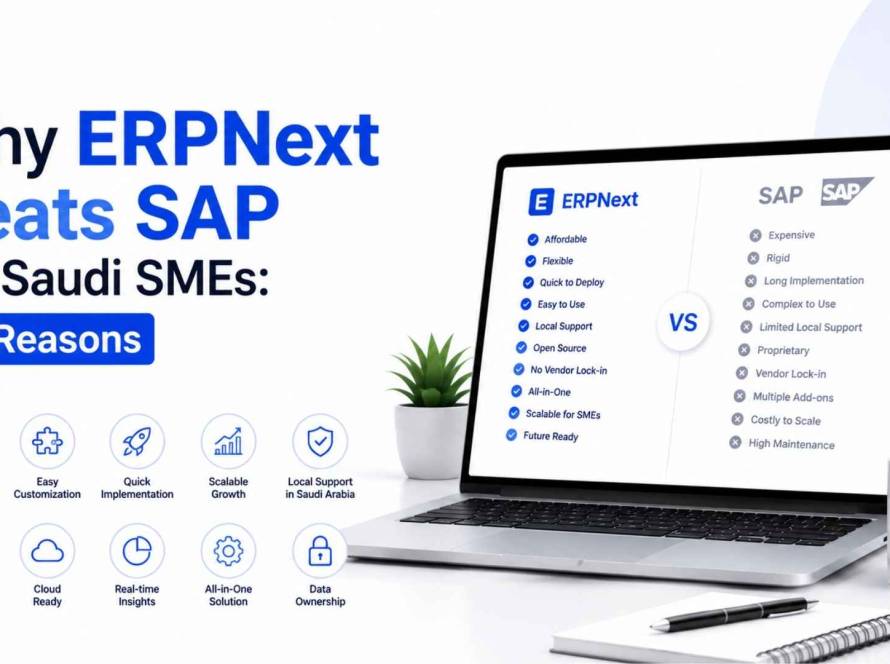
SAP Business One is a proven enterprise ERP with a long presence in Saudi Arabia. Its strengths are deep functionality, strong reporting, and wide partner network. Its challenges for Saudi SMEs are significant per-user licensing costs, lengthy implementation timelines, and high dependence on expensive SAP-certified consultants for any customisation.
ERPNext covers the same core functional scope as SAP Business One at a fraction of the total cost. For companies with under 200 users and without complex multi-entity group reporting requirements, ERPNext typically delivers comparable functionality and faster implementation timelines.
ERPNext vs Microsoft Dynamics 365
Microsoft Dynamics 365 is an excellent fit for organisations already deeply invested in the Microsoft ecosystem (Office 365, Azure, Power BI). It is a genuinely capable platform but comes with significant licensing overhead and a complex customisation environment. For Saudi SMEs without in-house IT capability and a Microsoft infrastructure budget, Dynamics 365 is frequently overkill.
ERPNext vs Daftra
Daftra is a popular cloud-based ERP and accounting platform targeting Saudi and Egyptian SMEs. It is easy to deploy quickly and has strong Arabic-language support. However, Daftra is a SaaS product with fixed modules, limited customisation, and ongoing per-user subscription costs that compound over time.
ERPNext, deployed by a capable partner, offers deeper customisation, full data ownership, no per-user licensing, and a broader functional scope that grows with your business. For businesses that have outgrown Daftra or need more control over their data and workflows, ERPNext is a natural next step.
Read the detailed Daftra vs ERPNext comparison for Saudi businesses
ERPNext vs Odoo
Odoo and ERPNext are both open-source ERP platforms with large global communities. The key differences lie in pricing model, ecosystem, and partner availability. Odoo’s Community edition is open-source, but many advanced modules require the paid Enterprise edition. ERPNext is fully open-source with no module-level licensing.
MAAS Consult works with both ERPNext and Odoo, which gives clients a genuinely unbiased recommendation based on their specific requirements rather than a platform the partner is locked into selling.
Migrating from TallyPrime to ERPNext in Saudi Arabia
One of the most common scenarios MAAS Consult encounters is businesses that started with TallyPrime and have grown beyond what Tally can comfortably handle. TallyPrime is excellent for basic accounting and is widely used among Saudi and GCC businesses, particularly those managed by Indian and South Asian business communities familiar with the platform.
The limitations of TallyPrime become apparent when businesses need:
- Multi-warehouse inventory management
- Purchase order and procurement workflow automation
- Manufacturing or production planning
- CRM and sales pipeline management
- ZATCA Phase 2 compliant e-invoicing with FATOORAH clearance
- HR, payroll, GOSI, and WPS in a single system
MAAS Consult holds authorised dealerships for both TallyPrime and ERPNext, which creates a genuinely unique migration capability. The team understands both platforms in depth, which means data migration is handled by people who know exactly how Tally structures its data and how ERPNext needs to receive it.
Explore MAAS Consult’s TallyPrime services and migration support
ERPNext Modules Relevant for Saudi Businesses
ERPNext covers the full spectrum of business operations. For Saudi companies, the most relevant modules are:
Accounting and Finance Multi-currency support, VAT-compliant tax templates, cost centre reporting, and financial statements in both Arabic and English. ZATCA Phase 2 e-invoicing is integrated directly into the sales invoice workflow.
Procurement and Purchase Management Purchase requests, purchase orders, vendor management, goods receipt notes, and vendor payment workflows with approval hierarchies.
Inventory and Warehouse Management Multi-warehouse stock tracking, batch and serial number management, stock reconciliation, and real-time inventory valuation. Particularly strong for trading and distribution businesses.
Sales and CRM Lead management, quotation creation, sales order processing, delivery notes, and sales invoices with ZATCA clearance. CRM pipeline tracking helps sales teams manage follow-ups and conversion rates.
Manufacturing Bill of materials, work order management, production planning, quality control checkpoints, and subcontracting workflow for manufacturers operating in Saudi industrial zones.
HR and Payroll Saudi payroll with GOSI contribution calculations, Nitaqat compliance tracking, WPS-formatted payroll files, leave management, and employee self-service portal.
Project Management Timesheet-based project billing, task assignment, milestone tracking, and project profitability reporting for professional services and contracting businesses.
What a Realistic ERPNext Implementation Timeline Looks Like
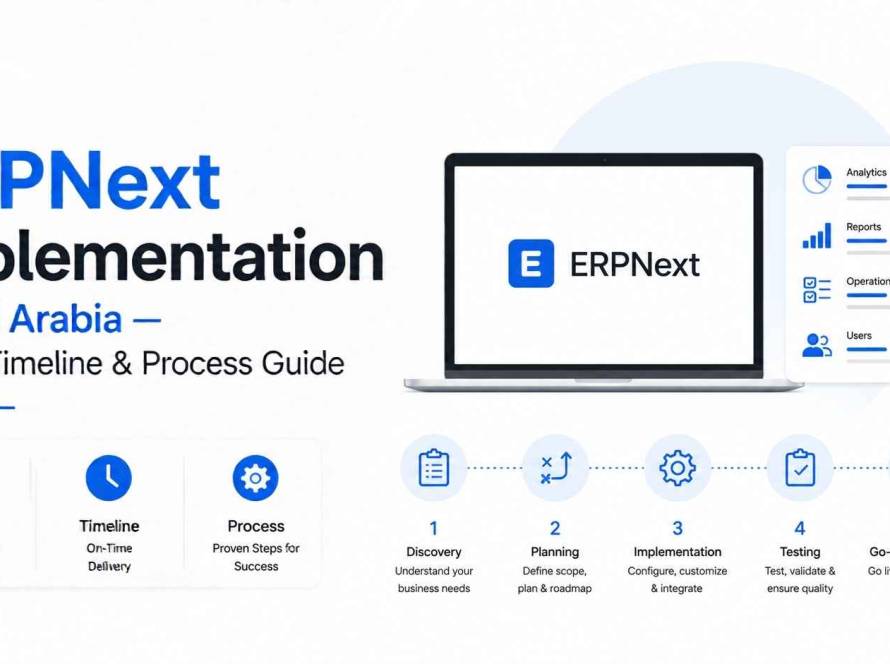
One of the most frequent frustrations businesses express after a bad ERP experience is that the implementation took far longer than the partner promised. Here is what a realistic ERPNext implementation timeline looks like for a mid-sized Saudi business.
Step-by-Step: ERPNext Implementation Process
Week 1 to 2: Discovery and Scoping Business process mapping, requirements documentation, module selection, and project plan finalisation. Gap analysis between current state and target state.
Week 3 to 5: System Configuration Chart of accounts setup, item master configuration, warehouse and location setup, tax templates, ZATCA configuration, and custom field creation.
Week 6 to 8: Data Migration Extraction of legacy data from TallyPrime, QuickBooks, or spreadsheets. Cleansing, transformation, and import into ERPNext. Validation of opening balances and master data accuracy.
Week 9 to 11: User Acceptance Testing Department heads and key users test all workflows against real business scenarios. Issues are logged, resolved, and retested. ZATCA e-invoice generation and clearance is tested end-to-end.
Week 12: Training Delivery Role-specific training sessions for finance, operations, warehouse, HR, and management. Training materials provided in Arabic and English.
Week 13: Go-Live System goes live with parallel running (old system and ERPNext running simultaneously for 2 to 4 weeks). Hypercare support from the implementation team is active.
Month 4 onwards: Stabilisation and Optimisation Regular review calls, performance tuning, additional user training, and phased rollout of advanced modules.
For small businesses with simpler operations, this timeline can compress to 6 to 8 weeks. For multi-company, multi-warehouse, or manufacturing-heavy implementations, 16 to 20 weeks is more realistic.
Common Mistakes Saudi Businesses Make When Choosing an ERPNext Partner
After more than 1,000 ERP implementations across the GCC, Mohamed Abdul Baseeth has seen the same avoidable mistakes repeat across businesses of every size. Here are the most costly ones.
Choosing on price alone The cheapest ERPNext offer is rarely the most economical. A failed or half-complete implementation costs far more in rework, staff time, and business disruption than a slightly higher upfront investment in a capable partner would have.
Not verifying ZATCA compliance capability Saudi Arabia’s ZATCA Phase 2 mandate is live and actively enforced. Choosing a partner without demonstrated ZATCA integration experience means you will either stay non-compliant or pay for a second implementation to fix what the first partner could not deliver.
Assuming a global ERPNext company knows Saudi requirements ERPNext is used in 50+ countries. An implementation partner with strong references in Europe or India does not automatically understand Saudi localisation requirements: ZATCA, GOSI,, WPS, Muqeem, Hijri calendar support, or Arabic-language invoicing. Always verify local experience.
Underestimating data migration complexity Businesses that have run on TallyPrime or manual spreadsheets for years have more data complexity than they realise. A partner who does not invest proper time in data migration planning will deliver an ERPNext system built on incomplete or inaccurate historical data.
Skipping the pilot test phase Go-live without adequate user acceptance testing is the single most common cause of ERP failures. Real-world business scenarios always reveal configuration gaps that a test environment using dummy data never exposes.
Choosing a partner without local support Remote-only support from a partner based outside Saudi Arabia creates real problems when urgent issues arise. Time zone gaps, language barriers, and an inability to deploy someone on-site when genuinely needed are risks that compound over time.
Why Open-Source ERP Makes Financial Sense for Saudi SMEs
One of the strongest arguments for ERPNext in the Saudi market is financial. Proprietary ERP platforms like SAP, Oracle, and Microsoft Dynamics carry per-user licensing fees that become a significant recurring cost as a business grows. A company with 50 users on a mid-range SAP licence can easily spend SAR 200,000 to SAR 400,000 annually on licensing alone, before any customisation or support costs.
ERPNext is fully open-source and free to use. The cost of an ERPNext project is implementation services, hosting, and ongoing support. Once implemented, there are no per-user fees, no module unlocking costs, and no vendor lock-in.
For Saudi SMEs and mid-market companies operating under margin pressure, this distinction matters enormously over a three to five-year horizon. The total cost of ownership comparison almost always favours ERPNext when licensing costs are factored in honestly.
Industry-Specific ERPNext Considerations in Saudi Arabia
Trading and Distribution Companies Saudi Arabia’s trading sector is large and competitive. ERPNext’s inventory, purchasing, and sales modules handle multi-warehouse stock, purchase price variance tracking, and customer credit limit management. ZATCA-compliant invoicing for B2B clearance invoices is fully supported.
Manufacturing Companies Saudi industrial zones in Riyadh, Jeddah, and Dammam host a growing manufacturing base. ERPNext’s manufacturing module supports work orders, bill of materials versioning, production scheduling, subcontracting, and quality control, all connected to the accounting and inventory modules in real time.
Construction and Contracting Project-based businesses benefit from ERPNext’s project module, which tracks cost against budget, manages subcontractor billing, and reports profitability per project. Labour cost tracking with Saudi payroll integration is particularly useful for contracting companies managing large Saudised workforces.
Retail and Food and Beverage ERPNext’s Point of Sale module supports multi-branch retail operations with centralised reporting. The inventory module handles perishable stock management, batch expiry tracking, and reorder level automation for F&B businesses.
Professional Services Consulting firms, IT companies, legal practices, and engineering firms use ERPNext’s project and timesheet modules to track billable hours, manage retainers, and generate service invoices with ZATCA clearance.
Expert Insight: What Sets Great ERPNext Implementations Apart
After working through implementations across manufacturing, trading, construction, healthcare, and professional services, the pattern that consistently separates successful ERPNext projects from troubled ones comes down to preparation quality, not software capability.
ERPNext as a platform can handle virtually any business scenario a Saudi SME or mid-market company will encounter. The differentiator is always whether the implementing partner invested sufficient time in the discovery phase to understand the business before touching the system configuration.
The businesses that get the most from ERPNext are those that came into the project with clean, well-organised data, clearly documented approval workflows, and a senior champion inside the organisation who drove team adoption. The partner’s job is to guide that process, not substitute for it.
This is why MAAS Consult’s implementation approach begins with a structured three-session discovery workshop before any system configuration begins. It is a slower start that consistently produces faster, cleaner go-lives.
MAAS Consult: ERPNext Partner in Saudi Arabia
MAAS Consult Middle East Co. is a Riyadh-based ERP implementation partner serving Saudi Arabia and the wider GCC. The company holds authorised dealerships for both ERPNext (via the Frappe partner network) and TallyPrime, which gives MAAS Consult a capability set that is genuinely rare among KSA-based ERP firms.
The team supports clients across five languages and operates seven days a week from 8AM to 8PM, which is particularly valued by businesses managing operations across multiple time zones or requiring weekend support during go-live periods.
Key credentials:
- 1,000+ ERP implementations completed across the GCC
- 800+ ZATCA Phase 2 compliance projects delivered
- Riyadh headquarters with on-site support capability across the Kingdom
- ERPNext and TallyPrime authorised partner
- Five-language support team (Arabic, English, Hindi, Tamil, Malayalam)
- 365-day availability, 8AM to 8PM
Explore MAAS Consult’s ERPNext implementation services
Contact MAAS Consult to discuss your ERP requirements
Best Practices for a Successful ERPNext Implementation in KSA
Define your requirements before approaching partners Know which modules you need, which business processes are causing pain, and what compliance obligations you carry. Partners who can start from a clear brief deliver better results.
Insist on a written project scope document Before any work begins, the scope, deliverables, timeline, and milestones should be documented in writing. Scope creep is the primary driver of ERPNext project overruns.
Allocate internal resources to the project ERP implementation is not something you hand off to a partner and check back on at go-live. Your finance manager, warehouse supervisor, and HR lead all need to be actively involved in configuration review and testing.
Plan data migration as a separate workstream Data migration deserves its own timeline, resources, and validation checkpoints. Do not let it get compressed into the last week before go-live.
Invest in training, not just installation A well-trained team using a basic ERPNext configuration will outperform an untrained team on a heavily customised system. Training is where the return on investment is realised.
Build a 90-day post-go-live support plan Agree with your partner on what support looks like for the first 90 days after go-live. Response time commitments, issue escalation paths, and scheduled review calls should all be defined before you sign.
Final Thoughts
The Saudi ERP market has matured considerably over the past three years. ZATCA Phase 2, Vision 2030 digitisation mandates, and growing investor scrutiny of financial reporting have all raised the floor on what businesses expect from their ERP systems.
Choosing an ERPNext partner in Saudi Arabia is not simply a technology decision. It is a business transformation decision with direct compliance, operational, and financial implications. The partner you choose will have access to your most sensitive business data, will shape your financial reporting, and will determine whether your team adopts the system or works around it.
Do your due diligence. Verify certifications, check references, ask hard questions about ZATCA experience, and pay attention to what the post-go-live support structure looks like. The partner who invests the most time understanding your business before configuring anything is almost always the right one to choose.
Ready to Evaluate Your ERPNext Options?
MAAS Consult offers a free ERP consultation for Saudi businesses ready to evaluate ERPNext. In a 45-minute session, the MAAS team will review your current systems, identify your ZATCA compliance status, and map out a realistic implementation plan tailored to your industry and business size.
Request a free ERPNext consultation with MAAS Consult
FAQs
Q1: What is an ERPNext partner in Saudi Arabia?
An ERPNext partner in Saudi Arabia is a company or consultant certified by Frappe Technologies to implement, customise, and support ERPNext for Saudi businesses. Certified partners are listed on the official Frappe Partner Network and have demonstrated competency across ERPNext modules including accounting, inventory, HR, payroll, and ZATCA Phase 2 e-invoicing compliance.
Q2: Is ERPNext compliant with ZATCA Phase 2 requirements?
Yes. ERPNext supports ZATCA Phase 2 e-invoicing through integration with the FATOORAH clearance portal. The system generates XML-format electronic invoices, applies cryptographic signing, and submits invoices for real-time or near-real-time clearance in line with ZATCA’s technical specifications. This integration must be configured and tested by a partner with verified ZATCA implementation experience.
Q3: How much does an ERPNext implementation cost in Saudi Arabia?
ERPNext implementation costs in Saudi Arabia vary based on the number of users, modules required, customisation complexity, data migration scope, and the partner’s fee structure. There is no fixed price. A small business implementation with standard modules typically costs significantly less than a multi-company, multi-warehouse project with custom workflows. MAAS Consult scopes all projects individually and provides a detailed cost breakdown before any engagement begins.
Q4: How long does an ERPNext implementation take in Saudi Arabia?
A standard ERPNext implementation for a Saudi SME with 10 to 50 users typically takes 10 to 14 weeks from discovery to go-live. Simpler implementations for micro-businesses can complete in 6 to 8 weeks. Complex projects involving manufacturing, multi-entity structures, or significant data migration from legacy systems may require 16 to 24 weeks.
Q5: What is the difference between an ERPNext partner and an ERPNext reseller?
A certified ERPNext partner has been formally assessed by Frappe Technologies and appears on the official partner directory. A reseller may distribute ERPNext access or provide basic installation without holding formal Frappe certification. For a critical business system with ZATCA compliance implications, working with a certified partner is strongly recommended.
Q6: Can ERPNext replace TallyPrime for a Saudi business?
Yes. ERPNext covers all core accounting functions that TallyPrime provides, plus significantly broader capabilities in areas like inventory management, procurement, sales, HR, payroll, and manufacturing. For businesses that have outgrown TallyPrime’s scope or need ZATCA Phase 2 clearance integration, ERPNext is a natural migration path. MAAS Consult holds authorised dealer status for both platforms, which makes the migration process technically straightforward and well-managed.
Q7: Does ERPNext support Arabic language and Hijri calendar?
Yes. ERPNext supports Arabic as a full interface language and includes Hijri calendar display options for Saudi date formats. ZATCA-compliant invoices can be generated in Arabic or bilingual Arabic/English format. ERPNext also supports right-to-left (RTL) text rendering throughout the interface.
Q8: Which is the best ERP system for small businesses in Saudi Arabia?
For most Saudi SMEs, ERPNext offers the best combination of functional scope, ZATCA compliance support, Arabic language capability, and total cost of ownership. It eliminates per-user licensing fees, is actively maintained with Saudi localisation, and can be implemented and supported by local certified partners. For businesses with simpler needs and tighter budgets, TallyPrime remains a strong accounting option, though its functional scope is narrower.
Q9: What should I ask an ERPNext partner before hiring them?
Ask whether they are listed on the official Frappe Partner Network. Ask how many ERPNext implementations they have completed in Saudi Arabia specifically. Ask for references from clients in your industry. Ask how many ZATCA Phase 2 integrations they have completed. Ask what their post-go-live support SLA looks like. Ask whether they have an in-country team capable of on-site support.
Q10: Can ERPNext handle multi-company and multi-branch operations in Saudi Arabia?
Yes. ERPNext supports multi-company and multi-branch configurations with consolidated reporting, inter-company transactions, and shared master data. This is particularly useful for Saudi business groups operating multiple legal entities or businesses managing operations across Riyadh, Jeddah, Dammam, and other cities.
Q11: Is MAAS Consult a certified ERPNext partner in Saudi Arabia?
MAAS Consult Middle East Co. is a Riyadh-based ERP implementation firm with more than 1,000 implementations and 800+ ZATCA compliance projects delivered across Saudi Arabia and the GCC. The company is an authorised partner for both ERPNext and TallyPrime. Contact MAAS Consult to verify credentials and discuss your project requirements.

3 Comments